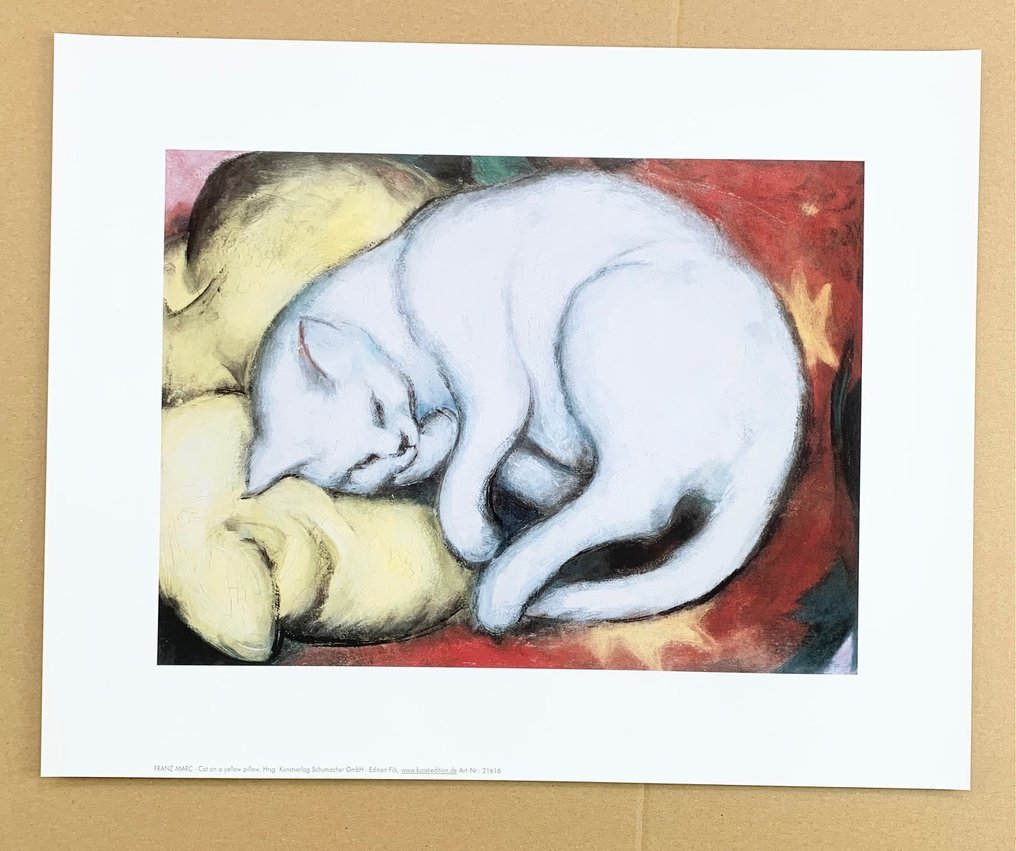
Franz Marc (1880-1916) - Cat on yellow pillow - Artprint - 50 x 40 cm



04
days
19
hours
16
minutes
16
seconds
Starting bid
€ 1
No reserve price

Expert
Selected by Juan Antonio Rodríguez
Eight years experience valuing posters, previously valuer at Balclis, Barcelona.
Estimate € 150 - € 200
No bids placed
Catawiki Buyer Protection
Your payment’s safe with us until you receive your object.View details
Trustpilot 4.4 | 145414 reviews
Rated Excellent on Trustpilot.
Description from the seller
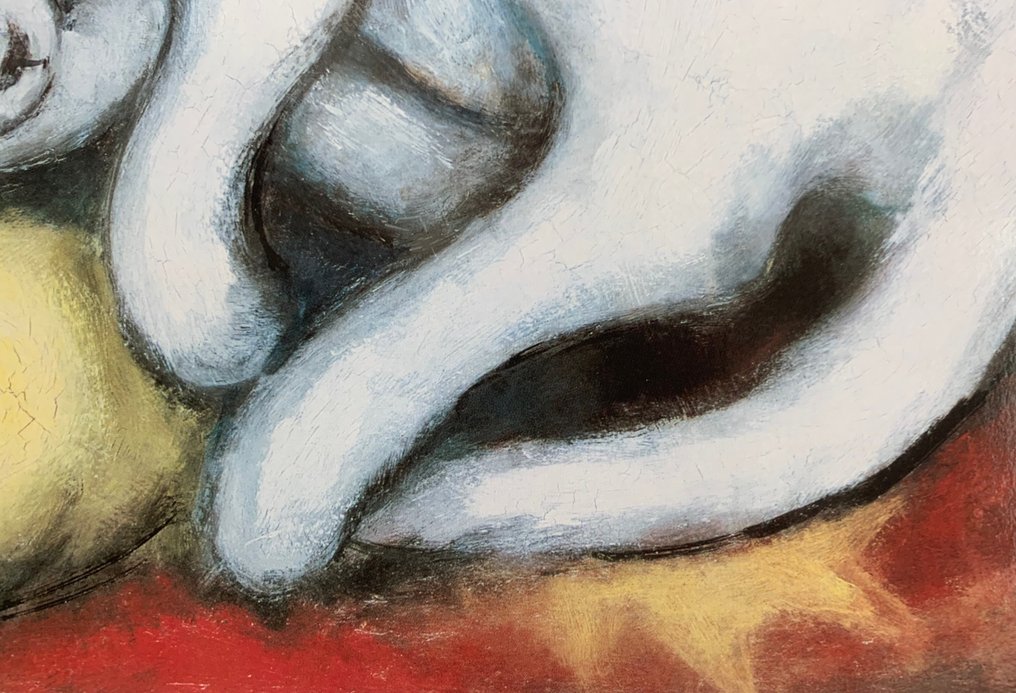
High-gloss print with a varnished surface of Franz Marc’s Cat on a Yellow Cushion, measuring 50 x 40 cm. Sturdy paper, high-quality art print in flawless condition.
Artist: Franz Marc
Title: Cat on a Yellow Cushion
Type: Art poster print
Category: High-quality art print
Technique: Offset print on sturdy, matte-gloss paper
Originality: Reproduction
Overall size: 50.0 x 40.0 cm
Condition: Very well preserved
Publisher: Kunstverlag Schumacher GmbH - Edition Fils
Style: Expressionism
Period: Modern art
Nationality: German art
Copyright: Kunstverlag Schumacher GmbH - Edition Fils
Franz Marc:
Franz Marc, one of the most important painters of German Expressionism and co-founder of the artists’ group “Der Blaue Reiter,” is known for his intensely colored depictions of animals, which carry deep symbolic meaning. His works, in which nature and the animal kingdom play a central role, have a fascinating connection with the work of Wassily Kandinsky, with whom he founded “Der Blaue Reiter.” Both artists shared a love of spirituality in art and sought to look beyond visible reality.
In their expressive power, Marc’s dynamic, vividly colored paintings also recall the works of August Macke, a close friend and fellow artist whose luminous color compositions and harmonious scenes celebrated life and nature. The expressive forms and intense colors in Marc’s paintings also show parallels with the work of Emil Nolde, whose art is likewise characterized by great emotional force and a deep connection with nature.
Marc’s depictions of animals, often rendered in vivid, non-naturalistic colors, reflect the influence of Fauvism, particularly Henri Matisse, whose revolutionary use of color as a means of expression was groundbreaking in modern art. At the same time, connections can be drawn to the Cubist forms of Pablo Picasso, whose influence is evident in Marc’s geometrically abstracted animal scenes.
The spiritual dimension of Marc’s art, in which animals are depicted as representatives of a pure, unspoiled nature, recalls the Symbolist works of Paul Gauguin, who also expressed in his paintings a profound search for a primordial, paradisiacal state. Marc’s use of intense, luminous colors could also be compared with the powerfully colored compositions of Vincent van Gogh, whose work likewise carries strong emotional and symbolic meaning.
Another comparison can be drawn with the works of Ernst Ludwig Kirchner, another member of the Expressionist movement “Die Brücke,” whose paintings radiate a drama and intensity similar to Marc’s through their expressive forms and colors. Marc’s focus on animals as a central motif also connects him with the work of Jean-François Millet, who explored simple rural life and the close relationship between people and nature in his paintings.
Marc’s interest in the inner world and the invisible forces of nature shows parallels with the work of Odilon Redon, whose mystical, Symbolist art also engaged with a deeper spiritual realm. The dynamic movement and rhythm felt in many of Marc’s paintings also recall the Futurist works of Umberto Boccioni, who likewise sought to depict movement and energy in art.
In the way Marc elevates animals in his paintings almost to metaphysical symbols, one might also find a connection with the Surrealist works of Max Ernst, who often merged animals and mythological figures in his art. The harmonious yet powerful depiction of nature in Marc’s paintings also brings to mind the landscapes of Claude Monet, whose Impressionist works likewise show a profound engagement with light and color.
Finally, Franz Marc could be placed alongside Paul Klee, whose playful and often abstract depictions of animals and nature express a similar search for the essence of life and nature. Marc remains a central figure of Expressionism, whose work, through its deep connection with nature and innovative use of color and form, continues to inspire modern art.
Shipping information:
We roll prints onto sturdy cardboard tubes, wrap them in corrugated cardboard, and ship them in special, very sturdy boxes. Shipments include a tracking number.
Wassily Kandinsky, Paul Klee, August Macke, Gabriele Münter, Lyonel Feininger, Alexej von Jawlensky, Ernst Ludwig Kirchner, Emil Nolde, Max Pechstein, Karl Schmidt-Rottluff, Erich Heckel, Otto Mueller, Heinrich Campendonk, Marianne von Werefkin, Alfred Kubin, Egon Schiele, Oskar Kokoschka, Hans Arp, Robert Delaunay, Sonia Delaunay, Piet Mondrian, Fernand Léger, Marc Chagall, Jean Arp, Henri Rousseau, Georges Braque, Pablo Picasso, André Derain, Henri Matisse, Raoul Dufy
About us:
We have been active in the art trade for over 20 years and have extensive experience in the professional handling and shipping of artworks.
Seller's Story
We have been operating several online shops in the art trade for over 20 years. On the one hand, we specialize in rare art prints, exhibition posters and collectible reproductions, and on the other hand, we trade in art editions and originals by well-known contemporary artists.
The works we offer all come from the respective publishers, art galleries and institutions such as museums that published them in close cooperation with the artists. The works you find with us are often several decades old, in perfect or good condition and without a previous private owner.
We place particular emphasis on professional packaging. Nothing is more annoying than purchasing a rare print that arrives damaged due to poor or inadequate packaging.
If you have any questions about the works on offer, we are always happy to help you!
Translated by Google TranslateHigh-gloss print with a varnished surface of Franz Marc’s Cat on a Yellow Cushion, measuring 50 x 40 cm. Sturdy paper, high-quality art print in flawless condition.
Artist: Franz Marc
Title: Cat on a Yellow Cushion
Type: Art poster print
Category: High-quality art print
Technique: Offset print on sturdy, matte-gloss paper
Originality: Reproduction
Overall size: 50.0 x 40.0 cm
Condition: Very well preserved
Publisher: Kunstverlag Schumacher GmbH - Edition Fils
Style: Expressionism
Period: Modern art
Nationality: German art
Copyright: Kunstverlag Schumacher GmbH - Edition Fils
Franz Marc:
Franz Marc, one of the most important painters of German Expressionism and co-founder of the artists’ group “Der Blaue Reiter,” is known for his intensely colored depictions of animals, which carry deep symbolic meaning. His works, in which nature and the animal kingdom play a central role, have a fascinating connection with the work of Wassily Kandinsky, with whom he founded “Der Blaue Reiter.” Both artists shared a love of spirituality in art and sought to look beyond visible reality.
In their expressive power, Marc’s dynamic, vividly colored paintings also recall the works of August Macke, a close friend and fellow artist whose luminous color compositions and harmonious scenes celebrated life and nature. The expressive forms and intense colors in Marc’s paintings also show parallels with the work of Emil Nolde, whose art is likewise characterized by great emotional force and a deep connection with nature.
Marc’s depictions of animals, often rendered in vivid, non-naturalistic colors, reflect the influence of Fauvism, particularly Henri Matisse, whose revolutionary use of color as a means of expression was groundbreaking in modern art. At the same time, connections can be drawn to the Cubist forms of Pablo Picasso, whose influence is evident in Marc’s geometrically abstracted animal scenes.
The spiritual dimension of Marc’s art, in which animals are depicted as representatives of a pure, unspoiled nature, recalls the Symbolist works of Paul Gauguin, who also expressed in his paintings a profound search for a primordial, paradisiacal state. Marc’s use of intense, luminous colors could also be compared with the powerfully colored compositions of Vincent van Gogh, whose work likewise carries strong emotional and symbolic meaning.
Another comparison can be drawn with the works of Ernst Ludwig Kirchner, another member of the Expressionist movement “Die Brücke,” whose paintings radiate a drama and intensity similar to Marc’s through their expressive forms and colors. Marc’s focus on animals as a central motif also connects him with the work of Jean-François Millet, who explored simple rural life and the close relationship between people and nature in his paintings.
Marc’s interest in the inner world and the invisible forces of nature shows parallels with the work of Odilon Redon, whose mystical, Symbolist art also engaged with a deeper spiritual realm. The dynamic movement and rhythm felt in many of Marc’s paintings also recall the Futurist works of Umberto Boccioni, who likewise sought to depict movement and energy in art.
In the way Marc elevates animals in his paintings almost to metaphysical symbols, one might also find a connection with the Surrealist works of Max Ernst, who often merged animals and mythological figures in his art. The harmonious yet powerful depiction of nature in Marc’s paintings also brings to mind the landscapes of Claude Monet, whose Impressionist works likewise show a profound engagement with light and color.
Finally, Franz Marc could be placed alongside Paul Klee, whose playful and often abstract depictions of animals and nature express a similar search for the essence of life and nature. Marc remains a central figure of Expressionism, whose work, through its deep connection with nature and innovative use of color and form, continues to inspire modern art.
Shipping information:
We roll prints onto sturdy cardboard tubes, wrap them in corrugated cardboard, and ship them in special, very sturdy boxes. Shipments include a tracking number.
Wassily Kandinsky, Paul Klee, August Macke, Gabriele Münter, Lyonel Feininger, Alexej von Jawlensky, Ernst Ludwig Kirchner, Emil Nolde, Max Pechstein, Karl Schmidt-Rottluff, Erich Heckel, Otto Mueller, Heinrich Campendonk, Marianne von Werefkin, Alfred Kubin, Egon Schiele, Oskar Kokoschka, Hans Arp, Robert Delaunay, Sonia Delaunay, Piet Mondrian, Fernand Léger, Marc Chagall, Jean Arp, Henri Rousseau, Georges Braque, Pablo Picasso, André Derain, Henri Matisse, Raoul Dufy
About us:
We have been active in the art trade for over 20 years and have extensive experience in the professional handling and shipping of artworks.
Seller's Story
We have been operating several online shops in the art trade for over 20 years. On the one hand, we specialize in rare art prints, exhibition posters and collectible reproductions, and on the other hand, we trade in art editions and originals by well-known contemporary artists.
The works we offer all come from the respective publishers, art galleries and institutions such as museums that published them in close cooperation with the artists. The works you find with us are often several decades old, in perfect or good condition and without a previous private owner.
We place particular emphasis on professional packaging. Nothing is more annoying than purchasing a rare print that arrives damaged due to poor or inadequate packaging.
If you have any questions about the works on offer, we are always happy to help you!
Translated by Google TranslateDetails
Sold by
Owner or reseller
Artist
Franz Marc (1880-1916)
Title of artwork
Cat on yellow pillow - Artprint - 50 x 40 cm
Technique
Offset print
Signature
Not signed
Country of origin
Germany
Condition
Excellent condition
Height
50 cm
Width
40 cm
Style
Modern
Sold with frame
No
Period
1910-1920