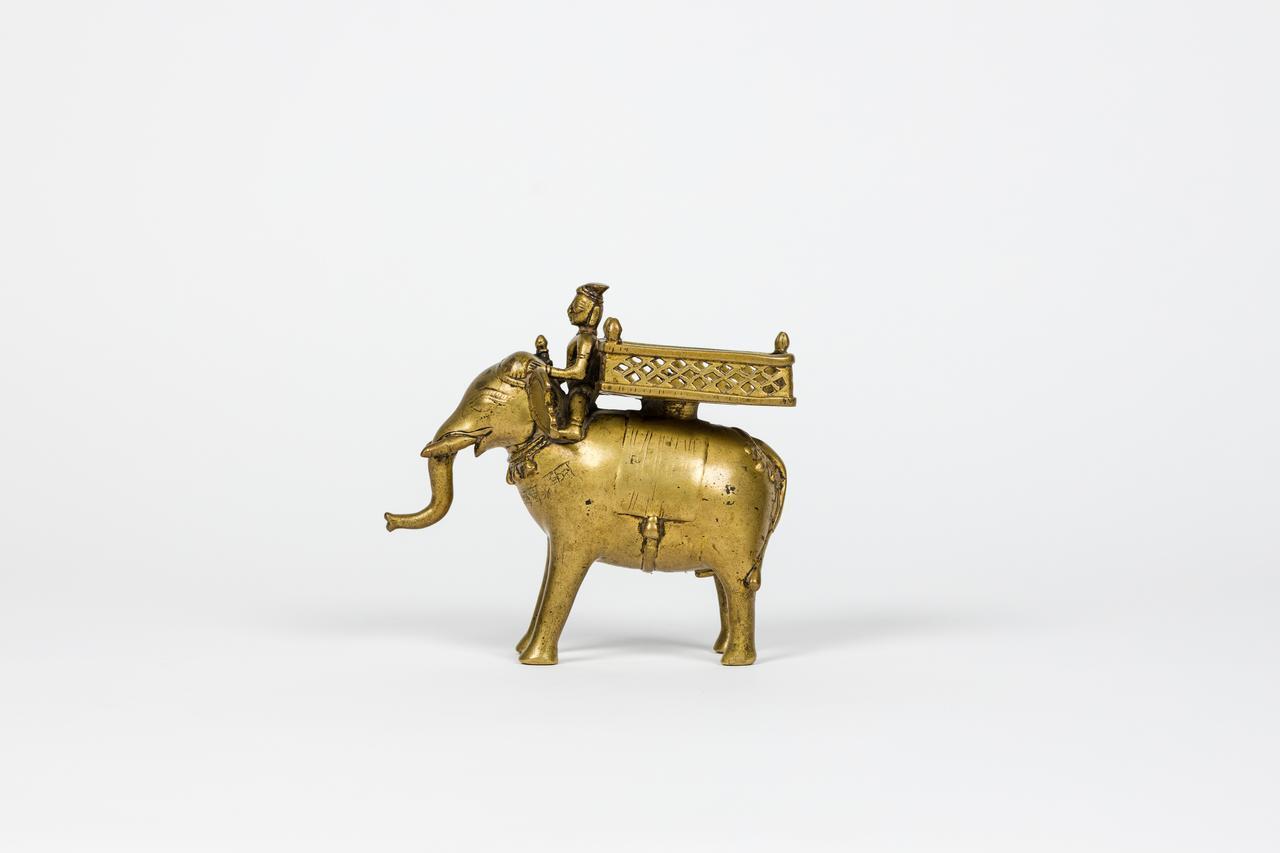
Jain statue - Bronze - India - 16th century


03
days
14
hours
22
minutes
08
seconds
Current bid
€ 400
Reserve price not met

Expert
Selected by Surya Rutten
Has over 25 years' experience in Asian art and owned an art gallery.
Estimate € 1,000 - € 1,500
 | €400 | |
|---|---|---|
 | €300 | |
 | €100 |
Catawiki Buyer Protection
Your payment’s safe with us until you receive your object.View details
Trustpilot 4.4 | 144916 reviews
Rated Excellent on Trustpilot.
This 16th-century Indian Jain statue is a bronze altar depicting a Jina in meditation, inscribed and dated 1573 on the reverse.
AI-assisted summary
Description from the seller
Rare Jainist altar, refined fusion of lost-wax bronze alloy finished by chasing.
The Jain image cult is meditative in nature, emphasizing the importance of austere and rigorous practices.
Forms and sizes are prescribed for each deity, and all parts and attributes such as body posture, emblems and ornaments, and the accompanying minor deities have a meaning.
In the center the Jina sits on a cushion in the lotus position with hands in Dhyana Mudra (right hand within the left hand in the lap, with palms facing up), indicating a state of deep meditation, topped by an umbrella.
To the left and right there are two Tirthankaras and two attendants, above them two Tirthankaras seated and two elephants, symbols of strength.
Other minor deities and attendants and Tirthankaras surround the Jina, the cushion rests on two leaping lions.
Inscribed and dated on the reverse Vikram Samvat 1629, a dating that in our calendar corresponds to the year 1573.
Good condition, beautiful patina, polished and worn from devotional use.
Height cm 13, weight g 495.
Gujarat, India XVI century.
Insured shipping
Details
Dynastic Style/Period
16th century
Country of Origin
India
Attribution
Original
Material
Bronze
Height
13 cm
Width
9 cm
Title of artwork
Jain statue
Depth
4.5 cm
Condition
Good condition
Provenance
Private collection
Authenticity
Original/official
Sold by