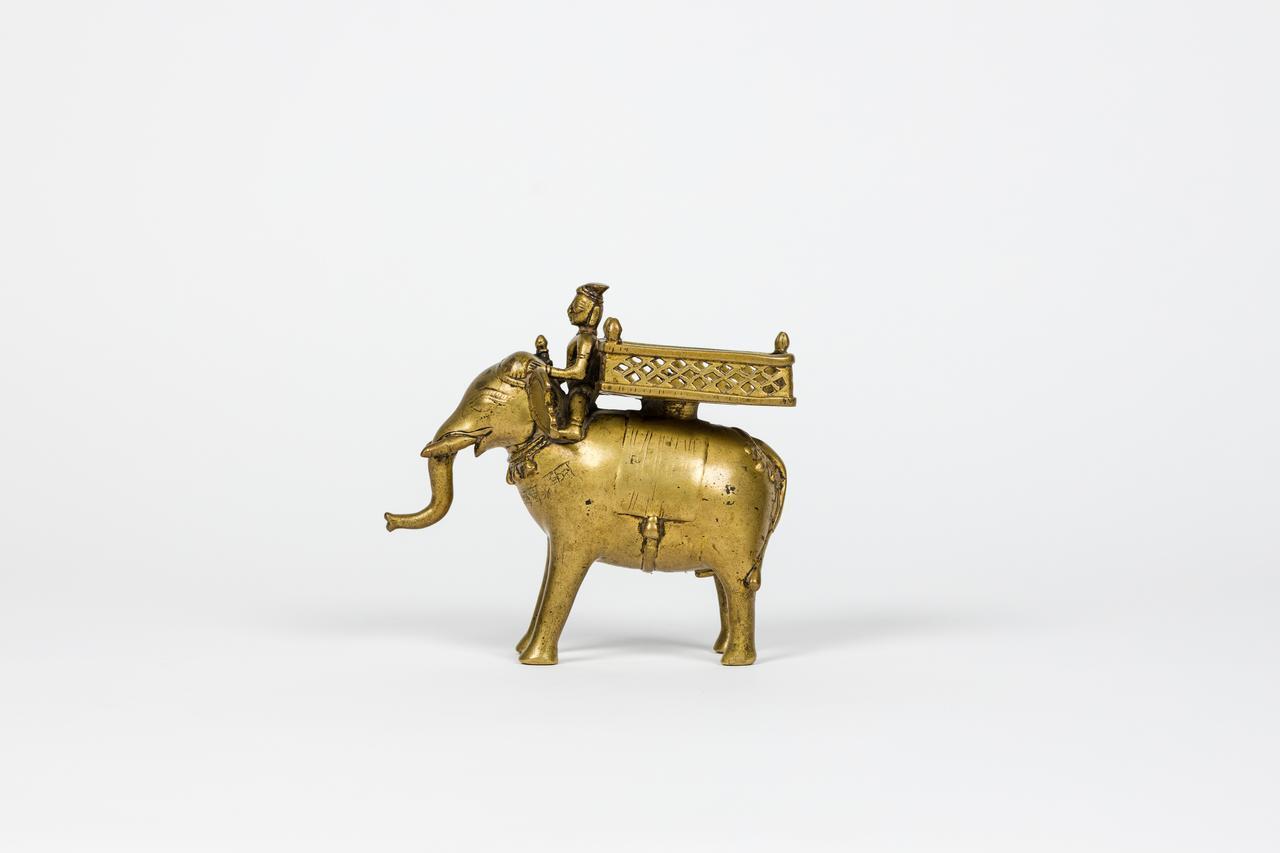
Teapot - Copper - Lota - 17th/18th c.


02
days
20
hours
13
minutes
30
seconds
Starting bid
€ 1
Reserve price not met

Expert
Selected by Surya Rutten
Has over 25 years' experience in Asian art and owned an art gallery.
Estimate € 150 - € 200
No bids placed
Catawiki Buyer Protection
Your payment’s safe with us until you receive your object.View details
Trustpilot 4.4 | 145472 reviews
Rated Excellent on Trustpilot.
This Indian copper ritual ewer, titled “Lota”, dates to the 17th century and has a long, curved spout.
AI-assisted summary
Description from the seller
Ritual long-beaked ewer (Lota)
India
17th/18th century
Copper
19 cm x 23 cm x 16 cm
Important copper ewer with globular body resting on a flared annular foot. The rounded shoulder extends into a high, slightly concave neck, finished with a wide thickened edge that overhangs. On the side, a remarkable tubular beak takes shape, strongly curved, erected vertically and ending in an oblique opening.
The silhouette, both ample and functional, belongs to the tradition of Indian metal vessels intended to contain and pour water. This type of vessel could be used in everyday life as well as in purification or ritual ablutions contexts, water occupying a fundamental place in religious practices of the Indian subcontinent.
The piece is made of hammered copper sheet, with numerous hammering traces visible across the entire surface. The body presents a regular construction, underscored at the base of the neck by a circular moulding. The beak, formed separately, is assembled to the body by means of a circular base. The wide annular foot provides stability to the overall form.
The surface bears an old patina rich in coppery, brown, and golden tones, locally punctuated by small green oxides. The irregularities, signs of use, wear, and repairs visible testify to long-term use. A very old restoration is visible on the front part of the foot, without altering the overall reading of the object.
Through its generous proportions, its characteristic sinuous beak, and the expressive quality of its hammered and patinated surface, this ewer is a fine example of the long Indian tradition of metalwork for utilitarian and ritual vessels.
Condition: wear, oxidation, small deformations and signs of use consistent with age, restoration.
Provenance: Kanaka The Collection, Portugal
Shipped with UPS and insurance
Seller's Story
Kanaka The Collection is a Portugal-based web gallery specialising in Asian art, with a particular focus on the arts of Southeast Asia.
With over 20 years of experience and passion for Asian art, we offer a carefully curated selection of sculptures, ceramics and works of art from across Asia, chosen for their artistic quality, authenticity and historical interest.
Every piece is professionally packed, and we ship worldwide to collectors and institutions.
We remain personally available to collectors before and after each acquisition.
Translated by Google TranslateRitual long-beaked ewer (Lota)
India
17th/18th century
Copper
19 cm x 23 cm x 16 cm
Important copper ewer with globular body resting on a flared annular foot. The rounded shoulder extends into a high, slightly concave neck, finished with a wide thickened edge that overhangs. On the side, a remarkable tubular beak takes shape, strongly curved, erected vertically and ending in an oblique opening.
The silhouette, both ample and functional, belongs to the tradition of Indian metal vessels intended to contain and pour water. This type of vessel could be used in everyday life as well as in purification or ritual ablutions contexts, water occupying a fundamental place in religious practices of the Indian subcontinent.
The piece is made of hammered copper sheet, with numerous hammering traces visible across the entire surface. The body presents a regular construction, underscored at the base of the neck by a circular moulding. The beak, formed separately, is assembled to the body by means of a circular base. The wide annular foot provides stability to the overall form.
The surface bears an old patina rich in coppery, brown, and golden tones, locally punctuated by small green oxides. The irregularities, signs of use, wear, and repairs visible testify to long-term use. A very old restoration is visible on the front part of the foot, without altering the overall reading of the object.
Through its generous proportions, its characteristic sinuous beak, and the expressive quality of its hammered and patinated surface, this ewer is a fine example of the long Indian tradition of metalwork for utilitarian and ritual vessels.
Condition: wear, oxidation, small deformations and signs of use consistent with age, restoration.
Provenance: Kanaka The Collection, Portugal
Shipped with UPS and insurance
Seller's Story
Kanaka The Collection is a Portugal-based web gallery specialising in Asian art, with a particular focus on the arts of Southeast Asia.
With over 20 years of experience and passion for Asian art, we offer a carefully curated selection of sculptures, ceramics and works of art from across Asia, chosen for their artistic quality, authenticity and historical interest.
Every piece is professionally packed, and we ship worldwide to collectors and institutions.
We remain personally available to collectors before and after each acquisition.
Translated by Google TranslateDetails
Era
1400-1900
Title additional information
Lota - 17th/18th c.
Number of objects
1
Material
Copper
Country of origin
India
Dynastic style/period
17th .
Provenance
Private collection
Condition
Good condition - used with small signs of aging & blemishes
Height
19 cm
Sold with stand
No
Width
23 cm
Diameter
16 cm
Estimated period
1650-1700
Sold by