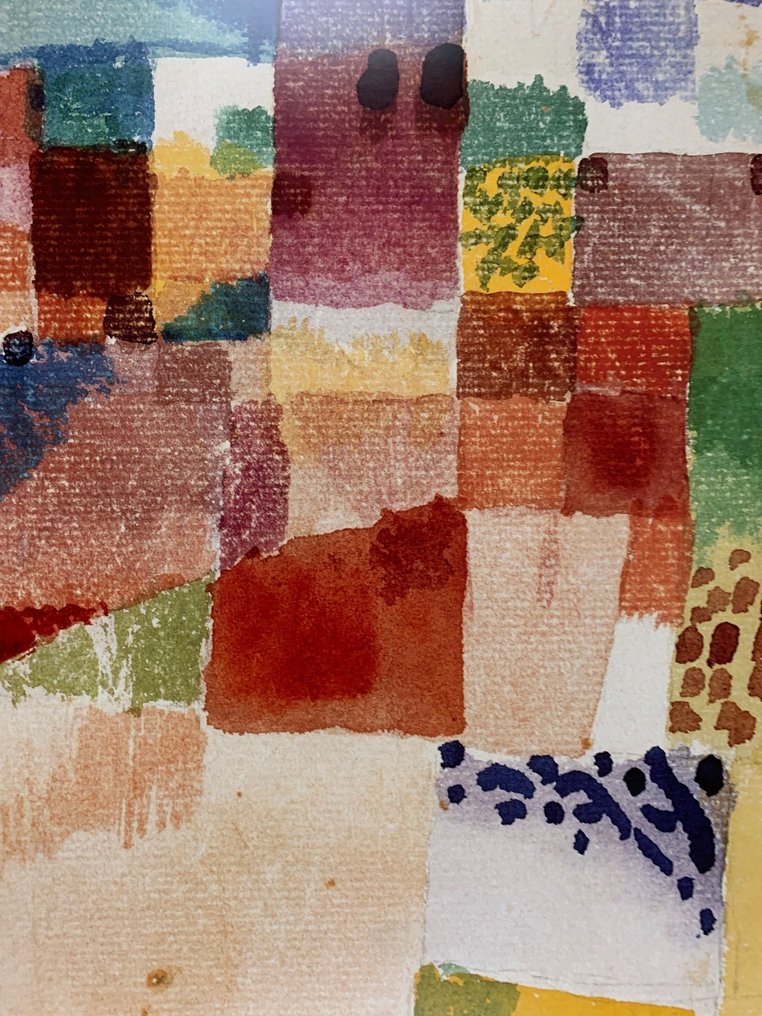
Paul Klee - Motiv aus Hammamet, 1914 - Artprint - 73 x 60 cm


03
days
08
hours
02
minutes
10
seconds
Current bid
€ 20
No reserve price

Expert
Selected by Juan Antonio Rodríguez
Eight years experience valuing posters, previously valuer at Balclis, Barcelona.
Estimate € 150 - € 200
 | €20 | |
|---|---|---|
 | €11 | |
| €10 | |
Catawiki Buyer Protection
Your payment’s safe with us until you receive your object.View details
Trustpilot 4.4 | 146353 reviews
Rated Excellent on Trustpilot.
Description from the seller
A beautiful, expressive art print by Paul Klee, measuring 73 x 60 cm, titled *Motif from Hammamet, 1914*. The work is a high-quality offset print on sturdy paper and is in very good condition.
- Printed and published by Kunstverlag, circa 1990–2000
- Purchased directly from Kunstverlag
- Professionally stored in a light-protected print storage facility ever since
Artist: Paul Klee
Title: Motif from Hammamet, 1914
Type: Art print
Technique: Offset print
Originality: Reproduction
Sheet size: 73 x 60 cm
Condition: New
Origin: Kunstverlag
Period: Classical Modernism
Nationality: German art
Paul Klee:
Paul Klee, born on December 18, 1879, in Münchenbuchsee, Switzerland, and died on June 29, 1940, in Muralto, Switzerland, is considered one of the most important artists of modernism. Known for his diverse styles and techniques, Klee had a lasting influence on the art world of the 20th century. His works, often inspired by music, poetry, and a childlike imagination, combine abstract forms with figurative elements, creating a unique visual language that influenced many artists who came after him.
Klee’s artistic training began at the Academy of Fine Arts in Munich, where he studied under, among others, Franz von Stuck. In his early years, Klee was strongly influenced by the symbolism and graphic art of Art Nouveau. Artists such as Gustav Klimt and Aubrey Beardsley, whose decorative and linear styles resonate in Klee’s work, helped shape his development. The linework and ornamentation in Klee’s early works strongly recall the work of Klimt and Beardsley.
A pivotal moment in Klee’s career was his encounter with the avant-garde movement “Der Blaue Reiter” in Munich, which he joined in 1911. Influenced by artists such as Wassily Kandinsky and Franz Marc, who championed a new spiritual art, Klee began to turn increasingly toward abstraction. Kandinsky’s ideas about color symbolism and abstract composition, as well as Marc’s depictions of animals, with their vibrant palettes and symbolic meaning, had a profound influence on Klee’s work.
Another significant influence on Klee’s art was the Cubist movement, led by Pablo Picasso and Georges Braque. Cubism, which broke objects down into geometric forms, inspired Klee to explore complex spatial structures in his works. His ability to integrate different artistic movements is evident in his fondness for playing with perspective and form. Fernand Léger and Juan Gris, other important Cubists, also contributed to the development of Klee’s abstract visual language.
Klee’s trip to Tunisia in 1914 marked another important moment in his artistic development. The intense colors and clear light of North Africa inspired Klee to create a series of watercolors and paintings that rank among the highlights of his work. These pieces, often referred to as the “Tunisia Watercolors,” feature luminous colors and a distinctive clarity that strongly influenced his later work. This explosion of color recalls the work of Henri Matisse, whose vivid colors and expressive forms exude a similar vitality.
During his time teaching at the Bauhaus in Weimar and Dessau from 1921 to 1931, Klee further developed his theories on color and form. At the Bauhaus, he worked alongside artists such as László Moholy-Nagy and Lyonel Feininger, whose experimental approaches and interdisciplinary methods enriched his own practice. Moholy-Nagy’s experiments with light and photography and Feininger’s Cubist cityscapes reflected similar aspirations to create a new, modern artistic language. Other Bauhaus artists, including Josef Albers, Anni Albers, and Johannes Itten, both influenced and were influenced by Klee’s work. His influence on color theory and compositional techniques is clearly visible in their work. Josef Albers’ “Homage to the Square” series demonstrates a systematic exploration of color interaction that can be traced back to Klee’s teaching at the Bauhaus.
The Surrealists, including artists such as Joan Miró and Max Ernst, were also inspired by Klee’s fantastical, dreamlike imagery. Miró’s biomorphic forms and Ernst’s experimental techniques show just how strongly Klee’s work influenced the Surrealist movement. Both artists shared Klee’s interest in exploring the unconscious and chance. Salvador Dalí and René Magritte, other prominent Surrealists, also explored the world of dreams and the unconscious in similar ways in their work.
The Abstract Expressionists, especially artists such as Jackson Pollock and Mark Rothko, also drew inspiration from Klee’s work. Pollock’s action paintings and Rothko’s color-field compositions reflect Klee’s intuitive approach to art and his ability to evoke a deep emotional response. Pollock’s dynamic lines and Rothko’s meditative fields of color engage in an artistic dialogue with Klee’s abstract and often spiritual compositions. Willem de Kooning and Barnett Newman, two other key figures in Abstract Expressionism, also showed the impact of Klee’s work in their art.
In contemporary art, artists such as Gerhard Richter and Sigmar Polke have carried Klee’s experimental spirit forward. Richter’s versatility and exploration of different styles and techniques reflect Klee’s own artistic journey. Polke’s playful, often ironic works display a similar sense of freedom and willingness to experiment. Other contemporary artists, such as Anselm Kiefer and Georg Baselitz, have incorporated Klee’s influence into their complex and often monumental works.
Klee’s influence also extends to sculpture and installation. Artists such as Alexander Calder and Jean Tinguely, who created kinetic sculptures, were inspired by Klee’s playful and often humorous approach to form and movement. Calder’s mobiles and Tinguely’s mechanical installations draw on Klee’s idea of a dynamic, ever-changing work of art. Louise Bourgeois and Richard Serra, known for their emotional depth and structural complexity, also show traces of Klee’s influence.
In abstract art, artists such as Bridget Riley and Ellsworth Kelly have further developed Klee’s principles of color and form. Riley’s Op Art paintings, which create visual illusions, and Kelly’s clear, geometric fields of color show how Klee’s theories of perception and abstraction continue to inform modern art. Agnes Martin and Frank Stella, whose works are often seen as meditative and structural explorations, also reflect the principles Klee pursued in his art.
Klee’s influence can also be felt in digital art. Artists such as Casey Reas and Joshua Davis use algorithms and programming to create generative artworks that recall Klee’s experimental and systematic approach to art. These contemporary artists carry Klee’s legacy forward by using new technologies and media to bring his ideas into the present.
Paul Klee remains a central figure in art history, whose influence spans numerous movements and generations of artists. His constant search for new forms of expression and his ability to blend different styles and techniques make him an inexhaustible source of inspiration for artists around the world. From the Expressionists and Surrealists to contemporary icons of the art world, Klee repeatedly redefined the boundaries of what was possible and remains a living legacy in 21st-century art.
Shipping information:
We roll prints onto sturdy cardboard tubes, wrap them in corrugated cardboard, and ship them in specially designed, very sturdy boxes. Orders are shipped with a tracking number.
About us:
We have been active in the art trade for over 20 years and have extensive experience in the professional handling and shipping of artworks.
- No shipping to the Canary Islands or Taiwan -
Seller's Story
We have been operating several online shops in the art trade for over 20 years. On the one hand, we specialize in rare art prints, exhibition posters and collectible reproductions, and on the other hand, we trade in art editions and originals by well-known contemporary artists.
The works we offer all come from the respective publishers, art galleries and institutions such as museums that published them in close cooperation with the artists. The works you find with us are often several decades old, in perfect or good condition and without a previous private owner.
We place particular emphasis on professional packaging. Nothing is more annoying than purchasing a rare print that arrives damaged due to poor or inadequate packaging.
If you have any questions about the works on offer, we are always happy to help you!
Translated by Google TranslateA beautiful, expressive art print by Paul Klee, measuring 73 x 60 cm, titled *Motif from Hammamet, 1914*. The work is a high-quality offset print on sturdy paper and is in very good condition.
- Printed and published by Kunstverlag, circa 1990–2000
- Purchased directly from Kunstverlag
- Professionally stored in a light-protected print storage facility ever since
Artist: Paul Klee
Title: Motif from Hammamet, 1914
Type: Art print
Technique: Offset print
Originality: Reproduction
Sheet size: 73 x 60 cm
Condition: New
Origin: Kunstverlag
Period: Classical Modernism
Nationality: German art
Paul Klee:
Paul Klee, born on December 18, 1879, in Münchenbuchsee, Switzerland, and died on June 29, 1940, in Muralto, Switzerland, is considered one of the most important artists of modernism. Known for his diverse styles and techniques, Klee had a lasting influence on the art world of the 20th century. His works, often inspired by music, poetry, and a childlike imagination, combine abstract forms with figurative elements, creating a unique visual language that influenced many artists who came after him.
Klee’s artistic training began at the Academy of Fine Arts in Munich, where he studied under, among others, Franz von Stuck. In his early years, Klee was strongly influenced by the symbolism and graphic art of Art Nouveau. Artists such as Gustav Klimt and Aubrey Beardsley, whose decorative and linear styles resonate in Klee’s work, helped shape his development. The linework and ornamentation in Klee’s early works strongly recall the work of Klimt and Beardsley.
A pivotal moment in Klee’s career was his encounter with the avant-garde movement “Der Blaue Reiter” in Munich, which he joined in 1911. Influenced by artists such as Wassily Kandinsky and Franz Marc, who championed a new spiritual art, Klee began to turn increasingly toward abstraction. Kandinsky’s ideas about color symbolism and abstract composition, as well as Marc’s depictions of animals, with their vibrant palettes and symbolic meaning, had a profound influence on Klee’s work.
Another significant influence on Klee’s art was the Cubist movement, led by Pablo Picasso and Georges Braque. Cubism, which broke objects down into geometric forms, inspired Klee to explore complex spatial structures in his works. His ability to integrate different artistic movements is evident in his fondness for playing with perspective and form. Fernand Léger and Juan Gris, other important Cubists, also contributed to the development of Klee’s abstract visual language.
Klee’s trip to Tunisia in 1914 marked another important moment in his artistic development. The intense colors and clear light of North Africa inspired Klee to create a series of watercolors and paintings that rank among the highlights of his work. These pieces, often referred to as the “Tunisia Watercolors,” feature luminous colors and a distinctive clarity that strongly influenced his later work. This explosion of color recalls the work of Henri Matisse, whose vivid colors and expressive forms exude a similar vitality.
During his time teaching at the Bauhaus in Weimar and Dessau from 1921 to 1931, Klee further developed his theories on color and form. At the Bauhaus, he worked alongside artists such as László Moholy-Nagy and Lyonel Feininger, whose experimental approaches and interdisciplinary methods enriched his own practice. Moholy-Nagy’s experiments with light and photography and Feininger’s Cubist cityscapes reflected similar aspirations to create a new, modern artistic language. Other Bauhaus artists, including Josef Albers, Anni Albers, and Johannes Itten, both influenced and were influenced by Klee’s work. His influence on color theory and compositional techniques is clearly visible in their work. Josef Albers’ “Homage to the Square” series demonstrates a systematic exploration of color interaction that can be traced back to Klee’s teaching at the Bauhaus.
The Surrealists, including artists such as Joan Miró and Max Ernst, were also inspired by Klee’s fantastical, dreamlike imagery. Miró’s biomorphic forms and Ernst’s experimental techniques show just how strongly Klee’s work influenced the Surrealist movement. Both artists shared Klee’s interest in exploring the unconscious and chance. Salvador Dalí and René Magritte, other prominent Surrealists, also explored the world of dreams and the unconscious in similar ways in their work.
The Abstract Expressionists, especially artists such as Jackson Pollock and Mark Rothko, also drew inspiration from Klee’s work. Pollock’s action paintings and Rothko’s color-field compositions reflect Klee’s intuitive approach to art and his ability to evoke a deep emotional response. Pollock’s dynamic lines and Rothko’s meditative fields of color engage in an artistic dialogue with Klee’s abstract and often spiritual compositions. Willem de Kooning and Barnett Newman, two other key figures in Abstract Expressionism, also showed the impact of Klee’s work in their art.
In contemporary art, artists such as Gerhard Richter and Sigmar Polke have carried Klee’s experimental spirit forward. Richter’s versatility and exploration of different styles and techniques reflect Klee’s own artistic journey. Polke’s playful, often ironic works display a similar sense of freedom and willingness to experiment. Other contemporary artists, such as Anselm Kiefer and Georg Baselitz, have incorporated Klee’s influence into their complex and often monumental works.
Klee’s influence also extends to sculpture and installation. Artists such as Alexander Calder and Jean Tinguely, who created kinetic sculptures, were inspired by Klee’s playful and often humorous approach to form and movement. Calder’s mobiles and Tinguely’s mechanical installations draw on Klee’s idea of a dynamic, ever-changing work of art. Louise Bourgeois and Richard Serra, known for their emotional depth and structural complexity, also show traces of Klee’s influence.
In abstract art, artists such as Bridget Riley and Ellsworth Kelly have further developed Klee’s principles of color and form. Riley’s Op Art paintings, which create visual illusions, and Kelly’s clear, geometric fields of color show how Klee’s theories of perception and abstraction continue to inform modern art. Agnes Martin and Frank Stella, whose works are often seen as meditative and structural explorations, also reflect the principles Klee pursued in his art.
Klee’s influence can also be felt in digital art. Artists such as Casey Reas and Joshua Davis use algorithms and programming to create generative artworks that recall Klee’s experimental and systematic approach to art. These contemporary artists carry Klee’s legacy forward by using new technologies and media to bring his ideas into the present.
Paul Klee remains a central figure in art history, whose influence spans numerous movements and generations of artists. His constant search for new forms of expression and his ability to blend different styles and techniques make him an inexhaustible source of inspiration for artists around the world. From the Expressionists and Surrealists to contemporary icons of the art world, Klee repeatedly redefined the boundaries of what was possible and remains a living legacy in 21st-century art.
Shipping information:
We roll prints onto sturdy cardboard tubes, wrap them in corrugated cardboard, and ship them in specially designed, very sturdy boxes. Orders are shipped with a tracking number.
About us:
We have been active in the art trade for over 20 years and have extensive experience in the professional handling and shipping of artworks.
- No shipping to the Canary Islands or Taiwan -
Seller's Story
We have been operating several online shops in the art trade for over 20 years. On the one hand, we specialize in rare art prints, exhibition posters and collectible reproductions, and on the other hand, we trade in art editions and originals by well-known contemporary artists.
The works we offer all come from the respective publishers, art galleries and institutions such as museums that published them in close cooperation with the artists. The works you find with us are often several decades old, in perfect or good condition and without a previous private owner.
We place particular emphasis on professional packaging. Nothing is more annoying than purchasing a rare print that arrives damaged due to poor or inadequate packaging.
If you have any questions about the works on offer, we are always happy to help you!
Translated by Google TranslateDetails
Sold by
Gallery
Artist
Paul Klee
Title of artwork
Motiv aus Hammamet, 1914 - Artprint - 73 x 60 cm
Technique
Offset print
Signature
Not signed
Country of origin
Germany
Year
1914
Condition
Excellent condition
Height
73 cm
Width
60 cm
Style
Modern
Sold with frame
No
Period
19th century