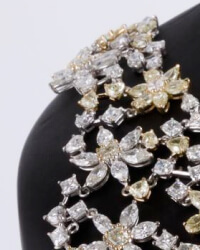
Bracelet - 18 kt. Rose gold, Silver Diamond (Natural) - Pearl


00
days
19
hours
04
minutes
32
seconds
Current bid
€ 1,300
Reserve price not met

Expert
Selected by Laura Trevino
She has 15 years' auction experience, specialising in vintage jewellery from 1920 to 2000.
Estimate € 6,500 - € 7,800
 | €1,300 | |
|---|---|---|
 | €1,200 | |
 | €750 | |
Catawiki Buyer Protection
Your payment’s safe with us until you receive your object.View details
Trustpilot 4.4 | 145414 reviews
Rated Excellent on Trustpilot.
This Victorian bracelet, dating to around 1870, is made of 18-carat rose gold and silver and set with 25 natural rose-cut diamonds and pearls.
AI-assisted summary
Description from the seller
A quintessential bracelet from the Grand Victorian Period, circa 1870, embodies the era's magnificence. Crafted from 18k red gold and silver, it features 25 meticulously set rose-cut diamonds complemented by a central natural orient saltwater pearl, flanked by five strands of delicate pearls. This exquisite piece, presumed Belgian, showcases the opulent design characteristic of the late Victorian aesthetic, influenced by global artistry, yet distinctly Western in execution. A testament to the period's rich cultural tapestry and ornate sensibilities.
Antique jewelry object group: bracelet
Condition: excellent condition
- (more info on our condition scale)
Country of origin: Although it does not carry any legible control marks we believe this to be of Belgian origin.
Style: Victorian - Victorian decorative arts refers to the style of decorative arts during the Victorian era. The Victorian era is known for its eclectic revival and interpretation of historic styles and the introduction of cross-cultural influences from the middle east and Asia in furniture, fittings, and Interior decoration. Victorian design is widely viewed as having indulged in a regrettable excess of ornament. The Arts and Crafts movement, the aesthetic movement, Anglo-Japanese style, and Art Nouveau style have their beginnings in the late Victorian era.
- See also: Victorian or more info on styles
Style specifics: The Grand Victorian Period - Experts divide the reign of Queen Victoria, also called The Victorian era (1837 - 1901) into three periods of about twenty years each; The Romantic Victorian Period (1837 - 1860), The Grand Victorian Period (1860 - 1880), and the Late or Aesthetic Victorian Period (1880 - 1901).
We consider this to be of the Grand Victorian Period.
This second Victorian period is famous for its ostentatious pieces set with pearls and diamonds (from South Africa). From ca. 1850 wealthy English had reported about jewelry from India and Japan, which heavily inspired the jewelers of this period. This period also corresponds with the death of Queen Victoria's husband King Albert making mourning jewelry (set with heavy dark stones) the type of jewelry specific for this period.
Period: ca. 1870
- (events & facts of this era, poetry of this era, fashion of this era)
Material: 18k red gold and silver, see also: The silver on gold technique
- (more info on precious metals)
Technique: The rose cuts are set on foil. This is a special technique that was used to bring the lustre of the diamonds to its best quality.
Diamond(s): 25 rose cut diamonds. We do not have the weight of the diamonds which is normal in our trade when it comes to rose cuts.
Precious stones: One pearl (most probably real natural orient saltwater)
Five strings of pearls
Birthstones: Diamond is the birthstone (or month stone) for April and pearl for June.
- (more info on birthstones)
Hallmarks: No trace.
- (more info on hallmarks)
Dimensions: diameter of closure Ø 2,55 cm (1,00 inch), total length bracelet 18,50 cm (7,28 inch)
Weight: 34,50 gram (22,18 dwt)
Reference Nº: 16323-0044
- Accompanied by a professional report of authenticity for your peace of mind.
- Shipped insured and registered for your security, though you're most welcome to collect in person.
- For shipments outside the EU, import duties and other charges may apply. We advise checking this in advance.
- We invite you to browse through our customer feedback to discover the level of satisfaction we consistently provide.
- See more of our products, visit: https://auction.catawiki.com/lotsfrom/Adin
- It is common for antique & vintage jewellery to be thoughtfully refurbished, remodelled, or repaired to extend its life of wearability. Older items may well show signs of this loving attention.
Seller's Story
Adin shares with their collection of vintage and antique jewellery over 4 decades of expertise. On our provider page, you get the experience of exploring our boutique, located in the world diamond center Antwerp. Elkan Wijnberg, Adin’s founder and CEO, is a member of the Belgian Chamber of Experts to the Courts of Justice and of both the British and American Society of Jewellery Historians.
Details
Era
1400-1900
Laboratory report
No laboratory report
Diamond type of main stone
Natural
Estimated period
1850-1900
Metal
Rose gold, Silver
Number of diamonds main stone
25
Brand jewellery
No
Fineness
18 kt.
Main stone
Diamond
Total weight
34.5 g
Surrounding stones
Pearl
Condition
Excellent condition - barely used with minimal signs of wear
Gender
Unisex
Cutting style of main stone
Rose cut
Disclaimer
Catawiki always aims to offer you the best possible buying experience. Our experts virtually review and select every object in line with our submission guidelines. While we strive to provide a detailed description and photographs of each jewellery object, discrepancies or inaccuracies may occur. It is your responsibility to review all of the information provided about an object, including the condition and description, before placing an order. Sellers are responsible for the information, pictures and description provided, including the quality, quantity and nature of the jewelry supplied. A small imperfection that cannot be seen in the photo but is included in the description is not a non-conformity. A Lab Report is not a guarantee, valuation or appraisal regarding the articles described therein. A Lab Report contains only the characteristics of an article described after it has been graded, tested, examined, and analyzed using the techniques and equipment used at the time of the examination from that specific Lab. The results of any other examination performed on the article may differ depending when, how, by whom and with which grading standard the article is examined. In addition, any changes and improvements in techniques and equipment that may have occurred which may enable the examiner to detect, among other things, the use of processes for altering the characteristics of an article which use was previously undetectable, does not automatically mean the object does not conform to its description.
Catawiki always aims to offer you the best possible buying experience. Our experts virtually review and select every object in line with our submission guidelines. While we strive to provide a detailed description and photographs of each jewellery object, discrepancies or inaccuracies may occur. It is your responsibility to review all of the information provided about an object, including the condition and description, before placing an order. Sellers are responsible for the information, pictures and description provided, including the quality, quantity and nature of the jewelry supplied. A small imperfection that cannot be seen in the photo but is included in the description is not a non-conformity. A Lab Report is not a guarantee, valuation or appraisal regarding the articles described therein. A Lab Report contains only the characteristics of an article described after it has been graded, tested, examined, and analyzed using the techniques and equipment used at the time of the examination from that specific Lab. The results of any other examination performed on the article may differ depending when, how, by whom and with which grading standard the article is examined. In addition, any changes and improvements in techniques and equipment that may have occurred which may enable the examiner to detect, among other things, the use of processes for altering the characteristics of an article which use was previously undetectable, does not automatically mean the object does not conform to its description.