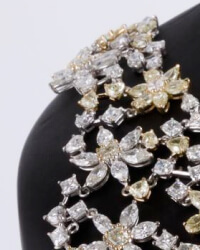
Ring - 18 kt. Yellow gold - 1.50ct. tw. - Diamond - Enamel, Rococo 1750's


00
days
14
hours
53
minutes
37
seconds
Current bid
€ 400
Reserve price not met

Expert
Selected by Laura Trevino
She has 15 years' auction experience, specialising in vintage jewellery from 1920 to 2000.
Estimate € 5,400 - € 6,500
 | €400 | |
|---|---|---|
| €300 | |
 | €2 | |
Catawiki Buyer Protection
Your payment’s safe with us until you receive your object.View details
Trustpilot 4.4 | 145414 reviews
Rated Excellent on Trustpilot.
This Rococo enamel ring is crafted in 18 kt yellow gold and set with 15 natural diamonds totalling approximately 1.50 ct, and it comes with an IJGC report.
AI-assisted summary
Description from the seller
A resplendent Rococo ring, dating back to circa 1750, captures the whimsical grace of the late Baroque period. Crafted in 18K yellow gold, this piece showcases the era's penchant for asymmetry and ornate natural motifs, with 15 old brilliant cut diamonds totalling approximately 1.50ct. The enamelling technique employed is a testament to the artistry of the period, imbuing this exquisite ring with a colourful history, all preserved in excellent condition.
Antique jewelry object group: ring
Condition: excellent condition
- (more info on our condition scale)
Country of origin: unknown
Style: Rococo - Rococo (less commonly roccoco) also referred to as "Late Baroque" is an 18th century style which developed as Baroque artists gave up their symmetry and became increasingly more ornate, florid, and playful. Rococo rooms were designed as total works of art with elegant and ornate furniture, small sculptures, ornamental mirrors, and tapestry complementing architecture, reliefs, and wall paintings. It was largely supplanted by the Neoclassic style. In 1835 the Dictionary of the French Academy stated that the word Rococo "usually covers the kind of ornament, style and design associated with Louis XV's reign and the beginning of that of Louis XVI". It includes therefore, all types of art produced around the middle of the 18th century in France.
- See also: Rococo or more info on styles
Style specifics: Rococo is a style of decoration that followed, c.1730, the baroque style in France (where it was also called rocaille), the principal features of which are asymmetry of ornament and a repertoire consisting to a considerable extent of rockwork, shells, flowers, foliage, and scrollwork. It was developed in France under Louis XV, 1715-74, and spread to Italy, Germany, and Austria and to a lesser extent to England.
Period: ca. 1750
- (events & facts of this era, poetry of this era, fashion of this era)
Material: 18K yellow gold
- (more info on precious metals)
Technique: Enamelling is an old and widely-adopted technology. The ancient Egyptians applied enamels to pottery and stone objects. The ancient Greeks, Celts, Russians, and Chinese also used enameling processes on metal objects. Enamel is the colorful result of fusing powdered glass to a substrate by firing, usually between 750 and 850 degrees Celsius. The powder melts and flows and hardens to a smooth, durable vitreous coating on metal, glass or ceramic. According to some sources, the word enamel comes from the High German word smelzan (to smelt) via the Old French esmail. Used as a noun, "an enamel" is a usually small decorative object, coated with enamel coating, such as a champlevé or a cloisonné (different techniques).
Diamond(s): 15 old brilliant cut diamonds with an estimated weight of ± 1.50ct. (colour and clarity: G/K, vs/i).
- All diamond weights, color grades and clarity are approximate since the stones were not removed from their mounts to preserve the integrity of the setting.
Total diamond weight: approx. 1.50 crt.
Birthstones: Diamond is the birthstone (or month stone) for April.
- (more info on birthstones)
Hallmarks: No trace.
- (more info on hallmarks)
Dimensions: top of ring 1,90 cm (0,75 inch) x 1,20 cm (0,47 inch)
Weight: 4,80 gram (3,09 dwt)
Ring size Continental: 51 & 16¼ , Size US 5½ , Size UK: K½ Free resizing*
*) Resizing: *Only for extreme changes we will charge something.
In case of resizing, use the Catawiki message system to contact us directly with the required ring size when you pay this ring. When we receive your message after we shipped your ring the free resizing offer is expired.
Reference Nº: 16340-0042
- Accompanied by a professional report of authenticity for your peace of mind.
- Shipped insured and registered for your security, though you're most welcome to collect in person.
- For shipments outside the EU, import duties and other charges may apply. We advise checking this in advance.
- We invite you to browse through our customer feedback to discover the level of satisfaction we consistently provide.
- See more of our products, visit: https://auction.catawiki.com/lotsfrom/Adin
- Antique and vintage jewellery often undergoes thoughtful refurbishment, remodelling, or repairs to enhance its longevity and wearability. Such pieces frequently bear marks of this tender care. Furthermore, we present our antique and vintage jewellery in its authentic state, refraining from removing scratches or applying rhodium plating to white gold items. Our priority is to preserve the genuine allure and history of each piece. However, as the new owner, you have the option to take it to a local goldsmith for a cosmetic refresh, should you choose.
Seller's Story
Adin shares with their collection of vintage and antique jewellery over 4 decades of expertise. On our provider page, you get the experience of exploring our boutique, located in the world diamond center Antwerp. Elkan Wijnberg, Adin’s founder and CEO, is a member of the Belgian Chamber of Experts to the Courts of Justice and of both the British and American Society of Jewellery Historians.
Details
Estimated period
17th century
Total carat weight of all stones
1.50
Lab report number
16340-0042
Diamond type of surrounding stones
Natural
Laboratory report
International Jewellery & Gems Certifiers (IJGC)
Era
1400-1900
Number of diamonds surrounding stones
15
Metal
Yellow gold
Brand jewellery
No
Fineness
18 kt.
Total carat weight of surrounding stones
1.50
Surrounding stones
Diamond
Total weight
4.8 g
Condition
Excellent condition - barely used with minimal signs of wear
Gender
Unisex
Title additional information
Enamel, Rococo 1750's
Ring size
51 (EU) / 11 (IT) / 5 ¾ (US)
Disclaimer
Catawiki always aims to offer you the best possible buying experience. Our experts virtually review and select every object in line with our submission guidelines. While we strive to provide a detailed description and photographs of each jewellery object, discrepancies or inaccuracies may occur. It is your responsibility to review all of the information provided about an object, including the condition and description, before placing an order. Sellers are responsible for the information, pictures and description provided, including the quality, quantity and nature of the jewelry supplied. A small imperfection that cannot be seen in the photo but is included in the description is not a non-conformity. A Lab Report is not a guarantee, valuation or appraisal regarding the articles described therein. A Lab Report contains only the characteristics of an article described after it has been graded, tested, examined, and analyzed using the techniques and equipment used at the time of the examination from that specific Lab. The results of any other examination performed on the article may differ depending when, how, by whom and with which grading standard the article is examined. In addition, any changes and improvements in techniques and equipment that may have occurred which may enable the examiner to detect, among other things, the use of processes for altering the characteristics of an article which use was previously undetectable, does not automatically mean the object does not conform to its description.
Catawiki always aims to offer you the best possible buying experience. Our experts virtually review and select every object in line with our submission guidelines. While we strive to provide a detailed description and photographs of each jewellery object, discrepancies or inaccuracies may occur. It is your responsibility to review all of the information provided about an object, including the condition and description, before placing an order. Sellers are responsible for the information, pictures and description provided, including the quality, quantity and nature of the jewelry supplied. A small imperfection that cannot be seen in the photo but is included in the description is not a non-conformity. A Lab Report is not a guarantee, valuation or appraisal regarding the articles described therein. A Lab Report contains only the characteristics of an article described after it has been graded, tested, examined, and analyzed using the techniques and equipment used at the time of the examination from that specific Lab. The results of any other examination performed on the article may differ depending when, how, by whom and with which grading standard the article is examined. In addition, any changes and improvements in techniques and equipment that may have occurred which may enable the examiner to detect, among other things, the use of processes for altering the characteristics of an article which use was previously undetectable, does not automatically mean the object does not conform to its description.