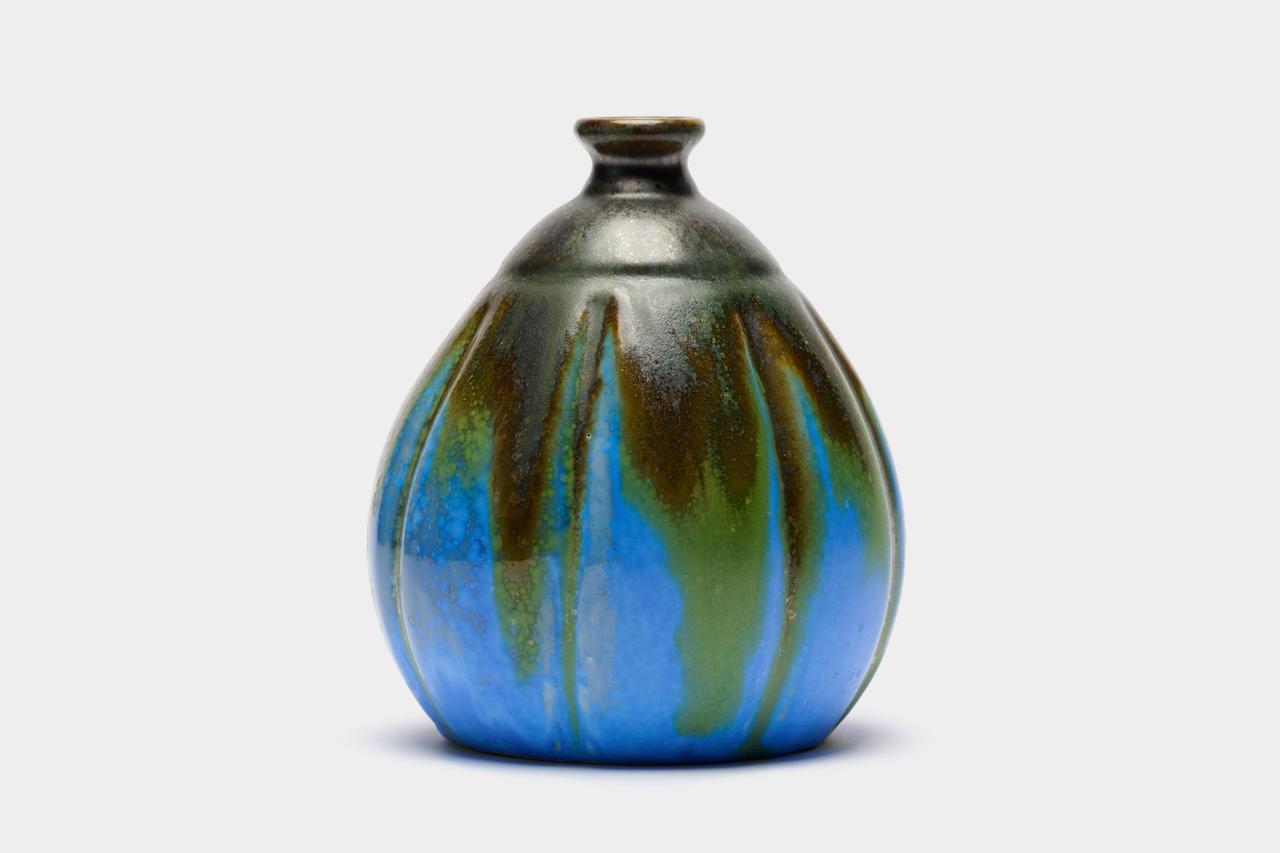
Villeroy & Boch - Amphorenvase 24 cm, Dekor "Paon" - Vase (2) - Form 4225 2 and SAAR S - Porcelain - Polychrome


01
day
21
hours
06
minutes
40
seconds

 | €10 | |
|---|---|---|
 | €7 | |
 | €6 | |
Catawiki Buyer Protection
Your payment’s safe with us until you receive your object.View details
Trustpilot 4.4 | 145304 reviews
Rated Excellent on Trustpilot.
This pair of multicoloured Villeroy & Boch porcelain pieces with hand-painted underglaze Paon décor comprises a 24 cm amphora vase and a 12 cm planter, in excellent condition with minimal signs of age and wear.
AI-assisted summary
Description from the seller
Villeroy & Boch, 2 ceramic objects, “Paon” pattern, 1950s–1980s
1. Amphora vase, 1980s
Material: Porcelain with a light mint-green base color.
Form: 4225 2
Height 24 cm, diameter 7 5-10-6.5 cm
Decoration: Underglaze, hand-painted
Condition: Immaculate
2. Planter, 1950s
Material: Porcelain with a light mint-green base color.
Form: SAAR S (blind stamp)
Height 12 cm, diameter 14 cm
Decoration: Underglaze, hand-painted
Base mark: Mettlach copper-plate printing, underglaze
Condition: Immaculate
Special feature:
SAAR / Made in Germany: Indicates production in the Saarland (Mettlach).
The inscription “SAAR” on the stamp is a direct document of economic history:
The semi-autonomous Saarland:
After the Second World War, the Saarland was separated from the French occupation zone and became a politically autonomous state (the Saar Protectorate) economically associated with France.
Circumventing customs barriers:
In order to export goods to France and other countries without French import duties, or to declare their origin correctly, businesses in the Saarland had to mark their products specially. Villeroy & Boch (headquartered in Mettlach in the Saarland) therefore added the designation “SAAR” (sometimes also “France-Saar”).
Reintegration into the Federal Republic:
On January 1, 1957, the Saarland was officially incorporated into the Federal Republic of Germany as a federal state (economic integration into the German customs territory followed in the summer of 1959).
Why does it nevertheless say “Made in Germany”?
Because the “Paon” series was produced over a very long period (starting in the late 1950s and continuing well into the 1970s/1980s).
On pieces from the very first production period (around 1955–1958), one often still finds “Made in France-Saar” or simply “Saar.” However, the stamp in your photo combines “SAAR” and “Made in Germany” — this is the typical transitional and subsequent mark from the period after reintegration (from the 1960s/1970s onward), when Villeroy & Boch retained the traditional “SAAR” factory designation for its Mettlach headquarters as part of its brand identity, even though the political customs border with Germany had long since disappeared.
Currently, no shipping to the USA.
Shipping is exclusively via DHL Deutsche Post.
All information is provided to the best of my knowledge and belief.
Please examine the attached photos. Any flaws are marked.
Color variations between the photos and the original are possible.
Signs of use and/or storage cannot be ruled out due to the age of the items.
Unevenness in the glaze and ceramic is typical of the product and does not constitute a defect.
In light of recent circumstances:
If, despite careful packaging, your lot arrives damaged, please have the damage confirmed in writing by your delivery person immediately and take detailed photos.
Under EU rules for courier companies, in the event of international shipments arriving damaged, the RECIPIENT must report the damage to their local carrier within 7 days of receiving the shipment. Only after the RECIPIENT (you) has received a damage certificate can I, as the sender, claim compensation. Please do not bid if you do not accept this.
If you nevertheless wish to bid on one of my lots, please provide a 100% accurate address (please check your Catawiki account) to ensure reliable delivery of the package. If the package cannot be delivered properly, substantial costs (postage, customs duties and taxes) will be incurred for its return to me. I will seek reimbursement of these costs.
Marking: The object is unmarked (without a maker’s mark), which is entirely typical of the period for decorative household items from upscale department stores and smaller arts-and-crafts businesses.
Details
Era
1900-2000
Title additional information
Polychrome
Number of objects
2
Country of origin
Germany
Model
Form 4225 2 and SAAR S
Designer/artist/maker
Amphorenvase 24 cm, Dekor "Paon"
Material
Porcelain
Style
Vintage
Manufacturer/brand
Villeroy & Boch
Colour
Multicolour
Condition
Excellent condition: barely used with minimal signs of wear
Height
0 cm
Width
0 cm
Depth
0 cm
Decor
Peacock
Diameter
0 cm
Estimated period
1950-1980
Sold by