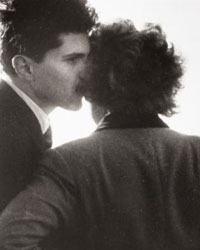
Robert Capa (1913–1954) - German Fräuleins with Russian and American soldiers in a Berlin Restaurant (1945)


03
days
18
hours
31
minutes
45
seconds
Current bid
€ 56
No reserve price

Expert
Selected by Kai Brückner
Over 35 years' experience; former gallery owner and Museum Folkwang curator.
Estimate € 350 - € 430
 | €56 | |
|---|---|---|
 | €53 | |
| €50 | |
Catawiki Buyer Protection
Your payment’s safe with us until you receive your object.View details
Trustpilot 4.4 | 145414 reviews
Rated Excellent on Trustpilot.
Robert Capa’s *German Fräuleins with Russian and American soldiers in a Berlin Restaurant (1945)* is a gelatin-silver print from 2025.
AI-assisted summary
Description from the seller
Robert Capa (1913–1954) - German Fräuleins with Russian and American soldiers in a Berlin Restaurant (1945)
Robert Capa
German Fräuleins with Russian and American soldiers in a Berlin restaurant. Robert Capa captured this photograph in August 1945 inside the famous Tanzcafé Femina (located on Nürnberger Straße in Berlin's Schöneberg district). It documents the brief, surreal period immediately following World War II, during the joint Allied occupation before Cold War tensions solidified.
• The Location: Tanzcafé Femina was one of Berlin's premier pre-war nightlife venues. Having survived severe bombings relatively intact, it quickly reopened after the city's fall to serve occupation forces and locals.
• The Atmosphere: The image shows a group of Soviet Red Army officers, American GIs (identifiable by uniforms and unit patches), British personnel, and local German women sharing a table, food, and toasts.
• The Contrast: Capa arrived in Berlin in the summer of 1945 to shoot a photo essay for LIFE magazine. While much of the city lay in catastrophic ruins with widespread poverty, spots like Femina offered a strange oasis of music, alcohol, and fragile camaraderie.
Robert Capa’s photographic assignment in Berlin during the summer of 1945 resulted in one of his most poignant post-war photo essays for LIFE magazine. Arriving just months after Germany's unconditional surrender in May 1945, Capa shifted his camera away from active combat to capture the heavy, surreal, and human reality of a shattered capital trying to rebuild from zero (Stunde Null).
Core Themes of the Berlin 1945 Series
• Life Among the Ruins: Capa documented Berliners navigating mountains of rubble in iconic spots like the Brandenburg Gate, Unter den Linden, and Kurfürstendamm. He focused heavily on the Trümmerfrauen ("rubble women") clearing bricks by hand to rebuild basic infrastructure.
• The Allied Occupation Dynamics: His photos highlighted the four-power division of Berlin (American, Soviet, British, and French sectors). He captured checkpoint exchanges, inter-Allied social gatherings, and soldiers adjusting to garrison duty alongside local citizens.
• Survival and the Black Market: Capa turned his lens toward daily survival: crowded open-air black markets, civilians foraging for food or trading personal belongings for cigarettes, and long queues outside ration offices and public transport hubs.
• Refugees and Displaced Persons: He recorded the movement of thousands of homeless civilians, returning prisoners of war, and displaced refugees carrying their remaining possessions through destroyed train stations.
•
Robert Capa born Endre Ernő Friedmann (Budapest, October 22, 1913 – died Thái Bình Province, Vietnam, May 25, 1954)
Friedman had fled political repression in Hungary when he was a teenager, moving to Berlin, where he enrolled in the university. He worked part-time as a darkroom assistant for income and then became a staff photographer for the German photographic agency, Dephot. He witnessed the rise of Hitler, which led him to move to Paris, where he met and began to work with his professional partner Gerda Taro, and they began to publish their work separately.
He subsequently covered five wars: the Spanish Civil War, the Second Sino-Japanese War, World War II across Europe, the 1948 Arab–Israeli War, and the First Indochina War, with his photos published in major magazines and newspapers.
In 1947, for his work recording World War II in pictures, U.S. general Dwight D. Eisenhower awarded Capa the Medal of Freedom. That same year, Capa co-founded Magnum Photos in Paris.
His biography is well described in Wikipedia
https://en.wikipedia.org/wiki/Robert_Capa
•
Details
Date of print
2025
Artist
Robert Capa (1913–1954)
Sold by
Owner or reseller
Title of artwork
German Fräuleins with Russian and American soldiers in a Berlin Restaurant (1945)
Condition
Extremely fine
Technique
Gelatin-silver print
Height
30 cm
Edition
5
Width
24 cm
Signature
Stamped
Genre
Military and war
Sold by