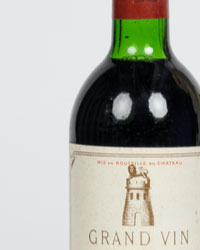
2013 Chateau Beychevelle - Saint-Julien 4ème Grand Cru Classé - 6 Bottles (0.75L)


05
days
13
hours
42
minutes
18
seconds
Current bid
€ 225
Reserve price not met

Expert
Selected by Patricia Verschelling
Holds WSET Level 3 and 4, Vinoloog degree; auction house wine expert since 2004.
Estimate € 500 - € 580
 | €225 | |
|---|---|---|
| €89 | |
| €86 | |
Catawiki Buyer Protection
Your payment’s safe with us until you receive your object.View details
Trustpilot 4.4 | 146393 reviews
Rated Excellent on Trustpilot.
A lot of six 2013 bottles of Chateau Beychevelle from Saint-Julien, each 0.75 L, in the original wooden case.
AI-assisted summary
Description from the seller
Six bottles of 2013 Château Beychevelle in a wooden case; labels and capsules in excellent condition.
Bottled at the estate.
95/100 Robert Parker
Shipped via FedEx!
About the estate
Located on a low-lying plateau, the vineyard—within the Saint-Julien AOC—borders the commune of Cussac. Most of the land features soil similar to that of Château Latour, consisting of large gravel deposits with drainage facilitated by numerous canals. The château was built in 1565 by Bishop François de Foix-Candale. His niece, who inherited the estate, married Jean Louis de Nogaret de La Valette—the first Duke of Épernon, Grand Admiral of France, Governor of Guyenne, and a close associate of King Henry III. The Duke’s power and renown were such that ships passing the estate were required to lower their sails as a gesture of allegiance—*baisse la voile* ("lower the sail") in the local dialect—which is the origin of the name "Beychevelle." A new château was constructed in the mid-18th century by the Marquis de Brassier, Baron de Beychevelle. The property was classified as a *Quatrième Grand Cru* (Fourth Growth) in 1855. Over the years, the estate has passed through several hands; today, the Japanese firm Suntory and the Castel Group are co-shareholders of GMF (Grands Millésimes de France), which owns Château Beychevelle, among other properties.
The vineyard spans 90 hectares within a 250-hectare estate. The grape varieties planted are 62% Cabernet Sauvignon, 31% Merlot, 5% Cabernet Franc, and 2% Petit Verdot. The vines are cultivated using sustainable farming practices. Château Beychevelle has firmly established itself as one of the premier names in the Médoc. Read the blog post about Château Beychevelle
About the wine
A Fourth Growth in the 1855 classification, Château Beychevelle would undoubtedly merit a different status were the classification to be revised today. With 70 hectares in the renowned Saint-Julien appellation of the Médoc, it has become an essential estate. The blend consists of 47% Cabernet Sauvignon and Merlot, with the remainder made up of Cabernet Franc and Petit Verdot. A rigorous selection process—both in the vineyards and in the cellar—ensures that only the finest fruit is used. The resulting wine is refined and balanced, rich in tannins, with charmingly delicate notes of fruit and spice. Possessing a solid structure, these wines are well-suited for long-term aging. Many enthusiasts, both in France and abroad, actively seek out older, particularly exceptional vintages. Meanwhile, more recent releases are highly sought after by a global clientele, especially in Asia.
It pairs wonderfully with red meats—though that is by no means the only option; feel free to let your imagination run wild.
Details
Vintage
2013
Producer, Name of wine
Chateau Beychevelle
Classification
4ème Grand Cru Classé
Number of bottles
6
Bottle size
Bottles (0.75L)
Country
France
Region
Saint-Julien
Grape varieties
Cabernet Franc, Cabernet Sauvignon, Petit Verdot
Fill level
Bordeaux bottle type, neck fill level
Original packaging
In original wooden case
Capsule/cork condition
Fully intact metal capsule
Critic score
88/100 points, Robert Parker
Label condition
Fully intact, readable label
Sold by