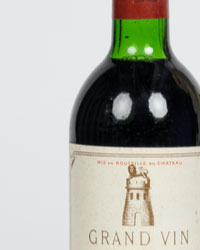
1979 Chateau Canon - Saint-Émilion 1er Grand Cru Classé B - 3 Bottles (0.75L)


08
days
07
hours
40
minutes
51
seconds
Current bid
€ 101
Reserve price not met

Expert
Selected by Patricia Verschelling
Holds WSET Level 3 and 4, Vinoloog degree; auction house wine expert since 2004.
Estimate € 250 - € 330
 | €101 | |
|---|---|---|
 | €63 | |
| €60 | |
Catawiki Buyer Protection
Your payment’s safe with us until you receive your object.View details
Trustpilot 4.4 | 146042 reviews
Rated Excellent on Trustpilot.
Three 0.75-litre bottles of Château Canon 1979 from Saint-Émilion, France.
AI-assisted summary
Description from the seller
Three bottles of Château Canon 1979.
Bottled at the estate.
Shipping via Fedex!
About the estate
Surrounded by other *Premiers Grands Crus Classés*—such as Belair, Magdelaine, Clos Fourtet, and Beauséjour—Château Canon is one of the oldest estates in Saint-Émilion. It takes its name from an 18th-century owner, Jacques Kanon (the "K" evolved into a "C" over the centuries). Located on the southwestern slope of the appellation, the vineyard sits on a diverse range of soils, including clay-limestone and sandy patches over a limestone subsoil. In 1996, the estate was purchased from the Fournier family—who had owned it since 1919—by the owners of the haute-couture house Chanel. This historic Saint-Émilion property expanded significantly in 2011 with the acquisition of 12.5 hectares from Château Matras, which adjoins the estate; this addition enabled the production of a second wine, Clos Canon. Through these restructurings, Cabernet Franc has come to play an increasingly prominent role in the blend, now accounting for 30% alongside Merlot.
Nicolas Audebert currently oversees operations as General Manager of the Chanel vineyards. The estate’s secrets include working the soil with horses, hand-harvesting, parcel-by-parcel vinification, manual *remontage* (pumping over) during fermentation, and aging for 18 to 20 months in French oak barrels. The freshness of the wines—even in hot vintages—is attributed to the limestone soil, which acts as a water reservoir. This highly regarded wine is defined by its elegance, charm, and lightness.
About the wine
Château Canon is an icon within its appellation, notably featuring a vineyard plot located within the village of Saint-Émilion itself. Its 34 hectares of vines grow on a limestone base veined with clay—an ideal environment for cultivating Merlot. Cabernet Franc is planted in the best-exposed plots, allowing it to reach full maturity. Naturally, the harvest is carried out entirely by hand.
As for vinification, the grapes from each plot are placed into vats separately—using gravity—to preserve the unique identity and characteristics of every parcel. The wine is then aged in French oak barrels for 18 to 20 months, depending on the vintage. This is followed by a process known as *soutirage à l'esquive* (racking via the bung hole)—a meticulous, labor-intensive technique used to separate the wine from its lees, tailored to the specific needs of each individual barrel and performed without the use of pumps.
The wines display a deep, dark hue. On the nose, they offer remarkable finesse, balancing notes of blackberry and blackcurrant with a very subtle touch of oak. On the palate, the tannins are rounded, refined, and elegant.
Château Canon is built to age for several decades. For a food pairing, venture off the beaten path and try it alongside a duck breast (*magret de canard*) served with blueberries.
Details
Vintage
1979
Producer, Name of wine
Chateau Canon
Classification
1er Grand Cru Classé B
Number of bottles
3
Bottle size
Bottles (0.75L)
Country
France
Region
Saint-Émilion
Grape varieties
Cabernet Franc, Cabernet Sauvignon, Merlot
Fill level
Bordeaux bottle type, base neck fill level
Capsule/cork condition
Slightly worn capsule
Critic score
86/100 points, Robert Parker
Label condition
Stained/written/torn or loose readable label
Sold by