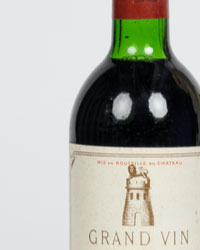
2019 Chateau Lafite Rothschild, Carruades de Lafite - Pauillac - 3 Magnum (1.5L)


08
days
00
hours
51
minutes
13
seconds
Starting bid
€ 1
Reserve price not met

Expert
Selected by Mattia Garon
Holds WSET Level 3 and court of master sommeliers qualifications, hospitality expert since 2009.
Estimate € 1,400 - € 1,600
No bids placed
Catawiki Buyer Protection
Your payment’s safe with us until you receive your object.View details
Trustpilot 4.4 | 146014 reviews
Rated Excellent on Trustpilot.
This lot comprises three 2019 magnums (1.5 L each) of Chateau Lafite Rothschild, Carruades de Lafite, from Pauillac, France.
AI-assisted summary
Description from the seller
Three magnums of 2019 Carruades de Lafite in a wooden case; in excellent condition.
Bottled at the estate.
Shipped via FedEx!
About the estate
The history of the Lafite vineyard dates back a long way. On an estate where vines were already growing, Jacques de Ségur organized the vineyard at the end of the 17th century, and the wine’s reputation was already well-established. His son, Alexandre, expanded the Château Lafite Rothschild estate by marrying the heiress to Latour in 1695. From this union came Nicolas-Alexandre, who, in the early 18th century, built the prestige and renown of Lafite—a wine highly sought after at Versailles and already popular across the English Channel. It became known as the "wine of kings," from the "prince of vines."
Following his death, Lafite passed through a succession of owners—it was even sold at auction after the French Revolution—yet its quality remained at the highest level, thanks to the care of its estate managers, the family of Joseph Goudal. Château Lafite was subsequently classified as a *Premier Cru* in 1855.
In 1868, Baron James de Rothschild acquired the estate—once again at auction—and it has remained in his family ever since. Beyond its exceptional *terroir* (deep gravel soils resting on marl and a limestone subsoil), the wine’s quality is due to the average age of the vines (over 40 years), low yields per hectare, and a rigorous selection process. During the 1960s and 1970s, the wines were of a lower standard, owing to less stringent management of the estate and the winemaking process. At the helm of the Rothschild group since 2018, Saskia de Rothschild represents the sixth generation to lead the estate. She is committed to upholding the spirit and quality of the property, continuing the legacy of her ancestors. Driven by a deep respect for the land and the fruit it yields, she acts as a guardian of the *terroir* and the natural environment. She has also expanded the Château’s portfolio by introducing a new label, Anseillan—the first such addition since the 19th century.
About the wine
The second wine of Château Lafite Rothschild rightly enjoys an excellent reputation. Its name is derived from the "plateau des Carruades"—the designation for the vineyard plots acquired in 1845 that lie adjacent to Château Lafite. The blend consists primarily of Cabernet Sauvignon (up to 70%, depending on the vintage), a significant proportion of Merlot (between 30% and 50%, depending on the vintage), and a small amount of Cabernet Franc and Petit Verdot. Aged for 18 to 20 months in barrels previously used for the preceding vintage of Château Lafite, the wine displays remarkable concentration and magnificent aromatic complexity. Highly tannic in its youth, it possesses an impressive structure that allows for long-term aging. In terms of quality, this wine surpasses many of the *Crus Classés* of the Médoc.
Details
Vintage
2019
Producer, Name of wine
Chateau Lafite Rothschild, Carruades de Lafite
Number of bottles
3
Bottle size
Magnum (1.5L)
Country
France
Region
Pauillac
Grape varieties
Cabernet Franc, Cabernet Sauvignon, Petit Verdot
Fill level
Bordeaux bottle type, neck fill level
Original packaging
In original wooden case
Capsule/cork condition
Fully intact metal capsule
Critic score
92/100 points, Robert Parker
Label condition
Fully intact, readable label
Sold by