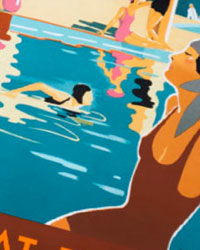
Marcel Wolff - Dehon & Cie (Valenciennes - Paris) - Poster Originale Butagaz-Propagaz - Litografia stile Mid-Century Modern - 1950s


03
days
02
hours
08
minutes
43
seconds
Current bid
€ 50
Reserve price not met

Expert
Selected by Juan Antonio Rodríguez
Eight years experience valuing posters, previously valuer at Balclis, Barcelona.
Estimate € 150 - € 200
 | €50 | |
|---|---|---|
| €4 | |
| €3 | |
Catawiki Buyer Protection
Your payment’s safe with us until you receive your object.View details
Trustpilot 4.4 | 145455 reviews
Rated Excellent on Trustpilot.
Description from the seller
This rare original vintage advertising poster on lithographed paper stands as an extraordinary and authentic testimony to French graphic design and late-1950s modernism. The work is printed on vintage billboard paper (papier affiche a grammatura medio-leggera), bearing the official signature on the left-hand side of the renowned illustrator Marcel Wolff and was printed by the prestigious Dehon & Cie printing house (with historic bases in Valenciennes and Paris), renowned in the postwar period for its superb lithographic quality and the handling of industrial colors. This particular poster was the centerpiece of a famous home-living campaign conceived by the energy giant Butagaz / Propagaz to revolutionize daily family life during the economic boom: the aim was to advertise the modern system of twin linked gas cylinders (“bouteilles jumelées... gaz sans arrêt”), a technological novelty that allowed automatic transfer from one empty cylinder to the other, ensuring a continuous and uninterrupted flow of gas for cooking and heating indoor spaces without the risk of running cold. The visual composition is a masterpiece of Mid-Century Modern aesthetics, featuring two stylized female figures with the geometry typical of the 1950s, framed by the famous slogan "Qu'il fait bon..." (How good it feels...) and by a masterful use of color contrast between the vibrant red background and the deep blue of the cylinders. From a conservation standpoint, the front of the poster has retained exceptional freshness and color vitality; as is natural for paper posters of their time, there are evident signs of wear along the outer margins, with creases, small tears, and some areas of missing paper extensively documented in the photographic set. The back of the poster is clean, free of writing or adhesive residues, showing only the physiological yellowing of the paper support and a few time-stains that certify its absolute originality. A collectible piece steeped in nostalgia and historical value, perfect for framing and becoming an exclusive interior decorative element for design interiors, retro kitchens, vintage workshops, or elite collections devoted to the history of the oil industry and 20th-century advertising.
This rare original vintage advertising poster on lithographed paper stands as an extraordinary and authentic testimony to French graphic design and late-1950s modernism. The work is printed on vintage billboard paper (papier affiche a grammatura medio-leggera), bearing the official signature on the left-hand side of the renowned illustrator Marcel Wolff and was printed by the prestigious Dehon & Cie printing house (with historic bases in Valenciennes and Paris), renowned in the postwar period for its superb lithographic quality and the handling of industrial colors. This particular poster was the centerpiece of a famous home-living campaign conceived by the energy giant Butagaz / Propagaz to revolutionize daily family life during the economic boom: the aim was to advertise the modern system of twin linked gas cylinders (“bouteilles jumelées... gaz sans arrêt”), a technological novelty that allowed automatic transfer from one empty cylinder to the other, ensuring a continuous and uninterrupted flow of gas for cooking and heating indoor spaces without the risk of running cold. The visual composition is a masterpiece of Mid-Century Modern aesthetics, featuring two stylized female figures with the geometry typical of the 1950s, framed by the famous slogan "Qu'il fait bon..." (How good it feels...) and by a masterful use of color contrast between the vibrant red background and the deep blue of the cylinders. From a conservation standpoint, the front of the poster has retained exceptional freshness and color vitality; as is natural for paper posters of their time, there are evident signs of wear along the outer margins, with creases, small tears, and some areas of missing paper extensively documented in the photographic set. The back of the poster is clean, free of writing or adhesive residues, showing only the physiological yellowing of the paper support and a few time-stains that certify its absolute originality. A collectible piece steeped in nostalgia and historical value, perfect for framing and becoming an exclusive interior decorative element for design interiors, retro kitchens, vintage workshops, or elite collections devoted to the history of the oil industry and 20th-century advertising.
Details
Era
1900-2000
Designer/artist
Marcel Wolff
Manufacturer/brand
Dehon & Cie (Valenciennes - Paris)
Poster title
Poster Originale Butagaz-Propagaz - Litografia stile Mid-Century Modern
Subject
Advertising
Estimated period
1950s
Country of origin
France
Condition
B+ (good - small imperfections)
Number of objects
1
Height
32 cm
Width
47 cm
Autographed by a famous person
No
Sold by