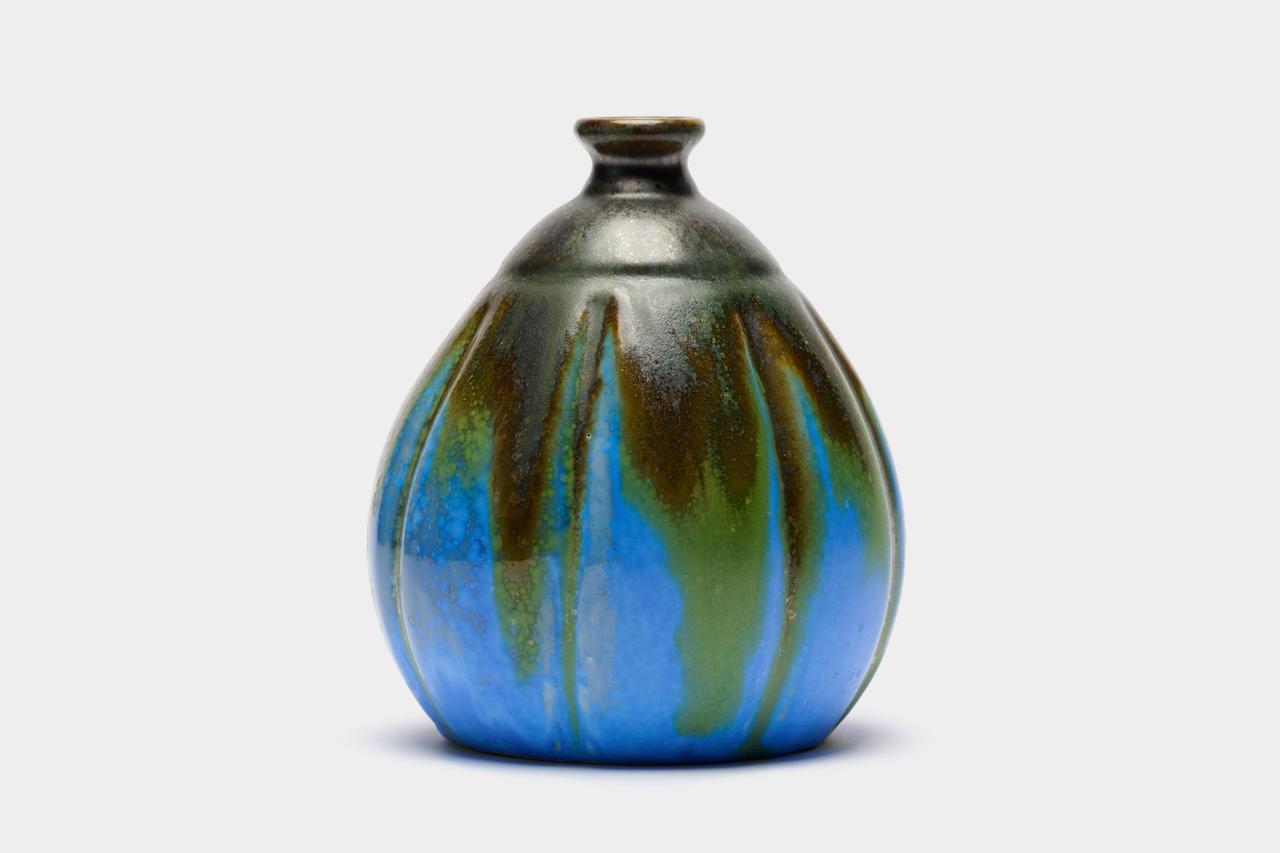
MANIFATTURA CALATINA XIX secolo maiolica craquelé - Vase - Ceramic


03
days
06
hours
55
minutes
26
seconds
Current bid
€ 20
No reserve price

Expert
Selected by Florentin Brunz Gaborieau
Holds a master’s in Art History, specialising in Second French Empire and Dutch Golden Age.
Estimate € 150 - € 200
 | €20 |
|---|
Catawiki Buyer Protection
Your payment’s safe with us until you receive your object.View details
Trustpilot 4.4 | 145776 reviews
Rated Excellent on Trustpilot.
Description from the seller
Artistic ceramic vase with craquelé glaze and distinctive twisted handles, linked to the style of Sicilian craftsmanship and, in particular, to the historic ceramic tradition of Caltagirone.
This type of artifact mirrors the classic shapes of Mediterranean amphorae and traditional apothecary vases, reinterpreting them through a light monochrome glaze, often in ivory or antique white tones. The surface is enriched by a dense network of glaze crazing, typical of the craquelé effect, while the prominent torchon-formed handles accentuate its plastic and decorative character.
Ceramics of Caltagirone
There is a place in Sicily where art is not only exhibited in museums, but is felt on the streets, adorning the facades of buildings and embellishing balconies. This place is Caltagirone, the "City of Ceramics," whose very name, derived from the Arabic Qal'at al-ghiran ("Rocca dei vasi"), reveals its deepest soul. The history of Calatine pottery is a fascinating tale, a thread of clay that unfurls for over two millennia, weaving together cultures, dominations, and renaissances.
Although clay-working in the area dates back to prehistoric and Greek times, it is with the arrival of the Arabs in the 9th century that Caltagirone experienced its first great artistic revolution. The Moors not only enhanced existing production techniques, but introduced a novelty that would change everything: tin glazes. This technique, which involved coating the artifact with a tin-based glaze, yielded a white, glossy surface perfect for decorating with vivid colors.
It was an explosion of creativity. Arab artisans introduced geometric motifs, phytomorphic (inspired by the plant world) designs, and calligraphic styles, together with the colors that still today define the Calatina palette: cobalt blue, copper green, and ochre yellow. This was the birth of Caltagirone maiolica.
The 18th and 19th centuries represent the peak of Calatina production. The great families of ceramists, such as the Bongiovanni and Vaccaro, reached exceptional levels of mastery. Production diversified: alongside tiles, large decorative amphorae, albarelli (apothecary jars), and figurative works gained prominence.
Being an antique object, an authentic vintage piece, it may show slight signs of time, altogether normal and characteristic of its history.
Product shipments are entrusted only to top couriers such as UPS, DHL and BRT, with guaranteed and insured delivery. Prices are publicly listed online.
NOTE**
Objects auctioned on Catawiki are subject to binding conditions for every bid. If a buyer does not make payment within three days of the auction end (or immediately via 'Buy It Now'), Catawiki may take action on their account. Specifically, it may suspend the ability to bid and purchase until payments owed are settled. Moreover, non-payment may result in the sale being canceled; in some cases, the buyer may still owe the Buyer Protection fee. Until account suspension of the Buyer.
Please note that, should a buyer win multiple lots, they will be required to pay the shipping for each lot separately to ensure the integrity of the material sent.
Seller's Story
Designers and textile-loving artisans present their creations: artworks, jewelry, furnishings, vintage clothing, experiments and other forms of textile expression. They also briefly share something about themselves and their work. A harmonious overview that brings color to a timeless moment.
Translated by Google TranslateArtistic ceramic vase with craquelé glaze and distinctive twisted handles, linked to the style of Sicilian craftsmanship and, in particular, to the historic ceramic tradition of Caltagirone.
This type of artifact mirrors the classic shapes of Mediterranean amphorae and traditional apothecary vases, reinterpreting them through a light monochrome glaze, often in ivory or antique white tones. The surface is enriched by a dense network of glaze crazing, typical of the craquelé effect, while the prominent torchon-formed handles accentuate its plastic and decorative character.
Ceramics of Caltagirone
There is a place in Sicily where art is not only exhibited in museums, but is felt on the streets, adorning the facades of buildings and embellishing balconies. This place is Caltagirone, the "City of Ceramics," whose very name, derived from the Arabic Qal'at al-ghiran ("Rocca dei vasi"), reveals its deepest soul. The history of Calatine pottery is a fascinating tale, a thread of clay that unfurls for over two millennia, weaving together cultures, dominations, and renaissances.
Although clay-working in the area dates back to prehistoric and Greek times, it is with the arrival of the Arabs in the 9th century that Caltagirone experienced its first great artistic revolution. The Moors not only enhanced existing production techniques, but introduced a novelty that would change everything: tin glazes. This technique, which involved coating the artifact with a tin-based glaze, yielded a white, glossy surface perfect for decorating with vivid colors.
It was an explosion of creativity. Arab artisans introduced geometric motifs, phytomorphic (inspired by the plant world) designs, and calligraphic styles, together with the colors that still today define the Calatina palette: cobalt blue, copper green, and ochre yellow. This was the birth of Caltagirone maiolica.
The 18th and 19th centuries represent the peak of Calatina production. The great families of ceramists, such as the Bongiovanni and Vaccaro, reached exceptional levels of mastery. Production diversified: alongside tiles, large decorative amphorae, albarelli (apothecary jars), and figurative works gained prominence.
Being an antique object, an authentic vintage piece, it may show slight signs of time, altogether normal and characteristic of its history.
Product shipments are entrusted only to top couriers such as UPS, DHL and BRT, with guaranteed and insured delivery. Prices are publicly listed online.
NOTE**
Objects auctioned on Catawiki are subject to binding conditions for every bid. If a buyer does not make payment within three days of the auction end (or immediately via 'Buy It Now'), Catawiki may take action on their account. Specifically, it may suspend the ability to bid and purchase until payments owed are settled. Moreover, non-payment may result in the sale being canceled; in some cases, the buyer may still owe the Buyer Protection fee. Until account suspension of the Buyer.
Please note that, should a buyer win multiple lots, they will be required to pay the shipping for each lot separately to ensure the integrity of the material sent.
Seller's Story
Designers and textile-loving artisans present their creations: artworks, jewelry, furnishings, vintage clothing, experiments and other forms of textile expression. They also briefly share something about themselves and their work. A harmonious overview that brings color to a timeless moment.
Translated by Google TranslateDetails
Era
1400-1900
Weight
2.2 kg
Country of origin
Italy
Material
Ceramic
Manufacturer/brand
MANIFATTURA CALATINA XIX secolo maiolica craquelé
Condition
Excellent condition: barely used with minimal signs of wear
Height
27 cm
Width
22 cm
Depth
13 cm
Estimated period
1850-1900
Sold by