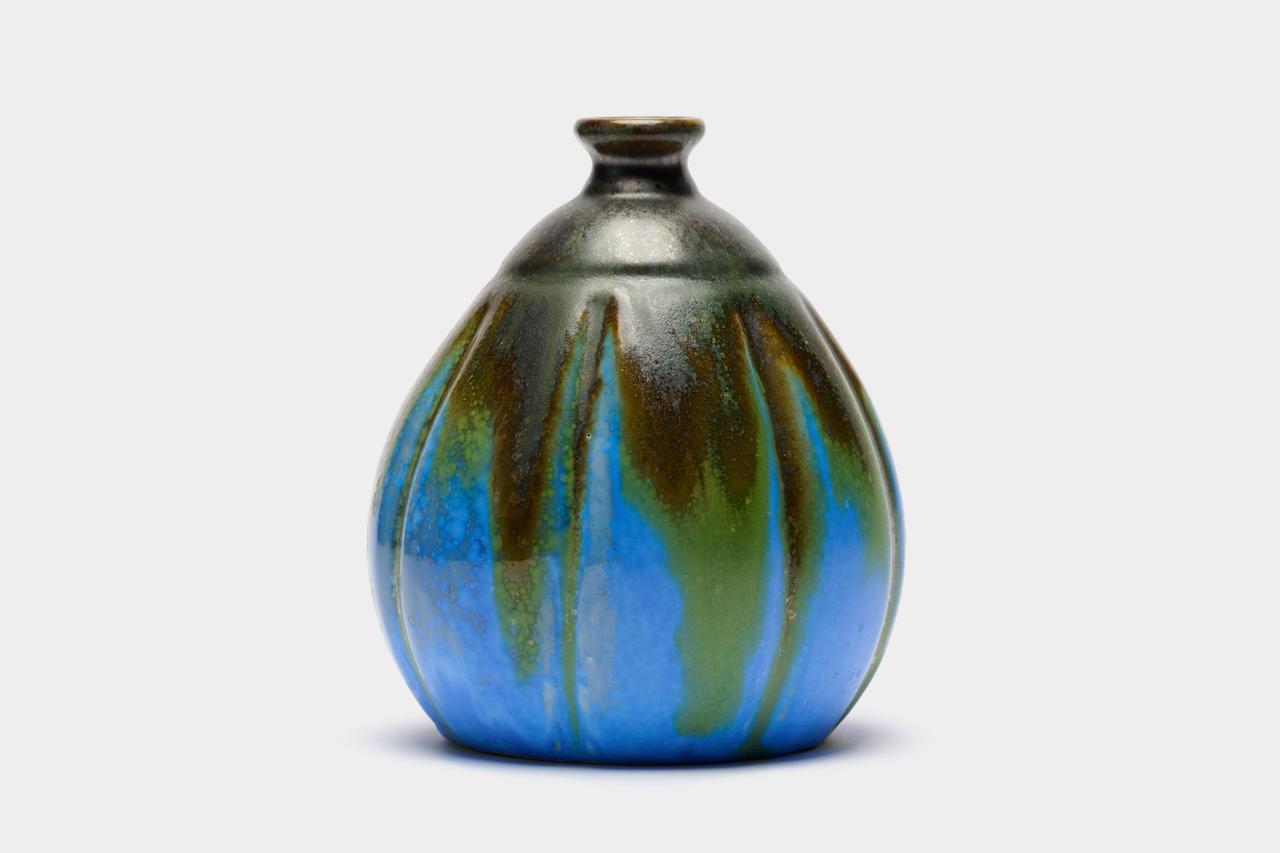
Vase - Crystal - SOMMERSO XXL - 26 cm


03
days
05
hours
45
minutes
37
seconds
Current bid
€ 40
No reserve price

Expert
Selected by Sophie Aziz
Graduate in Art History, with five years of professional experience in ceramics and glass.
Estimate € 130 - € 190
 | €40 | |
|---|---|---|
| €35 | |
 | €30 | |
Catawiki Buyer Protection
Your payment’s safe with us until you receive your object.View details
Trustpilot 4.4 | 146014 reviews
Rated Excellent on Trustpilot.
This 26.2 cm-tall, 1,600 g crystal vase in the Sommerso technique has layered blue and blue-grey glass, a faceted geometric form and a tiny scratch on the rim.
AI-assisted summary
Description from the seller
Exceptional large crystal vase made in the “Sommerso” technique, probably dating from the 1960s–1970s. This remarkable piece of art glass features a particularly deep chromatic composition, combining several shades of blue with a bluish-gray internal inclusion. Its slender silhouette and faceted geometric work lend it a strongly assertive modernist aesthetic, characteristic of Italian glassmaking in the mid-20th century.
Parallelepiped in form, the vase presents a thick mass of crystal with carefully faceted edges. Its decoration rests on a succession of oblique planes and longitudinal facets that frame a substantial central inclusion with rounded, elongated contours. The overlapping layers of deep blue and bluish-gray glass create transparency, depth, and refraction effects that are particularly striking depending on the light’s orientation. The crystal’s density is remarkable, as testified by its weight of 1,600 grams for a height of 26.2 centimeters and a width of 7.5 centimeters.
The piece is in exceptional condition, virtually like new. Only an infinitesimal scratch along the upper edge, on the order of a millimeter, is noticeable and hardly perceptible, with no impact on the vase’s overall presentation.
The “Sommerso” technique, literally “immersed” in Italian, is one of the most emblematic expressions of Murano glassmaking in the 20th century. It consists of stacking multiple layers of colored glass, typically by successive immersion into different molten glass masses, without the layers mixing. Particularly developed from the 1950s onward, this technique allowed Italian master glassmakers to explore new chromatic and sculptural possibilities. The geometric compositions, massive volumes, and colored inclusions of this piece fully evoke the modernist current and Italian design of the 1960s–1970s."} )} } ৰ} }}{}} }}}} }08:>
Details
Era
1900-2000
Weight
1600 g
Title additional information
SOMMERSO XXL - 26 cm
Number of objects
1
Country of origin
Europe
Material
Crystal
Style
Vintage
Colour
Blue, Grey, Transparent
Condition
As new - unused
Height
26.2 cm
Width
7.5 cm
Depth
26.2 cm
Diameter
7.5 cm
Estimated period
1960-1970
Sold by