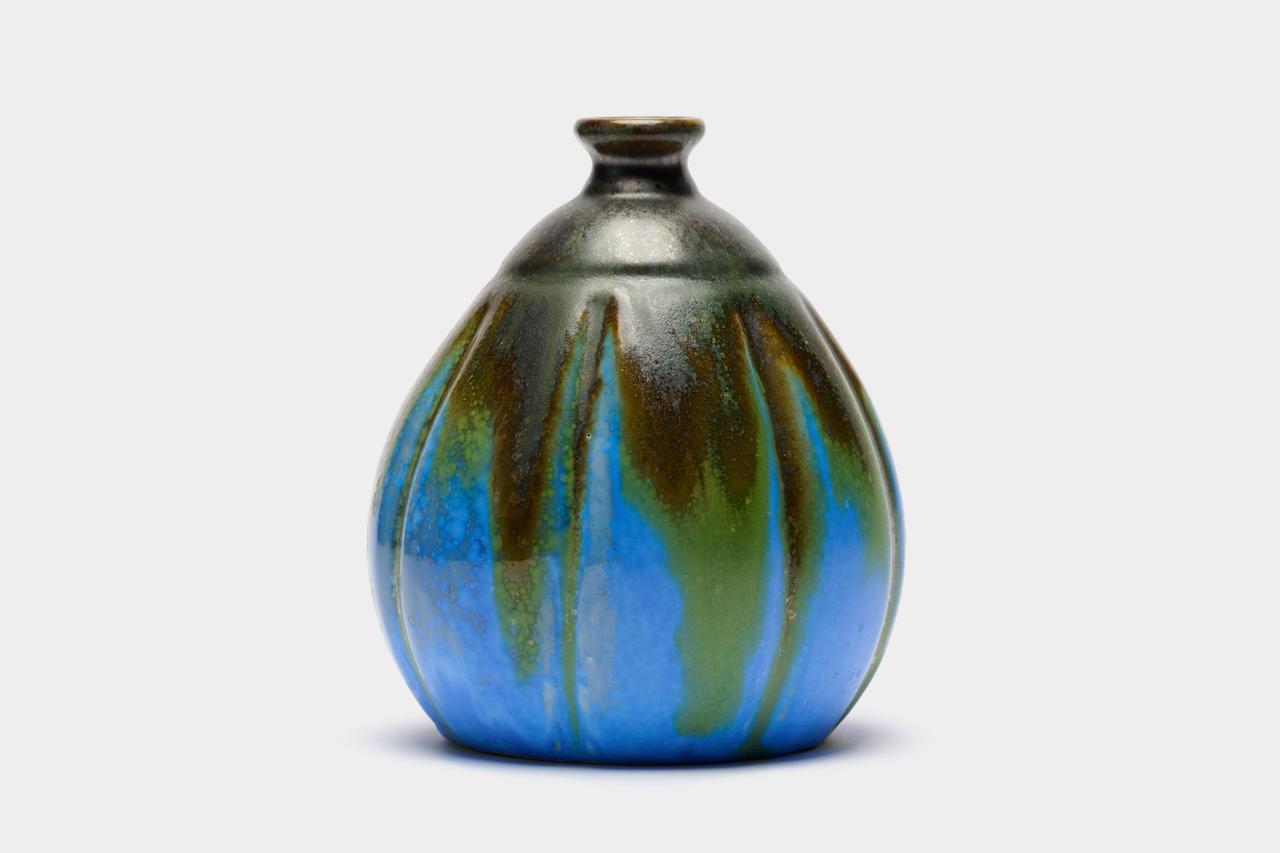
Waechtersbach - Vase - Dynamic MCM black-and-white decor, mandarin, turquoise • West Germany • circa 1950–1965 - Porcelain


05
days
11
hours
11
minutes
54
seconds

No bids placed
Catawiki Buyer Protection
Your payment’s safe with us until you receive your object.View details
Trustpilot 4.4 | 146042 reviews
Rated Excellent on Trustpilot.
This Waechtersbach mid-century modern porcelain vase, made in West Germany around 1950–1965, has a multicoloured black, orange and turquoise design, a gilt rim and measures 15.5 × 12 × 12 cm.
AI-assisted summary
Description from the seller
Swirls, curls, and dotted shapes drift around the rounded belly, until the eye comes to rest on a mandarin-orange and turquoise leaf. This is a surrealist black-and-white design from West Germany in the 1950s and early 1960s, in the spirit of Joan Miró. The linework is so fine that you can see the halftone dots, and a gilt rim finishes the mouth. This vase was made by Waechtersbach (Waechtersbacher Steingutfabrik); the crown mark is on the base.
Description:
A globular body with a short, wide-opening neck on an oval foot ring: the vase is oval when viewed from above, too. Black spirals, bows, little four-petaled flowers, and dotted teardrop shapes cover the entire surface. The black decoration is printed in a fine halftone pattern. The serrated leaf shapes are colored mandarin orange and turquoise. The interior is glazed in ivory, while the foot ring is unglazed, with a white ceramic body. Tapping the rim produces a high-pitched tone that resonates for a long time. The base bears the mark with a crown and striped shield.
About the maker:
Count Adolf zu Ysenburg und Büdingen founded Waechtersbacher Steingutfabrik in 1832 in Schlierbach, Hesse, using white clay from his family’s forest. From 1901, Christian Neureuther created Art Nouveau designs in an in-house art studio. Designer Ursula Fesca joined in 1931, bringing Bauhaus influences. From the 1960s, the decorative ceramics were also exported to America. The factory closed in 2011.
In an interior:
On a white sideboard in the soft light of evening, the mandarin-orange leaf shapes are the first thing to catch the eye.
Follow DECADERS Gallery by clicking the heart next to my name above: new pieces of West German pottery and interwar ceramics every week, and you’ll be the first to see them.
———
Condition:
Good. No chips, hairline cracks, or restorations observed on the rim, body, or foot. The gilding on the rim is intact. Foot ring: unglazed, with light soiling. Base: a small dark speck beside the mark. Interior: no flaws. See the images.
At a glance:
Material: porcelain, glossy glazed, with printed black line-and-halftone decoration, orange and turquoise color fields, and a gilt rim
Dimensions and weight: h 12 x w 15.5 x d 12 cm, 415 grams
Mark: Waechtersbach (Waechtersbacher Steingutfabrik), crown mark with striped shield and 'WAECHTERSBACH', with 'Made in West Germany' below, on the base
Date: circa 1950–1965
Provenance: from a private collection in Western Europe
Attribution and sources:
Marked Waechtersbach (Waechtersbacher Steingutfabrik): the name, crown, and shield appear on the base, along with 'Made in West Germany'. This country designation refers to the Federal Republic of Germany and was used after 1949; the maker is certain. The black halftone decoration and abstract design language are consistent with the postwar 1950s, hence the circa 1950–1965 date.
Shipping:
Professionally packed in a sturdy box with cushioning material; fragile items are double-boxed. Always shipped insured with Track & Trace. More than 1,100 reviews from previous buyers; see the feedback.
Seller's Story
Decaders Gallery
Region Eindhoven, Netherlands
Our passion lies in 20th-century applied art and design, with a particular focus on the periods Art Nouveau, Art Deco and Mid-Century Modern. But styles from the sixties, seventies, and later also capture our attention. Each decade has made a unique contribution to the art world, which perfectly reflects our name – Decaders Gallery.
Thanks to our love for art and design, we present new, exceptional decorative objects weekly. In addition, we have a broad interest in Asian art, antiques, and collectibles.
Our scavenges across Europe have led to a valuable network of like-minded enthusiasts who help us track down unique finds. This network has paid off: we are proud to have supplied artworks to renowned museums, including:
Museums & collections
Netherlands:
• CODA Museum, Apeldoorn
• Drents Museum, Assen
• National Textile Museum, Tilburg
• National Glass Museum, Leerdam
• Museum 'Amsterdam School' ('t Schip), Amsterdam
• PSV Football Museum, Eindhoven
• National War Museum, Overloon
Belgium:
• Musée de la Famenne, Marche-en-Famenne
• Museum of Natural Sciences, Belgium
Spain:
• Maritime Museum, Barcelona
---
We warmly invite you to visit our auctions with surprising artworks and to follow us on Instagram. Discover your favorite decade at Decaders Gallery!
Marc van der Heijden
Decaders Gallery, Netherlands.
Translated by Google TranslateSwirls, curls, and dotted shapes drift around the rounded belly, until the eye comes to rest on a mandarin-orange and turquoise leaf. This is a surrealist black-and-white design from West Germany in the 1950s and early 1960s, in the spirit of Joan Miró. The linework is so fine that you can see the halftone dots, and a gilt rim finishes the mouth. This vase was made by Waechtersbach (Waechtersbacher Steingutfabrik); the crown mark is on the base.
Description:
A globular body with a short, wide-opening neck on an oval foot ring: the vase is oval when viewed from above, too. Black spirals, bows, little four-petaled flowers, and dotted teardrop shapes cover the entire surface. The black decoration is printed in a fine halftone pattern. The serrated leaf shapes are colored mandarin orange and turquoise. The interior is glazed in ivory, while the foot ring is unglazed, with a white ceramic body. Tapping the rim produces a high-pitched tone that resonates for a long time. The base bears the mark with a crown and striped shield.
About the maker:
Count Adolf zu Ysenburg und Büdingen founded Waechtersbacher Steingutfabrik in 1832 in Schlierbach, Hesse, using white clay from his family’s forest. From 1901, Christian Neureuther created Art Nouveau designs in an in-house art studio. Designer Ursula Fesca joined in 1931, bringing Bauhaus influences. From the 1960s, the decorative ceramics were also exported to America. The factory closed in 2011.
In an interior:
On a white sideboard in the soft light of evening, the mandarin-orange leaf shapes are the first thing to catch the eye.
Follow DECADERS Gallery by clicking the heart next to my name above: new pieces of West German pottery and interwar ceramics every week, and you’ll be the first to see them.
———
Condition:
Good. No chips, hairline cracks, or restorations observed on the rim, body, or foot. The gilding on the rim is intact. Foot ring: unglazed, with light soiling. Base: a small dark speck beside the mark. Interior: no flaws. See the images.
At a glance:
Material: porcelain, glossy glazed, with printed black line-and-halftone decoration, orange and turquoise color fields, and a gilt rim
Dimensions and weight: h 12 x w 15.5 x d 12 cm, 415 grams
Mark: Waechtersbach (Waechtersbacher Steingutfabrik), crown mark with striped shield and 'WAECHTERSBACH', with 'Made in West Germany' below, on the base
Date: circa 1950–1965
Provenance: from a private collection in Western Europe
Attribution and sources:
Marked Waechtersbach (Waechtersbacher Steingutfabrik): the name, crown, and shield appear on the base, along with 'Made in West Germany'. This country designation refers to the Federal Republic of Germany and was used after 1949; the maker is certain. The black halftone decoration and abstract design language are consistent with the postwar 1950s, hence the circa 1950–1965 date.
Shipping:
Professionally packed in a sturdy box with cushioning material; fragile items are double-boxed. Always shipped insured with Track & Trace. More than 1,100 reviews from previous buyers; see the feedback.
Seller's Story
Decaders Gallery
Region Eindhoven, Netherlands
Our passion lies in 20th-century applied art and design, with a particular focus on the periods Art Nouveau, Art Deco and Mid-Century Modern. But styles from the sixties, seventies, and later also capture our attention. Each decade has made a unique contribution to the art world, which perfectly reflects our name – Decaders Gallery.
Thanks to our love for art and design, we present new, exceptional decorative objects weekly. In addition, we have a broad interest in Asian art, antiques, and collectibles.
Our scavenges across Europe have led to a valuable network of like-minded enthusiasts who help us track down unique finds. This network has paid off: we are proud to have supplied artworks to renowned museums, including:
Museums & collections
Netherlands:
• CODA Museum, Apeldoorn
• Drents Museum, Assen
• National Textile Museum, Tilburg
• National Glass Museum, Leerdam
• Museum 'Amsterdam School' ('t Schip), Amsterdam
• PSV Football Museum, Eindhoven
• National War Museum, Overloon
Belgium:
• Musée de la Famenne, Marche-en-Famenne
• Museum of Natural Sciences, Belgium
Spain:
• Maritime Museum, Barcelona
---
We warmly invite you to visit our auctions with surprising artworks and to follow us on Instagram. Discover your favorite decade at Decaders Gallery!
Marc van der Heijden
Decaders Gallery, Netherlands.
Translated by Google TranslateDetails
Era
1900-2000
Weight
415 g
Number of objects
1
Country of origin
Germany
Model
Dynamic MCM black-and-white decor, mandarin, turquoise • West Germany • circa 1950–1965
Material
Porcelain
Style
Mid-century modern
Manufacturer/brand
Waechtersbach
Colour
Multicolour
Condition
Good condition - used with small signs of aging & blemishes
Height
12 cm
Width
15.5 cm
Depth
12 cm
Estimated period
1950-1960, 1960-1970
Sold by