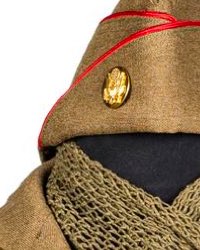
British East India - Military belt 106 Hazara Pioneers - ± 1905 - Military equipment


07
days
00
hours
33
minutes
07
seconds
Current bid
€ 10
Reserve price not met

Expert
Selected by Marcel van Hulst
Over 35 years trading and collecting militaria with deep industry knowledge.
Estimate € 350 - € 450
 | €10 | |
|---|---|---|
| €9 | |
| €8 | |
Catawiki Buyer Protection
Your payment’s safe with us until you receive your object.View details
Trustpilot 4.4 | 146014 reviews
Rated Excellent on Trustpilot.
An original leather and metal military belt of the 106th Hazara Pioneers, circa 1905, from British India, in very good condition.
AI-assisted summary
Description from the seller
he 106th Hazara Pioneers was a pioneer infantry regiment of the British Indian Army. They were formed in 1904 at Quetta from Hazara people. They were disbanded in 1933.
The 106th Hazara Pioneers were raised at Quetta in 1904 by Major C. W. Jacob; a nucleus was formed by drafts from the 124th Duchess of Connaught's own and the 126th Baluchistan Infantry. The Battalion was composed of eight companies of Hazaras, and their permanent peace station was at Quetta. Their full dress uniform was drab with red facings.
In 1918 the Hazaras of the 124th and the 126th Baluchistan Infantry were transferred to the 106 Hazara Pioneers, then on active service Mesopotamia. Prior to this, the Guides Cavalry had ceased to include Hazaras in their ranks. The 106th Hazara Pioneers were now the only unit in the Indian Army enlisting them.
There were two changes in the title of the regiment after the 1914-1918 war. The 106th Hazara Pioneers became "The 1st Battalion 4th Pioneers" in 1922 and the "The Hazara Pioneers" in 1929. As a result of the financial crisis in 1933, all Pioneer Regiments in the Indian Army, including the Hazaras Pioneers, were disbanded.
Details
Era
1900-2000
Army unit
Military belt 106 Hazara Pioneers - ± 1905
Country of origin
British East India
Material
Leather, Metal
Condition
Very good condition
Authenticity
Original/official
Brand
Military belt 106 Hazara Pioneers
Comes with certificate of authenticity
No
Sold by