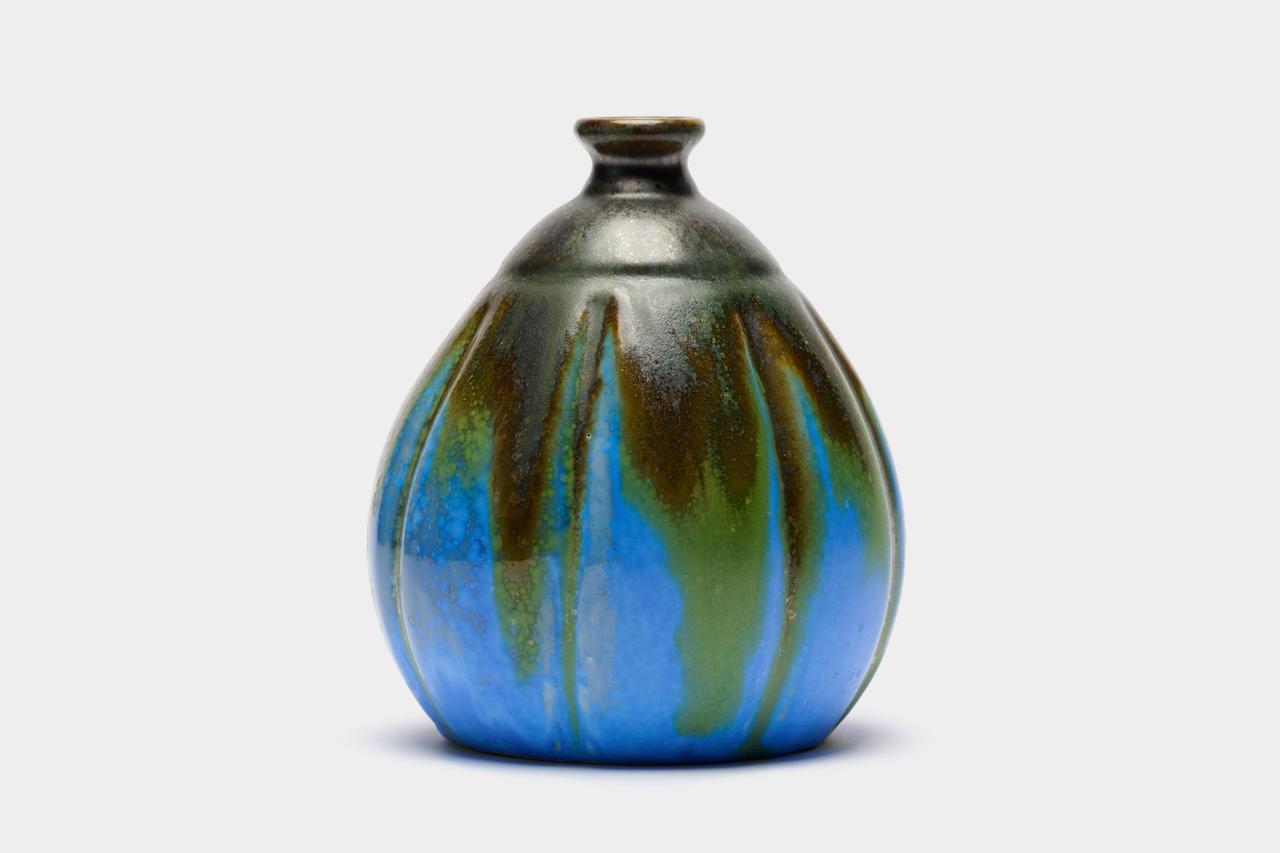
Grès de Bouffioulx - Jules Guérin - Vase - V30VF1 - Stoneware - XXL - 32cm


04
days
18
hours
50
minutes
24
seconds

 | €15 | |
|---|---|---|
| €10 | |
| €10 | |
Catawiki Buyer Protection
Your payment’s safe with us until you receive your object.View details
Trustpilot 4.4 | 146211 reviews
Rated Excellent on Trustpilot.
This multicoloured stoneware basket-shaped vase by Jules Guérin was made in Belgium around 1960–1970 and features raised carnival scenes, a curved handle and the model mark V30VF1; it measures 32.5 cm high and is unused.
AI-assisted summary
Description from the seller
Remarkable, this basket-shaped stoneware vase is a creation by Jules Guérin (1919–1999), a Belgian ceramicist and son of the celebrated potter Roger Guérin (1896–1954), an important figure in Belgian Art Deco ceramics. Heir to a family tradition deeply rooted in the production of Bouffioulx stoneware, Jules Guérin developed a personal style in which sculptural forms and narrative decoration hold a special place. This original piece, topped with a curved handle, features a relief decoration devoted to the carnival folklore of Belgium’s Centre region.
The body of the vase features several decorative relief panels depicting figures evocative of the Gilles, along with various architectural and ornamental elements. The compositions are enhanced with glazes in cream, brown, green, and bluish tones, contrasting with the darker parts of the handle and borders. The foot is embellished with a geometric pattern of colored diamonds, framed by twisted bands. The piece as a whole attests to particularly expressive modeling, with textural effects and reliefs harmoniously structuring the composition. The base also bears the inscription V30VF1, providing an additional identifying detail. The vase measures 32.5 cm high by 16 cm wide and weighs 1,650 grams.
The piece is in excellent condition, with no losses or notable structural defects. The reliefs and glazes are very well preserved, allowing the richness of the decoration and the palette’s varied nuances to be fully appreciated.
The decoration refers to a carnival tradition characteristic of several towns in the Centre region: the burning of the “humps.” This ritual, which symbolically takes place at the end of carnival festivities, is a distinctive feature of local folklore and differs in particular from the Binche tradition, where this practice does not exist. Jules Guérin thus carries on the legacy of his father, Roger Guérin, who helped bring renown to Bouffioulx ceramics. After his father’s death in 1954, Jules continued to keep this pottery tradition alive while developing his own creations. This work therefore represents a particularly compelling encounter between Belgian ceramic craftsmanship and regional folkloric heritage, making this decorative object an original testament to popular Walloon culture.
Details
Specific region of origin
Wallonie
Weight
1650 g
Era
1900-2000
Title additional information
XXL - 32cm
Number of objects
1
Country of origin
Belgium
Model
V30VF1
Designer/artist/maker
Jules Guérin
Material
Stoneware
Style
Design
Manufacturer/brand
Grès de Bouffioulx
Colour
Multicolour
Condition
As new - unused
Height
32.5 cm
Width
16 cm
Depth
32.5 cm
Diameter
16 cm
Estimated period
1960-1970
Sold by