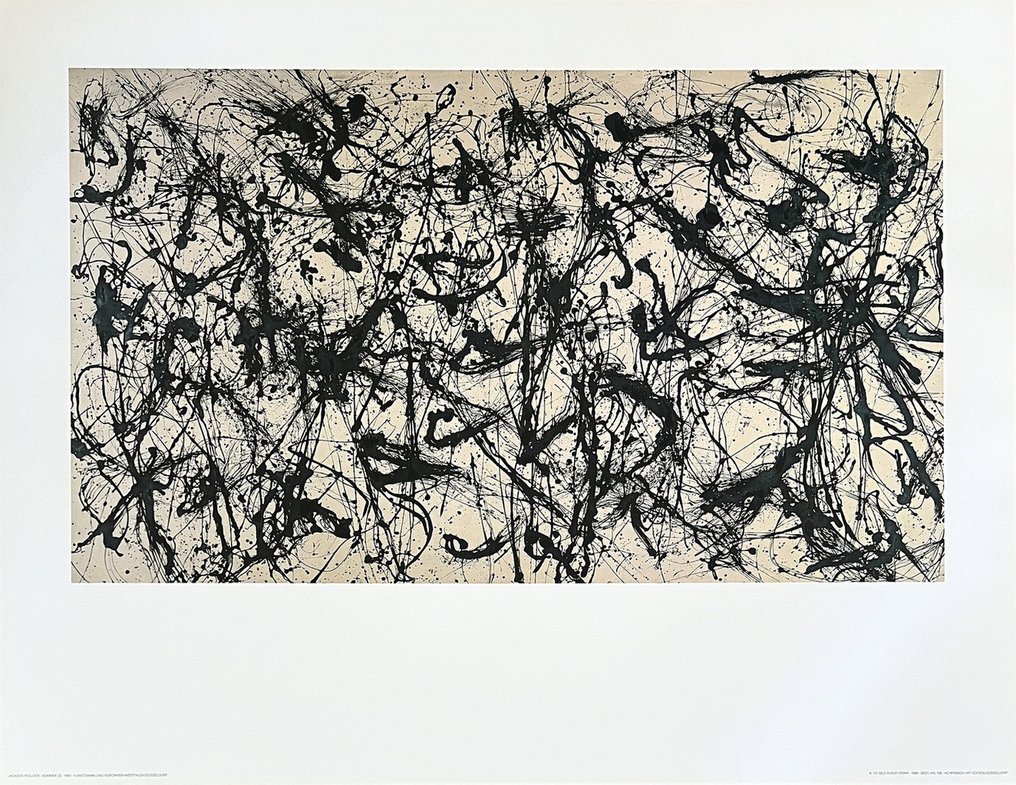
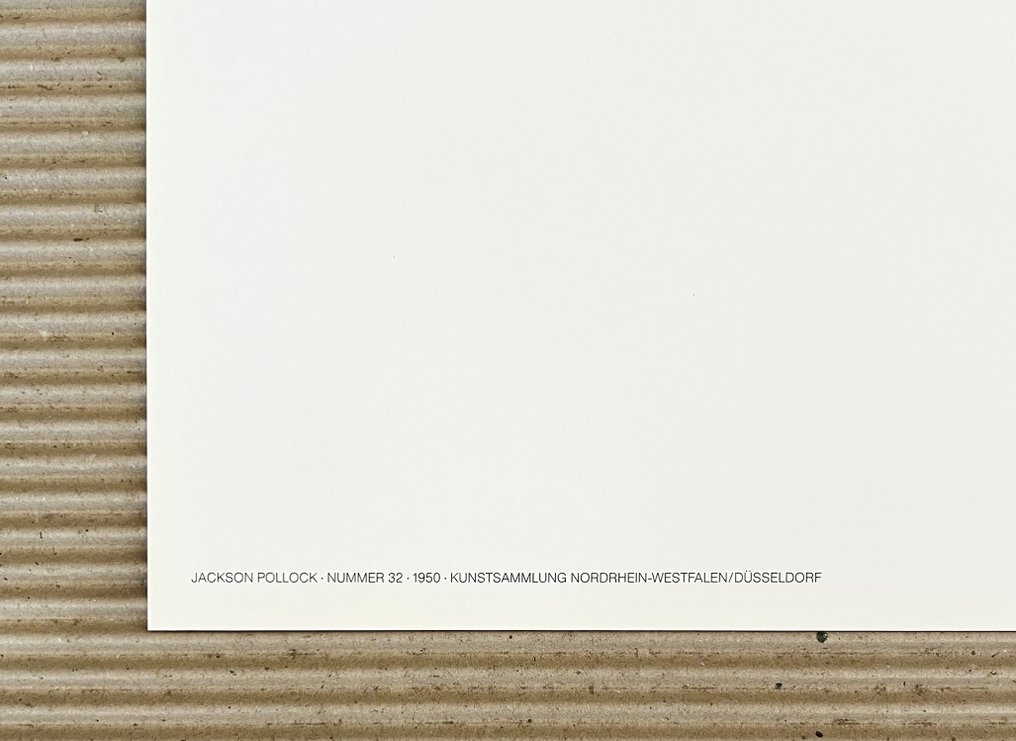
Jackson Pollock (after) - "Nummer 32" - nach Original von 1950



Starting bid
€ 1
Add to your favourites to get an alert when the auction starts.

Expert
Selected by Juan Antonio Rodríguez
Eight years experience valuing posters, previously valuer at Balclis, Barcelona.
Estimate € 150 - € 200
Catawiki Buyer Protection
Your payment’s safe with us until you receive your object.View details
Trustpilot 4.4 | 146042 reviews
Rated Excellent on Trustpilot.
Description from the seller
Reproduction of the work “Number 32,” created in 1950 by Jackson Pollock
Original: enamel paint on canvas, 269 x 457.5 cm
Copyright: Bild Kunst/Bonn
Artist: Jackson Pollock* (born January 28, 1912, in Cody, USA; died August 11, 1956, in New York, United States)
Printing technique: color offset lithograph
Printing medium: lightweight card (300 gsm)
Original artwork: in the North Rhine-Westphalia Art Collection, Düsseldorf
Sheet dimensions: 70.0 x 90.0 cm
Image dimensions: 45.5 x 77.0 cm
Publisher: Achenbach Art Edition - Düsseldorf 1990
Condition: excellent
The artwork has been carefully stored in a flat-file cabinet, protected from dust and UV light. It is therefore in excellent condition. This color offset lithograph has, of course, never been framed.
Shipping will be carried out with great care, using completely professional packaging that provides the greatest possible protection against any damage. The parcel is also insured against damage and loss at no cost to the buyer.
(*) Paul Jackson Pollock (born January 28, 1912, in Cody, Wyoming; died August 11, 1956, in East Hampton, New York), the founding father and grand master of Action Painting, is unquestionably one of the most important artists of the postwar era. From 1925 to 1929, he attended Manual Arts School in Los Angeles. In 1930, he moved to New York and studied painting at the Art Students League under Thomas Hart Benton. During the 1930s, he engaged with the Mexican muralists José Clemente Orozco and Diego Rivera. From 1938 to 1942, he painted murals for the Federal Art Project of the Works Progress Administration. In 1942, he took part in the International Surrealist Exhibition. In addition to the New York Surrealist group, he was also in contact with artists such as Willem de Kooning and Robert Motherwell. In 1943, Pollock had his first solo exhibition at Peggy Guggenheim’s gallery, Art of this Century. Soon afterward, he began creating his “Drip Paintings,” in which he poured, flung, or dripped paint onto canvases. Numerous solo and group exhibitions followed across the United States and Europe. He became a central figure of Abstract Expressionism. Pollock struggled with alcohol addiction throughout his life and underwent therapy several times. In 1956, he died in a car accident in East Hampton.
Works by Jackson Pollock, one of the most important artists of the past century, can be found in prestigious museums around the world, including the Art Institute of Chicago, the British Museum and Tate Gallery in London, the Centre Pompidou in Paris, Museum Folkwang in Essen, the National Museum of Western Art in Tokyo, and the Tel Aviv Museum of Art.
About the artwork:
“Number 32, 1950” is among the most radical pictorial innovations not only in Jackson Pollock’s work, but in American Abstract Expressionist art as a whole. It stands as a paradigm of the New York School’s break from European art history and of the articulation of a new American self-confidence in art after the Second World War. “Number 32, 1950” represents a summation and intensification of his art since the end of 1947.
Details
Era
1900-2000
Designer/artist
Jackson Pollock (after)
Poster title
"Nummer 32" - nach Original von 1950
Country of origin
Germany
Condition
A (excellent - mint condition)
Number of objects
1
Height
70 cm
Width
90 cm
Sold by