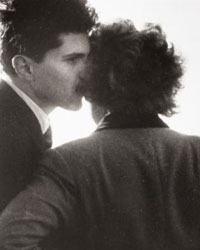
Weegee (1899–1968) - Barbara Streisand


09
days
01
hour
08
minutes
28
seconds
Starting bid
€ 1
No reserve price

Expert
Selected by Kai Brückner
Over 35 years' experience; former gallery owner and Museum Folkwang curator.
Estimate € 400 - € 500
No bids placed
Catawiki Buyer Protection
Your payment’s safe with us until you receive your object.View details
Trustpilot 4.4 | 146353 reviews
Rated Excellent on Trustpilot.
Weegee’s portrait of Barbara Streisand is a stamped gelatin-silver print measuring 25 × 20.5 cm.
AI-assisted summary
Description from the seller
WEEGEE – BARBRA STREISAND
Print 1980's
The specific original photograph of Barbra Streisand is not individually documented in standard archival databases (such as those of the ICP or Getty Images); however, it can be identified with reasonable precision based on visual features present in Weegee’s distorted version (*Distorted Barbara*, c. 1964–1968):
1. Source of the original image: As with most of his later distortions, Weegee did not take a new, live portrait for this piece. Instead, he utilized an existing press or studio photograph—a so-called "copy negative"—which he then optically distorted in his New York darkroom using curved glass, lenses, or kaleidoscopic attachments. [1, 2]
2. Visual characteristics of the original subject: In the version featured by Getty Images and *The Guardian* (*Distorted Barbara*, c. 1960s), Streisand wears her signature 1960s pageboy-style bob with short bangs; her hand is positioned near her mouth or chin, and she is looking slightly off to the side. [1, 2]
3. Dating the original image: This look—a short bob with bangs and heavy eyeliner—dates from her early Broadway and *Funny Girl* era, between 1963 and 1965 (it was frequently used for publicity portraits for Columbia Records or in connection with her early television appearances).
The famous photojournalist Arthur Fellig, known as Weegee, did not live at a "451 W." address on 44th Street, but rather lived and operated out of an apartment at 451 West 47th Street in New York City.
While his most famous, iconic tabloid work from the 1930s and 1940s was based out of his room at 5 Center Market Place (right across from New York's Police Headquarters), he later used the 451 West 47th Street address (complete with his telephone number, Columbus 5-1955 or 265-1955) as his contact and studio stamp on the back of his prints during his later career in the 1950s and 1960s after returning from Hollywood.
Details
Date of print
19
Artist
Weegee (1899–1968)
Sold by
Owner or reseller
Title of artwork
Barbara Streisand
Condition
Good condition
Technique
Gelatin-silver print
Height
25 cm
Edition
1
Width
20.5 cm
Signature
Stamped
Genre
Portrait
Sold by