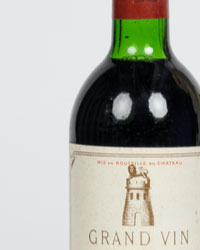
2018 Chateau Lafite Rothschild, Carruades de Lafite - Pauillac - 6 Bottles (0.75L)


09
days
08
hours
37
minutes
55
seconds
Starting bid
€ 1
Reserve price not met

Expert
Selected by Mattia Garon
Holds WSET Level 3 and court of master sommeliers qualifications, hospitality expert since 2009.
Estimate € 1,100 - € 1,400
No bids placed
Catawiki Buyer Protection
Your payment’s safe with us until you receive your object.View details
Trustpilot 4.4 | 146424 reviews
Rated Excellent on Trustpilot.
This lot comprises six 0.75-litre bottles of Chateau Lafite Rothschild Carruades de Lafite 2018 from Pauillac, presented in the original wooden case.
AI-assisted summary
Description from the seller
Six Bottles of 2018 Carruades de Lafite in a wooden case; label and capsule in excellent condition.
Bottled at the estate.
Ships via FedEx!
About the estate
The history of the Lafite vineyard stretches back a long way. On an estate where vines were already growing, Jacques de Ségur organized the vineyard at the end of the 17th century, and the wine had already established a strong reputation. His son, Alexandre, expanded the Château Lafite Rothschild estate by marrying the heiress to Latour in 1695. Their son, Nicolas-Alexandre, built Lafite’s prestige and renown in the early 18th century—the wine was highly acclaimed at Versailles and even across the English Channel. It became known as the “wine of kings,” the “prince of vines.”
After his death, Lafite passed through a succession of owners—it was even sold at auction after the French Revolution—yet its quality remained at the highest level thanks to the care of its managers, the family of Joseph Goudal. Château Lafite was subsequently classified as a *Premier Cru* in 1855.
In 1868, Baron James de Rothschild acquired the estate—once again at auction—and it has remained in his family’s possession ever since. Beyond its exceptional *terroir* (deep gravelly soil over marl and limestone subsoil), the wine’s quality is due to the average age of the vines (over 40 years), low yields per hectare, and a very rigorous selection process. During the 1960s and 1970s, the wines were of lower quality because the estate and winemaking process were managed less stringently. At the helm of the Rothschild group since 2018, Saskia de Rothschild is the sixth generation to lead the estate. She is committed to upholding the property’s spirit and quality, continuing her ancestors’ legacy. Guided by deep respect for the land and its fruit, she acts as a guardian of the *terroir* and the natural environment. She has also expanded the Château’s portfolio by introducing a new label, Anseillan—the first such addition since the 19th century.
About the wine
The second wine of Château Lafite Rothschild rightly enjoys an excellent reputation. Its name comes from the “plateau des Carruades,” referring to vineyard plots acquired in 1845 that lie adjacent to Château Lafite. The blend consists primarily of Cabernet Sauvignon (up to 70%, depending on the vintage), a significant proportion of Merlot (between 30% and 50%, depending on the vintage), and a small amount of Cabernet Franc and Petit Verdot. Aged for 18 to 20 months in barrels previously used for the preceding vintage of Château Lafite, the wine displays remarkable concentration and magnificent aromatic complexity. Highly tannic in its youth, it has an impressive structure that allows it to age for a long time. In terms of quality, this wine surpasses many of the *Crus Classés* of the Médoc.
Details
Vintage
2018
Producer, Name of wine
Chateau Lafite Rothschild, Carruades de Lafite
Number of bottles
6
Bottle size
Bottles (0.75L)
Country
France
Region
Pauillac
Grape varieties
Cabernet Franc, Cabernet Sauvignon, Petit Verdot
Fill level
Bordeaux bottle type, neck fill level
Original packaging
In original wooden case
Capsule/cork condition
Fully intact metal capsule
Critic score
94/100 points, Robert Parker
Label condition
Fully intact, readable label
Sold by