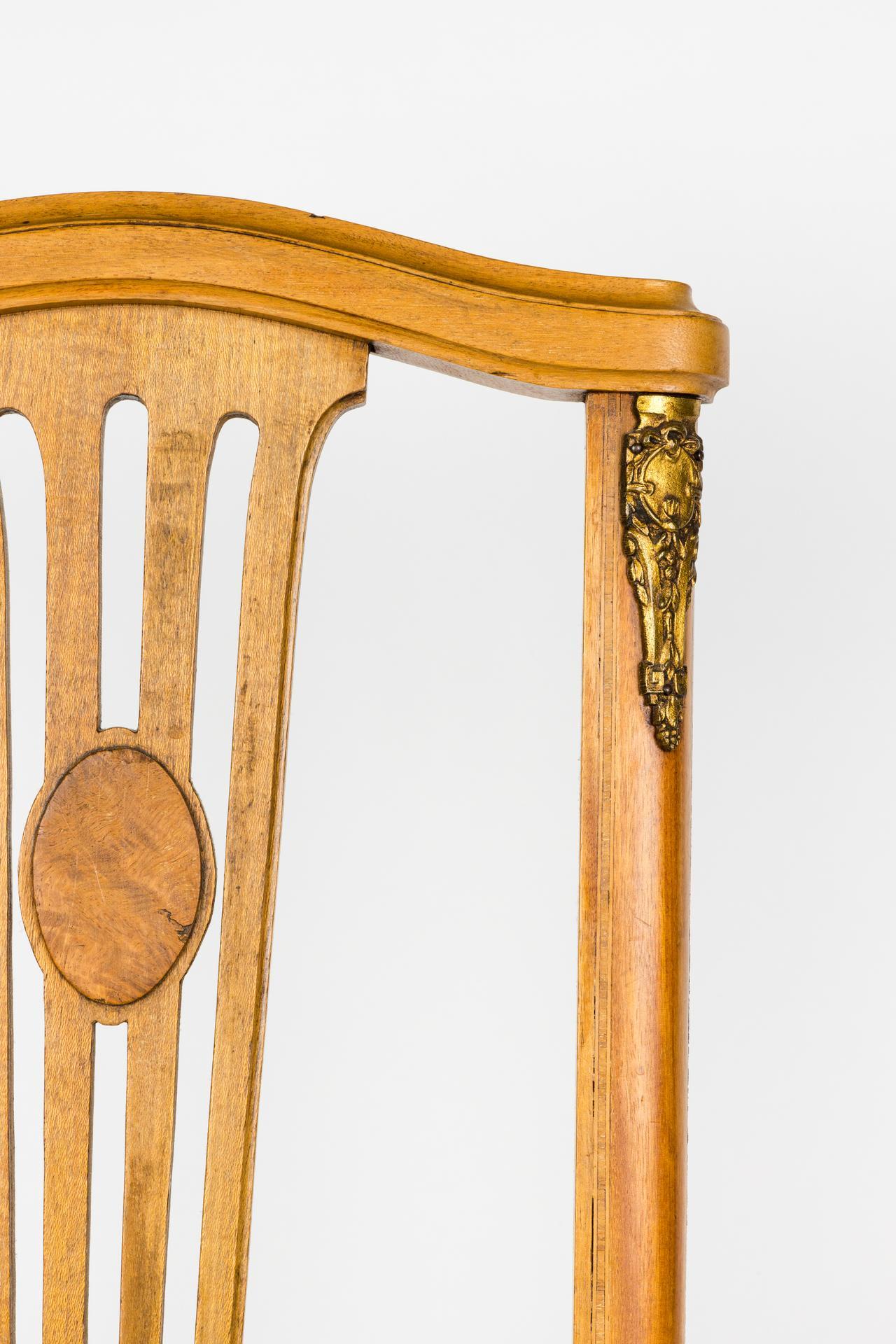
Console table - Wood - Early 20th-century Venetian


10
days
22
hours
33
minutes
43
seconds
Current bid
€ 1
Reserve price not met

Expert
Selected by Paul Wullems
He accumulated 18 years' experience, worked as junior specialist at Sotheby’s and managed Kunsthandel Jacques Fijnaut.
Estimate € 550 - € 650
 | €1 |
|---|
Catawiki Buyer Protection
Your payment’s safe with us until you receive your object.View details
Trustpilot 4.4 | 146211 reviews
Rated Excellent on Trustpilot.
A 1900–1910 Italian wooden console table in Venetian Neoclassical style, with ivory-coloured lacquer and carved, gilded details.
AI-assisted summary
Description from the seller
Beautiful early 20th-century table/console in the Venetian Neoclassical (or Louis XVI) style, made of ivory/cream-lacquered wood with carved and gilded details. Its straight lines, slender proportions and symmetrical decorations evoke the Italian Neoclassical aesthetic of the late 18th and early 19th centuries, as seen in later Louis XVI-style reproductions. It has four tapered square-section legs (in the form of inverted truncated pyramids), with vertical fluting finished in gold. The legs are joined at the bottom by an H-shaped (or rectangular) perimeter stretcher that provides stability. The central apron is embellished with a raised carved frieze featuring gilded floral and scrolling foliage motifs, framed by a moulded rope-pattern border. At the four corners, above the legs, are square panels with gilded rosettes (paterae). The rectangular wooden top has a shaped edge and a gently aged patina, with small areas of paint loss revealing the underlying ground. In good condition; only conservational restoration has been carried out, with old woodworm holes filled with wax. A rare piece that can complement any interior, whether classic or modern, thanks to its compact dimensions and understated, elegant lines.
Beautiful early 20th-century table/console in the Venetian Neoclassical (or Louis XVI) style, made of ivory/cream-lacquered wood with carved and gilded details. Its straight lines, slender proportions and symmetrical decorations evoke the Italian Neoclassical aesthetic of the late 18th and early 19th centuries, as seen in later Louis XVI-style reproductions. It has four tapered square-section legs (in the form of inverted truncated pyramids), with vertical fluting finished in gold. The legs are joined at the bottom by an H-shaped (or rectangular) perimeter stretcher that provides stability. The central apron is embellished with a raised carved frieze featuring gilded floral and scrolling foliage motifs, framed by a moulded rope-pattern border. At the four corners, above the legs, are square panels with gilded rosettes (paterae). The rectangular wooden top has a shaped edge and a gently aged patina, with small areas of paint loss revealing the underlying ground. In good condition; only conservational restoration has been carried out, with old woodworm holes filled with wax. A rare piece that can complement any interior, whether classic or modern, thanks to its compact dimensions and understated, elegant lines.
Details
Era
1900-2000
Weight
7 kg
Style subtype
Neoclassical Style
Title additional information
Early 20th-century Venetian
Number of objects
1
Country of origin
Italy
Material
Wood
Style
Antique
Condition
Good condition - used with small signs of aging & blemishes
Height
96 cm
Width
71 cm
Depth
30 cm
Estimated period
1900-1910