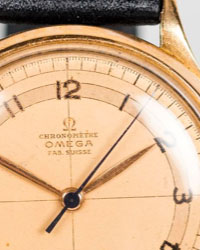
orologio da taschino - 10224 - 1850-1900


02
days
17
hours
38
minutes
10
seconds
Current bid
€ 300
Reserve price met

Expert
Selected by Mauro Atienza
Graduated master watchmaker with over 30 years' experience and teaching background.
Estimate € 400 - € 450
 | €300 | |
|---|---|---|
 | €280 | |
| €160 | |
Catawiki Buyer Protection
Your payment’s safe with us until you receive your object.View details
Trustpilot 4.4 | 142317 reviews
Rated Excellent on Trustpilot.
Pocket watch branded orologio da taschino, reference 10224, dating from 1850–1900, with a manual winding movement.
AI-assisted summary
Description from the seller
Outer case: 14-karat yellow gold (585/1000 fineness), certified by the official Swiss hallmark of the “squirrel” and by the “14C” mark. Inner cover (Cuvette) and pins: common/ Copper metal (as indicated by the official stamp “CUIVRE” [Copper]). Chain and Key: Metal (the key is brass/metal gilded).
Inside the gold back (beside the serial number) you can clearly see very fine hand-engraved markings (including “3047” and other, less legible initials). At the time, master watchmakers would engrave these markings with a pointed tool every time the watch underwent maintenance or repair. There is no legible maker’s signature, which is completely normal for this type of late 19th-century Swiss watches.
The outer gold case is in excellent condition; the splendid floral engravings on the back are sharp and not worn by time. The metal inner cuvette and the interior of the back show micro-scratches and wear lines (visible in close-up photos), due to the historic rubbing of the winding key during winding operations and past maintenance work. There are no deep dents, cracks in the dial, or structural damage.
Outer case: 14-karat yellow gold (585/1000 fineness), certified by the official Swiss hallmark of the “squirrel” and by the “14C” mark. Inner cover (Cuvette) and pins: common/ Copper metal (as indicated by the official stamp “CUIVRE” [Copper]). Chain and Key: Metal (the key is brass/metal gilded).
Inside the gold back (beside the serial number) you can clearly see very fine hand-engraved markings (including “3047” and other, less legible initials). At the time, master watchmakers would engrave these markings with a pointed tool every time the watch underwent maintenance or repair. There is no legible maker’s signature, which is completely normal for this type of late 19th-century Swiss watches.
The outer gold case is in excellent condition; the splendid floral engravings on the back are sharp and not worn by time. The metal inner cuvette and the interior of the back show micro-scratches and wear lines (visible in close-up photos), due to the historic rubbing of the winding key during winding operations and past maintenance work. There are no deep dents, cracks in the dial, or structural damage.
Details
Brand
orologio da taschino
Reference number
10224
Shipped insured
Yes
Period
1850-1900
Movement
Manual winding
Case material
gold
Case diameter
30 mm
Condition
Good - visible signs of wear
Weight
22 g
Width lug/ watch band
30 cm
In working order
Yes
Sold by