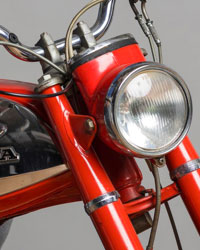
NSU - Supermax - 250 cc - 1957


With 15 years' trade experience, he has written extensively for moped magazines.
| €150 | ||
|---|---|---|
| €140 | ||
| €130 | ||
Catawiki Buyer Protection
Your payment’s safe with us until you receive your object.View details
Trustpilot 4.4 | 125857 reviews
Rated Excellent on Trustpilot.
NSU Supermax, 247 cc OHV, first registered in 1957, in good condition, located in the Netherlands, with Dutch registration papers, 26,664 km on the odometer, frame no. 3229907 and engine no. 1836241, CoC present: No.
Description from the seller
NSU 1957 251 OSB Supermax 247 cc OHC frame # 3229907 engine # 1836241
The machine we present here is an older restoration in very unspoiled condition. She is in working condition but has been unused for quite a number of years and will benefit from a thorough checkup.
Transport can be arranged at cost.
Production at NSU was already resumed in May 1945. The company was fortunate that only part of the production facilities had been damaged, and the American occupiers immediately designated the works as a repair facility for US army vehicles. Initially, bicycles, Kettenkrad off-road vehicles, and Quick motorized bicycles were produced, and from the summer of 1947, the pre-war 125 ZDB and 251 OSL models left the factory again. The chief designer became Albert Roder; he had worked with NSU under Walter Moore in the thirties but had left to become head of the design department at Victoria in Nuremberg in 1939. The Allies had imposed strict rules for motorcycle production in post-war Germany; only light machines were to be designed and produced. Roder designed a 98cc OHV machine with a pressed steel frame and forks. This new 'Fox' also featured pressed steel swingarm, front and rear suspension, and produced 6 HP at 6,000 rpm. The machine weighed only 85 kg and was comfortable to ride due to its good suspension and comfortable Pagusa saddle. In 1952, a new creation of Albert Roder was marketed, the 'Max 251 OSB,' where 251 stood for 250 cc single-cylinder and OSB for Obengesteuertes (OHV) Sport Blockmotor (unit engine). The Max series would be produced in various configurations until 1963.
The Max was a non-conformist but very modern design with its sheet metal rolling chassis. The short-stroke 69 x 66 engine had an overhead camshaft driven by a very clever system with reciprocating rods, developed by Albert Roder. The rear suspension was implemented using a cantilever system, which was replaced by a more conventional swingarm with shocks in 1956 when the 'Supermax' was introduced.
NSU 1957 251 OSB Supermax 247 cc OHC frame # 3229907 engine # 1836241
The machine we present here is an older restoration in very unspoiled condition. She is in working condition but has been unused for quite a number of years and will benefit from a thorough checkup.
Transport can be arranged at cost.
Production at NSU was already resumed in May 1945. The company was fortunate that only part of the production facilities had been damaged, and the American occupiers immediately designated the works as a repair facility for US army vehicles. Initially, bicycles, Kettenkrad off-road vehicles, and Quick motorized bicycles were produced, and from the summer of 1947, the pre-war 125 ZDB and 251 OSL models left the factory again. The chief designer became Albert Roder; he had worked with NSU under Walter Moore in the thirties but had left to become head of the design department at Victoria in Nuremberg in 1939. The Allies had imposed strict rules for motorcycle production in post-war Germany; only light machines were to be designed and produced. Roder designed a 98cc OHV machine with a pressed steel frame and forks. This new 'Fox' also featured pressed steel swingarm, front and rear suspension, and produced 6 HP at 6,000 rpm. The machine weighed only 85 kg and was comfortable to ride due to its good suspension and comfortable Pagusa saddle. In 1952, a new creation of Albert Roder was marketed, the 'Max 251 OSB,' where 251 stood for 250 cc single-cylinder and OSB for Obengesteuertes (OHV) Sport Blockmotor (unit engine). The Max series would be produced in various configurations until 1963.
The Max was a non-conformist but very modern design with its sheet metal rolling chassis. The short-stroke 69 x 66 engine had an overhead camshaft driven by a very clever system with reciprocating rods, developed by Albert Roder. The rear suspension was implemented using a cantilever system, which was replaced by a more conventional swingarm with shocks in 1956 when the 'Supermax' was introduced.
Details
Disclaimer
Catawiki always aims to offer you the best possible buying experience. Our experts virtually review and select every vehicle in line with our submission guidelines and we require our sellers to provide the most accurate description of the vehicle. However, providing a fully detailed analysis of the vehicle is extremely difficult, and close to impossible. To guide you, we ask our sellers to provide information about the vehicle’s condition. Please consider that most vehicles for sale are classic vehicles and they often already have a whole life behind them, meaning that even a condition 1 or 2 vehicle might need maintenance to be ready for the road. It is advised to carefully read our submission guidelines that further describe details about the condition grades and types to manage your expectations. Cars are sold “as is”, meaning as described and in the condition they are in at the time of the sale and without any representation, warranty or assumption of liability of any kind as to the condition by Catawiki or by the seller. The condition of this item is the opinion of the seller and may differ from yours, your local garage, or the dealer’s opinion. This does not automatically mean the car does not conform to its description. Before bidding, please check your local legislation regarding vehicle registration. Neither the seller nor Catawiki is responsible for the registration of the vehicle in your country and will not accept a cancellation for your failure to register the vehicle. We also recommend that, if possible, you arrange a viewing with the seller before placing a bid.