Valencian School (XX) - The dance of the peasants




05
days
19
hours
34
minutes
39
seconds

8 other people are watching this object
 Bidder 3030 Bidder 3030 | €2 |
|---|
Catawiki Buyer Protection
Your payment’s safe with us until you receive your object.View details
Trustpilot 4.4 | 122115 reviews
Rated Excellent on Trustpilot.
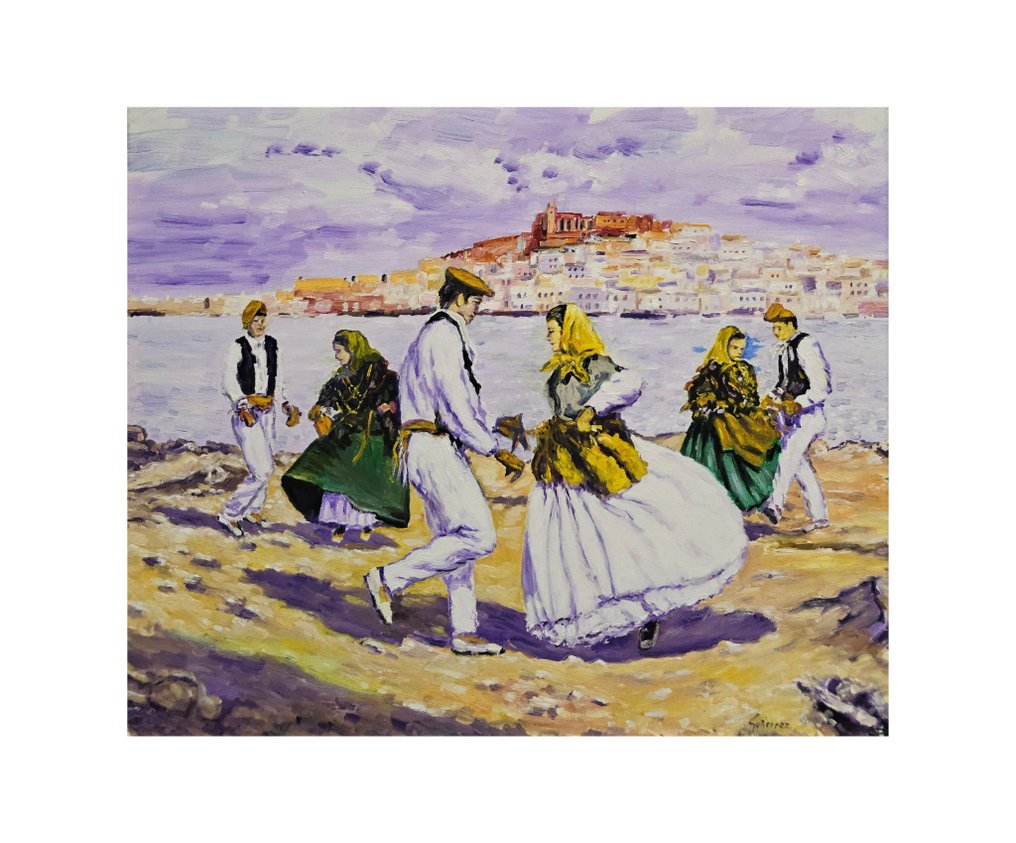
The Dance of the Peasants, an oil painting from Spain, dated 1970–1980, sold with frame.
AI-assisted summary
Description from the seller
The dance of the farmers
Technical Data Sheet
Author: Gutiérrez (signature in the lower right corner; identity to be documented).
Chronology: circa 1970–1990.
Technique: oil on canvas.
Measurements: 50 × 61 cm (artwork) · 56 × 66 cm (framed).
Support: canvas on a wooden frame; clean reverse side and modern craftsmanship.
Style: Mediterranean customs rooted in post-impressionist and luminist traditions.
Conservation state: very good; fresh and stable pictorial layer, without visible craquelures.
Compositional and iconographic description
Choral scene of the ball pagès in the foreground, with six figures in traditional attire (green skirts and yellow scarves for them; white shirts and dark vests for the men), dancing on the shores of the sea.
In the background, the bay of Eivissa and the stepped silhouette of Dalt Vila with its cathedral, creating a recognizable urban backdrop.
Paste-like and vibrant brushstroke, with spatula touches; malva-violet chromaticism in the sky and shadows that enhance the white textiles and the earthy greens of the ground.
The circular dynamism of the bodies and the castanets play bring rhythm and festivity, capturing a characteristic ethnographic moment of the Pitiüsas.
Style, School, and Historical Context
The work is rooted in the Balearic and Levantine tradition of the mid- and late-20th century, inheriting Valencian luminism and Mediterranean costumbrism.
It dialogues with the colorful and atmospheric gaze that artists like Laureà Barrau and Rigoberto Soler dedicated to Ibiza, and with the vibrant material of post-impressionist lineage.
The emphasis on oblique light, the cool-luminous palette, and the fragmented stroke place the painting within the orbit of workshops and active circles in Ibiza in the second half of the last century.
Aesthetic and Comparative Evaluation
A piece with strong iconographic appeal due to its combination of a recognizable landscape and festive character, executed with skill, a generous application, and a great sense of color.
The motif of the ball pagès and the view of Dalt Vila align it with works demanded by the Balearic market of the post-war and late Franco/Transition period, where the best examples — in a luminist key — achieve solid collector consideration.
It is recommended to document the 'Gutiérrez' firm (1970–1990) in local archives and catalogs, as a precise attribution within the Ibizan context could increase its exclusivity and value.
Seller's Story
At Barcelona Art Gallery, we are a large family of art collectors in Barcelona who have been acquiring all kinds of paintings for 2 centuries.
Headquartered in the Les Corts neighborhood of Barcelona.
We offer part of our private collection for auction: high period and modern paintings that we have been acquiring over time, mainly from art galleries, antique dealers, auctions, private collections and very diverse origins.
Translated by Google TranslateThe dance of the farmers
Technical Data Sheet
Author: Gutiérrez (signature in the lower right corner; identity to be documented).
Chronology: circa 1970–1990.
Technique: oil on canvas.
Measurements: 50 × 61 cm (artwork) · 56 × 66 cm (framed).
Support: canvas on a wooden frame; clean reverse side and modern craftsmanship.
Style: Mediterranean customs rooted in post-impressionist and luminist traditions.
Conservation state: very good; fresh and stable pictorial layer, without visible craquelures.
Compositional and iconographic description
Choral scene of the ball pagès in the foreground, with six figures in traditional attire (green skirts and yellow scarves for them; white shirts and dark vests for the men), dancing on the shores of the sea.
In the background, the bay of Eivissa and the stepped silhouette of Dalt Vila with its cathedral, creating a recognizable urban backdrop.
Paste-like and vibrant brushstroke, with spatula touches; malva-violet chromaticism in the sky and shadows that enhance the white textiles and the earthy greens of the ground.
The circular dynamism of the bodies and the castanets play bring rhythm and festivity, capturing a characteristic ethnographic moment of the Pitiüsas.
Style, School, and Historical Context
The work is rooted in the Balearic and Levantine tradition of the mid- and late-20th century, inheriting Valencian luminism and Mediterranean costumbrism.
It dialogues with the colorful and atmospheric gaze that artists like Laureà Barrau and Rigoberto Soler dedicated to Ibiza, and with the vibrant material of post-impressionist lineage.
The emphasis on oblique light, the cool-luminous palette, and the fragmented stroke place the painting within the orbit of workshops and active circles in Ibiza in the second half of the last century.
Aesthetic and Comparative Evaluation
A piece with strong iconographic appeal due to its combination of a recognizable landscape and festive character, executed with skill, a generous application, and a great sense of color.
The motif of the ball pagès and the view of Dalt Vila align it with works demanded by the Balearic market of the post-war and late Franco/Transition period, where the best examples — in a luminist key — achieve solid collector consideration.
It is recommended to document the 'Gutiérrez' firm (1970–1990) in local archives and catalogs, as a precise attribution within the Ibizan context could increase its exclusivity and value.
Seller's Story
At Barcelona Art Gallery, we are a large family of art collectors in Barcelona who have been acquiring all kinds of paintings for 2 centuries.
Headquartered in the Les Corts neighborhood of Barcelona.
We offer part of our private collection for auction: high period and modern paintings that we have been acquiring over time, mainly from art galleries, antique dealers, auctions, private collections and very diverse origins.
Translated by Google TranslateDetails
Artist
Valencian School (XX)
Sold with frame
Yes
Sold by
Gallery
Edition
Original
Title of artwork
The dance of the peasants
Technique
Oil painting
Signature
Hand signed
Country of Origin
Spain
Condition
Excellent condition
Colour
Purple
Height
56 cm
Width
66 cm
Weight
3 kg
Depiction/Theme
Seascape
Style
Impressionism
Period
1970-1980
Sold by
