Andries van Eertvelt (1590–1652), Attributed to - Flemish seascape - Ships in a mediterranean harbour



01
day
10
hours
02
minutes
49
seconds
Current bid
€ 420
Reserve price not met

28 other people are watching this object
 Bidder 6180 Bidder 6180 | €420 | |
|---|---|---|
 Bidder 2371 Bidder 2371 | €400 | |
| Bidder 6180 | €320 | |
Catawiki Buyer Protection
Your payment’s safe with us until you receive your object.View details
Trustpilot 4.4 | 122813 reviews
Rated Excellent on Trustpilot.
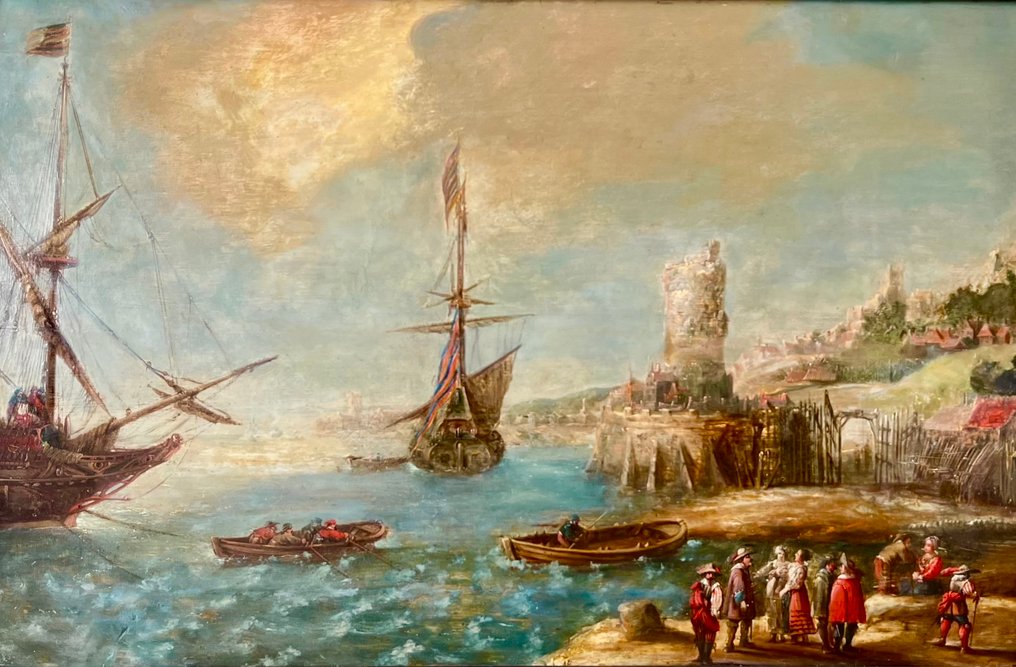
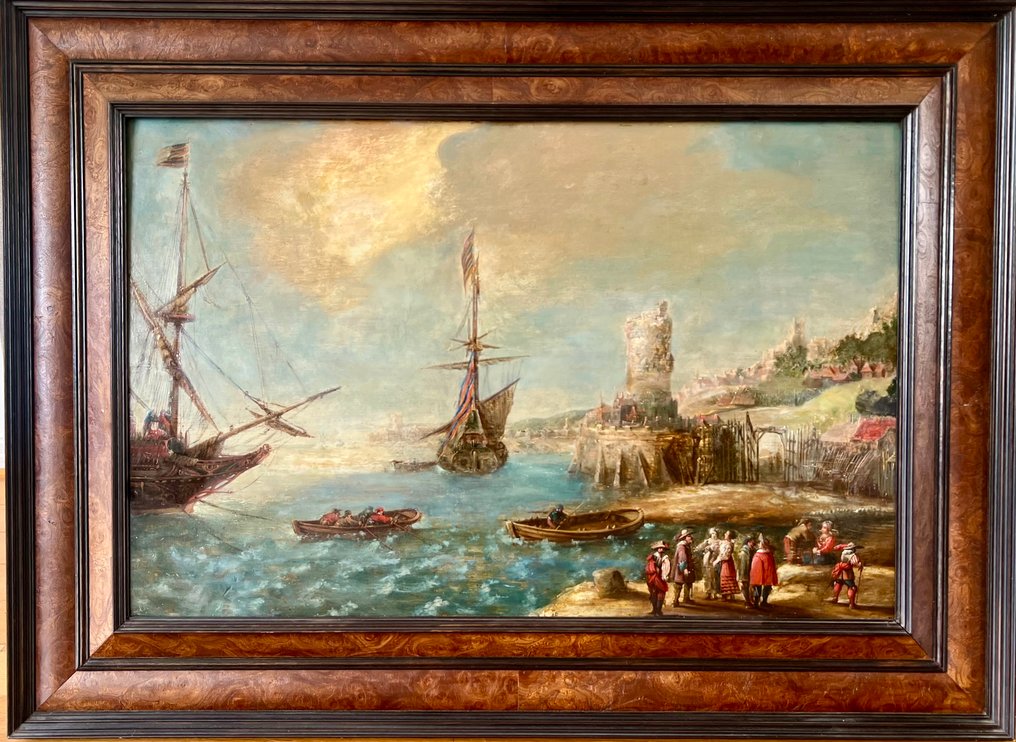
Flemish seascape - Ships in a mediterranean harbour, a 17th‑century oil painting from Belgium, attributed to Andries van Eertvelt, signed and framed in good condition.
AI-assisted summary
Description from the seller
Where the Sea Meets Home, A 17th-Century Port Seascape, attributed to Van Eertvelt
Bathed in the warm and vibrant light of a beautiful day, this remarkable 17th-century seascape opens a window onto a world where every sail on the horizon carried with it stories of adventure, trade, and distant lands. Along the harbor’s edge, finely dressed figures gather, merchants and families alike, watching the returning vessels with a mix of expectation, pride, and wonder.
Yet, for all its evocation of travel and commerce, this painting also radiates a deep sense of home. Children play, women converse, and life hums gently in the background, nestled among terraced rooftops and rolling hills. A watchtower rises at the water’s edge, timeless and steady. Rendered in vibrant tones and atmospheric light, the scene is alive with movement and human connection. Rowboats cut through the glinting water, sailors hoist lines, and townsfolk pause in conversation, their presence grounding the vastness of the sea in the intimacy of daily life. It is a painting that stirs both the imagination and the heart, a meditation on the romance of departure and the quiet joy of return.
Andries van Eertvelt (1590–1652) was a pioneering Flemish marine painter and draughtsman, recognized as one of the earliest Flemish artists to focus primarily on maritime subjects. Born and baptized in Antwerp in 1590, he became a master in the Antwerp Guild of St. Luke by 1609. In 1615, he married Catherine de Vlieger, with whom he had two children. During the late 1620s, van Eertvelt traveled to Italy, settling in Genoa for a time where he shared a residence with fellow marine artist Cornelis de Wael. By 1630, he had returned to Antwerp.
Van Eertvelt earned considerable acclaim for his dynamic marine paintings, which ranged from stormy seas and naval battles to serene harbor scenes. His clientele spanned across Europe, with works reaching collectors in Spain, Portugal, and the Dutch Republic. His reputation was such that the notable artist Anthony van Dyck painted his portrait, which was later reproduced as an engraving. In addition to his painting career, van Eertvelt took on pupils, including Matthieu van Plattenberg and Gaspar van Eyck, who would themselves become respected marine artists. He also engaged in some diplomatic activities, acting as a courier for letters related to peace negotiations between Spain and the Dutch Republic.
The panel has the mark of Antwerp panel maker Lambert Steens, a detail also found on other works by Eertvelt, such as his painting in the Prado. The Antwerp brand (no. 4) seen next to his mark, allows it to be dated 1619-1638.
It is monogrammed in the lower middle, rather similar monograms can be found on several of his works. A comparable painting, with a compositionally similar central tower and composition, was offered at auction in Switzerland on September 17, 2010 (Lot 3099), estimated at 18,000–22,000 CHF.
Dimensions
Panel: approx. 48 × 74 cm
Framed: approx. 68 × 94 cm
Provenance
Private collection in France
Ready to hang, inpainting visible under UV-light. We recommend a good light source to bring out the vibrancy of the colors, photographed underneath gallery lights.
Seller's Story
All works are safely packed and shipped with DHL express or GLS and within Belgium with Bpost.
Where the Sea Meets Home, A 17th-Century Port Seascape, attributed to Van Eertvelt
Bathed in the warm and vibrant light of a beautiful day, this remarkable 17th-century seascape opens a window onto a world where every sail on the horizon carried with it stories of adventure, trade, and distant lands. Along the harbor’s edge, finely dressed figures gather, merchants and families alike, watching the returning vessels with a mix of expectation, pride, and wonder.
Yet, for all its evocation of travel and commerce, this painting also radiates a deep sense of home. Children play, women converse, and life hums gently in the background, nestled among terraced rooftops and rolling hills. A watchtower rises at the water’s edge, timeless and steady. Rendered in vibrant tones and atmospheric light, the scene is alive with movement and human connection. Rowboats cut through the glinting water, sailors hoist lines, and townsfolk pause in conversation, their presence grounding the vastness of the sea in the intimacy of daily life. It is a painting that stirs both the imagination and the heart, a meditation on the romance of departure and the quiet joy of return.
Andries van Eertvelt (1590–1652) was a pioneering Flemish marine painter and draughtsman, recognized as one of the earliest Flemish artists to focus primarily on maritime subjects. Born and baptized in Antwerp in 1590, he became a master in the Antwerp Guild of St. Luke by 1609. In 1615, he married Catherine de Vlieger, with whom he had two children. During the late 1620s, van Eertvelt traveled to Italy, settling in Genoa for a time where he shared a residence with fellow marine artist Cornelis de Wael. By 1630, he had returned to Antwerp.
Van Eertvelt earned considerable acclaim for his dynamic marine paintings, which ranged from stormy seas and naval battles to serene harbor scenes. His clientele spanned across Europe, with works reaching collectors in Spain, Portugal, and the Dutch Republic. His reputation was such that the notable artist Anthony van Dyck painted his portrait, which was later reproduced as an engraving. In addition to his painting career, van Eertvelt took on pupils, including Matthieu van Plattenberg and Gaspar van Eyck, who would themselves become respected marine artists. He also engaged in some diplomatic activities, acting as a courier for letters related to peace negotiations between Spain and the Dutch Republic.
The panel has the mark of Antwerp panel maker Lambert Steens, a detail also found on other works by Eertvelt, such as his painting in the Prado. The Antwerp brand (no. 4) seen next to his mark, allows it to be dated 1619-1638.
It is monogrammed in the lower middle, rather similar monograms can be found on several of his works. A comparable painting, with a compositionally similar central tower and composition, was offered at auction in Switzerland on September 17, 2010 (Lot 3099), estimated at 18,000–22,000 CHF.
Dimensions
Panel: approx. 48 × 74 cm
Framed: approx. 68 × 94 cm
Provenance
Private collection in France
Ready to hang, inpainting visible under UV-light. We recommend a good light source to bring out the vibrancy of the colors, photographed underneath gallery lights.
Seller's Story
All works are safely packed and shipped with DHL express or GLS and within Belgium with Bpost.
Details
Artist
Andries van Eertvelt (1590–1652)
Sold with frame
Yes
Attribution
Attributed to
Title of artwork
Flemish seascape - Ships in a mediterranean harbour
Technique
Oil painting
Signature
Hand signed
Country of Origin
Belgium
Condition
Good condition
Height
48 cm
Width
74 cm
Style
Baroque
Period
17th century
Sold by
