Carlos Nadal (1917-1998) - Village Scene



16
days
04
hours
58
minutes
25
seconds
Current bid
€ 550
Reserve price not met

Expert
Selected by Giulia Couzzi
Master’s in culture and arts innovation, with a decade in 20th-21st century Italian art.
Estimate € 1,000 - € 1,400
7 other people are watching this object
 Bidder 8609 Bidder 8609 | €550 | |
|---|---|---|
| Bidder 8609 | €450 | |
| Bidder 8609 | €250 | |
Catawiki Buyer Protection
Your payment’s safe with us until you receive your object.View details
Trustpilot 4.4 | 121980 reviews
Rated Excellent on Trustpilot.
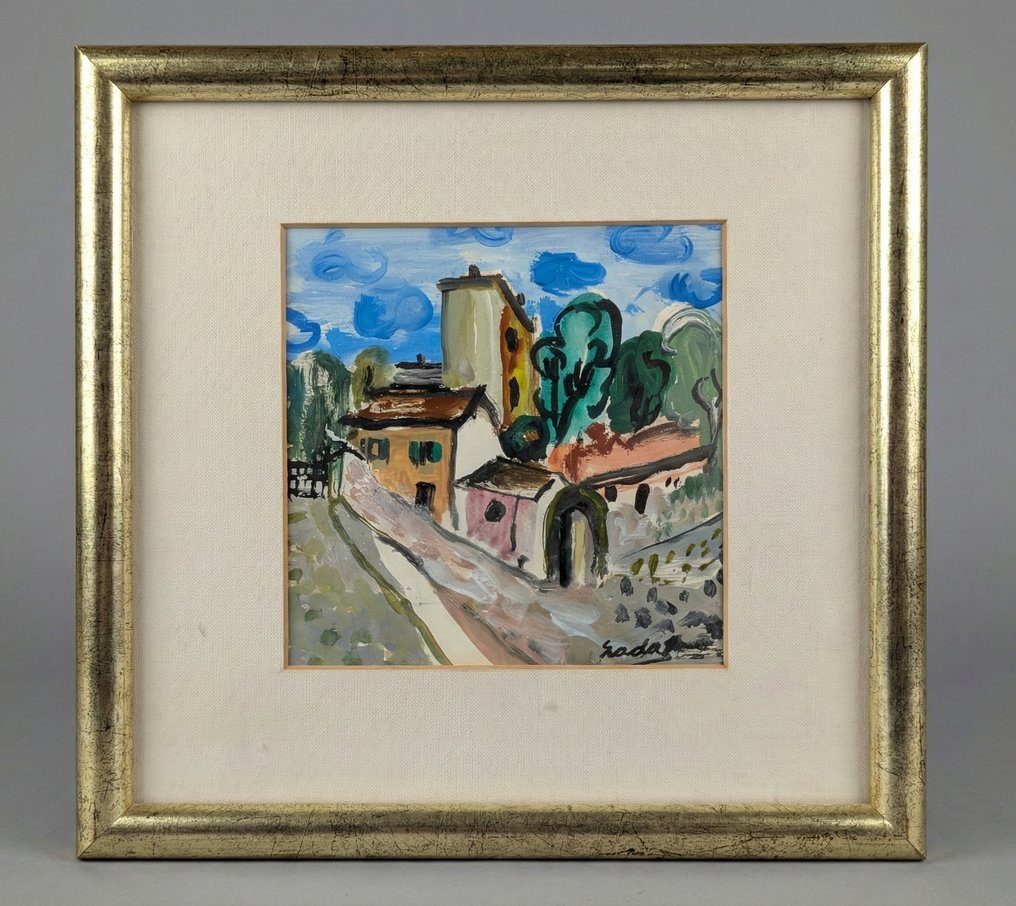
Carlos Nadal (1917–1998), Village Scene, mixed technique, original edition, created in 1970–1980, hand signed, sold with frame, 18 cm by 18 cm, Spain.
AI-assisted summary
Description from the seller
Expressive and colourful watercolour by Spanish fauvist Carlos Nadal (1917–1998), a key figure in 20th-century European modernism and closely associated with the Fauvist movement. This work vividly captures a charming village scene composed in Nadal's unmistakable style—bold, rhythmic brushwork and a palette bursting with vibrant hues. The houses are rendered in rich earth tones under a sky of swirling blue, framed by stylised trees evoking a Mediterranean warmth.
Nadal, who worked in the tradition of artists like Henri Matisse, Raoul Dufy, André Derain, Maurice de Vlaminck, and Kees van Dongen, brought an intense joie de vivre to his works. His paintings reflect a love for travel and theatricality, and this particular piece demonstrates his ability to turn ordinary street scenes into dynamic, emotionally charged compositions. This is a fine example of Nadal’s late style, where spontaneity, decorative rhythm, and simplified forms come together harmoniously.
The work is signed 'Nadal' in the lower right corner. It is mounted behind glass in a tasteful golden frame with a linen mount. 33x33 cm frame
Nadal’s style has also been compared to that of Jean Cocteau, Jean Dufy, Francis Picabia, and Sonia Delaunay in its use of bold line, joyful patterning, and theatrical composition.
Expressive and colourful watercolour by Spanish fauvist Carlos Nadal (1917–1998), a key figure in 20th-century European modernism and closely associated with the Fauvist movement. This work vividly captures a charming village scene composed in Nadal's unmistakable style—bold, rhythmic brushwork and a palette bursting with vibrant hues. The houses are rendered in rich earth tones under a sky of swirling blue, framed by stylised trees evoking a Mediterranean warmth.
Nadal, who worked in the tradition of artists like Henri Matisse, Raoul Dufy, André Derain, Maurice de Vlaminck, and Kees van Dongen, brought an intense joie de vivre to his works. His paintings reflect a love for travel and theatricality, and this particular piece demonstrates his ability to turn ordinary street scenes into dynamic, emotionally charged compositions. This is a fine example of Nadal’s late style, where spontaneity, decorative rhythm, and simplified forms come together harmoniously.
The work is signed 'Nadal' in the lower right corner. It is mounted behind glass in a tasteful golden frame with a linen mount. 33x33 cm frame
Nadal’s style has also been compared to that of Jean Cocteau, Jean Dufy, Francis Picabia, and Sonia Delaunay in its use of bold line, joyful patterning, and theatrical composition.
Details
Artist
Carlos Nadal (1917-1998)
Sold with frame
Yes
Sold by
Owner or reseller
Edition
Original
Title of artwork
Village Scene
Technique
Mixed technique
Signature
Hand signed
Country of Origin
Spain
Condition
Excellent condition
Height
18 cm
Width
18 cm
Style
Fauvism
Period
1970-1980
Sold by
