Box - All hand-carved Gold lacquer wood maki-e - 1881 year Antique Jubako


05
days
15
hours
33
minutes
29
seconds
Starting bid
€ 1
Reserve price not met

Expert
Selected by Giovanni Bottero
Holds a master’s in Japanese art history with over 10 years’ expertise in Asian art.
Estimate € 400 - € 500
No bids placed
Catawiki Buyer Protection
Your payment’s safe with us until you receive your object.View details
Trustpilot 4.4 | 122553 reviews
Rated Excellent on Trustpilot.
A lot of five Japanese Meiji-period jubako boxes, hand-carved gold lacquer wood maki-e with interior vermilion and gold, dated 1881, each measuring 39 cm high, 24.5 cm wide and 23.5 cm deep, total weight 5,300 g, provenance Gallery / Antique dealer, in excellent condition.
AI-assisted summary
Description from the seller
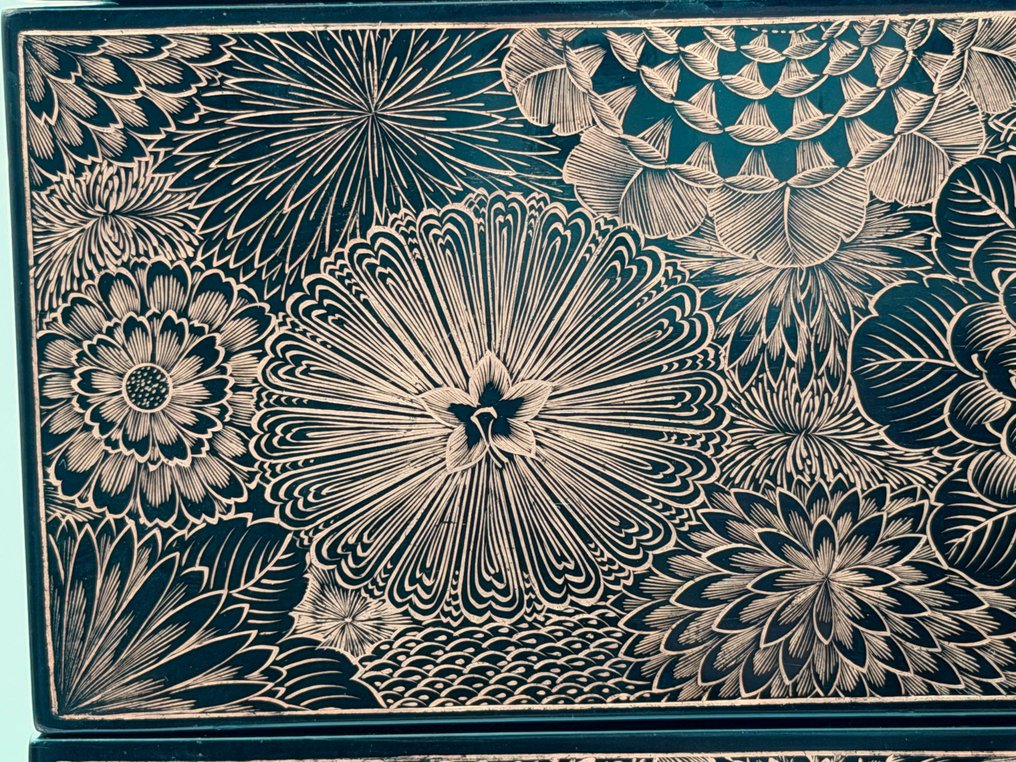
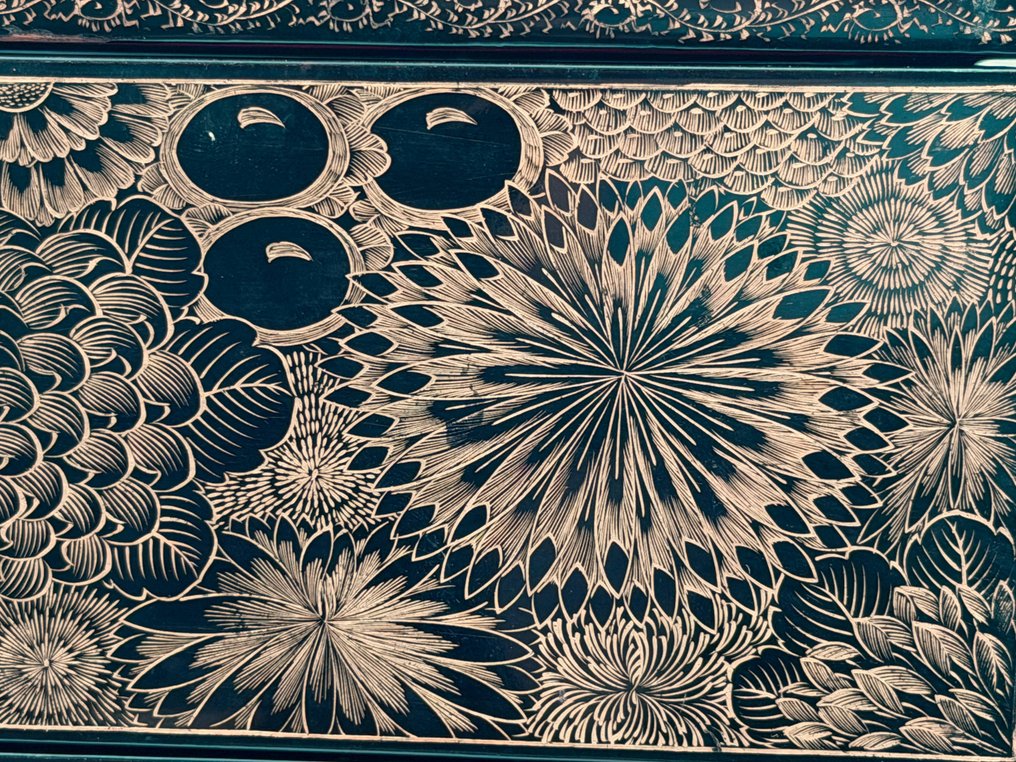
This is a jubako (Japanese box) featuring beautiful, intricately carved flowers.
Jubako boxes have long been used in Japan to hold delicious food, like lunch boxes for large groups.
The intricate gold carving is called chinkin (sparkle gold).
Chinkin is a decorative technique for lacquerware in which patterns are carved into the lacquered surface and the carved grooves are filled with gold powder or gold leaf. It originated in China's Song Dynasty as "sōkin" (spear gold), and was introduced to Japan during the Muromachi period (1336-1573). It developed in Wajima lacquerware in Ishikawa Prefecture, Japan, and was designated an Important Intangible Cultural Property in 1955.
It is a traditional technique that has been passed down in Japan since 1336.
Japanese lacquer can be achieved with multiple coats to achieve a black luster.
It takes several days to several weeks for a single coat of natural lacquer to dry.
After multiple coats, fine lines are carefully carved with a carving knife.
It is a craftsmanship that cannot be faulted.
This product is particularly impressive, with its thin floral lines applied all over.
The 1873 Vienna World's Fair marked the beginning of lacquerware's rise to international attention as a Japanese art and craft.
This was the catalyst for the production of many lacquer boxes, furniture, and screens with inlaid gold detailing for sale in Europe.
It was an era in which artisans competed to show off their skills.
As a result, the level of detail in these works was extremely high.
It would be difficult to recreate in modern times; it is a lost technology.
The interior is painted vermilion and gold.
Usually, works with gold detailing on the interior are rare.
It can be assumed that this piece was considered a luxury item even at the time.
The original box is dated April 1881, indicating that it dates to 1881.
Five boxes standing: Height 39cm, Width 24.5cm x 23.5cm, Weight 3kg
Original box: Height 56cm, Width 27cm x 26cm, Weight 2.3kg
This is a jubako (Japanese box) featuring beautiful, intricately carved flowers.
Jubako boxes have long been used in Japan to hold delicious food, like lunch boxes for large groups.
The intricate gold carving is called chinkin (sparkle gold).
Chinkin is a decorative technique for lacquerware in which patterns are carved into the lacquered surface and the carved grooves are filled with gold powder or gold leaf. It originated in China's Song Dynasty as "sōkin" (spear gold), and was introduced to Japan during the Muromachi period (1336-1573). It developed in Wajima lacquerware in Ishikawa Prefecture, Japan, and was designated an Important Intangible Cultural Property in 1955.
It is a traditional technique that has been passed down in Japan since 1336.
Japanese lacquer can be achieved with multiple coats to achieve a black luster.
It takes several days to several weeks for a single coat of natural lacquer to dry.
After multiple coats, fine lines are carefully carved with a carving knife.
It is a craftsmanship that cannot be faulted.
This product is particularly impressive, with its thin floral lines applied all over.
The 1873 Vienna World's Fair marked the beginning of lacquerware's rise to international attention as a Japanese art and craft.
This was the catalyst for the production of many lacquer boxes, furniture, and screens with inlaid gold detailing for sale in Europe.
It was an era in which artisans competed to show off their skills.
As a result, the level of detail in these works was extremely high.
It would be difficult to recreate in modern times; it is a lost technology.
The interior is painted vermilion and gold.
Usually, works with gold detailing on the interior are rare.
It can be assumed that this piece was considered a luxury item even at the time.
The original box is dated April 1881, indicating that it dates to 1881.
Five boxes standing: Height 39cm, Width 24.5cm x 23.5cm, Weight 3kg
Original box: Height 56cm, Width 27cm x 26cm, Weight 2.3kg
Details
Era
1400-1900
Weight
5300 g
Title additional information
1881 year Antique Jubako
Country of Origin
Japan
Material
All hand-carved Gold lacquer wood maki-e
Dynastic Style/Period
Meiji period (1868-1912)
Provenance
Gallery / Antique dealer
Condition
Excellent condition: barely used with minimal signs of wear
Height
39 cm
Width
24.5 cm
Depth
23.5 cm
Estimated period
1850-1900
Sold by
