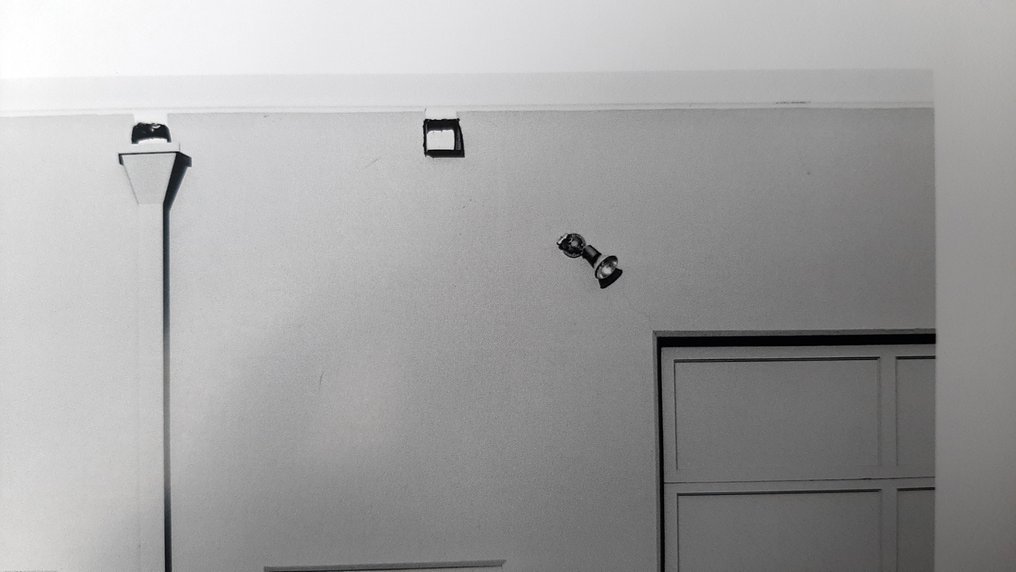
Lewis Baltz - Northwest Wall Unoccupied Industrial Spaces 17875 C and D Skypark Circle Irvine

00
days
16
hours
24
minutes
42
seconds

No bids placed
Catawiki Buyer Protection
Your payment’s safe with us until you receive your object.View details
Trustpilot 4.4 | 121798 reviews
Rated Excellent on Trustpilot.
Description from the seller
Subscribers of the art magazine received this photograph and all others from the series as a noble print from STEIDL Verlag. For each issue, paper, format, and printing process were coordinated with the photographer. This resulted in a high-quality collection of the best contemporary photography in a precious edition.
Lewis Baltz
Extraordinary, crystal-clear, almost graphic images
Lewis Baltz made photographic history with his very first works. During a period of economic growth in the early 1970s, he found his subject in the new suburban infrastructure with its highways, malls, and industrial parks. In his extensive series "New Industrial Parks Near Irvine, California," published in 1975, the artist, born in Newport Beach in 1945, explores the appearance of these new utilitarian buildings. Characterized by interchangeability and anonymity, Baltz's black-and-white photographs make it clear that there is no longer any established relationship between the buildings and their occupants: the facades no longer reveal what is produced behind them.
Although Baltz's radical, highly abstract photographs differ from the primarily objective images of the "New Topographics," he is repeatedly cited as a representative of this style-defining movement. These artists, with their distanced visual language, were oriented toward the photographs of the 19th-century photographic pioneers. While the latter aimed for the most accurate possible representation of visible reality in their strictly documentary photographs, their successors used photographic means to formulate their own vision of the world. Further series, created in California, Nevada, and Utah, address the comprehensive transformation of the American myth of an untouched natural landscape into a cultural and utilitarian one. Baltz presented his groups of works as wall-sized tableaux that allowed for comparative viewing.
Since the late 1980s, the now internationally acclaimed artist lived and taught in Europe. His work shifted to color photography, exploring the appearance of new technologies and production techniques. Like no other photographer, he used the cold precision of this technical medium to dissect late-capitalist reality and present our alienation to us in analytical yet crystal-clear images. Lewis Baltz died on November 22, 2014, in Paris.
Subscribers of the art magazine received this photograph and all others from the series as a noble print from STEIDL Verlag. For each issue, paper, format, and printing process were coordinated with the photographer. This resulted in a high-quality collection of the best contemporary photography in a precious edition.
Lewis Baltz
Extraordinary, crystal-clear, almost graphic images
Lewis Baltz made photographic history with his very first works. During a period of economic growth in the early 1970s, he found his subject in the new suburban infrastructure with its highways, malls, and industrial parks. In his extensive series "New Industrial Parks Near Irvine, California," published in 1975, the artist, born in Newport Beach in 1945, explores the appearance of these new utilitarian buildings. Characterized by interchangeability and anonymity, Baltz's black-and-white photographs make it clear that there is no longer any established relationship between the buildings and their occupants: the facades no longer reveal what is produced behind them.
Although Baltz's radical, highly abstract photographs differ from the primarily objective images of the "New Topographics," he is repeatedly cited as a representative of this style-defining movement. These artists, with their distanced visual language, were oriented toward the photographs of the 19th-century photographic pioneers. While the latter aimed for the most accurate possible representation of visible reality in their strictly documentary photographs, their successors used photographic means to formulate their own vision of the world. Further series, created in California, Nevada, and Utah, address the comprehensive transformation of the American myth of an untouched natural landscape into a cultural and utilitarian one. Baltz presented his groups of works as wall-sized tableaux that allowed for comparative viewing.
Since the late 1980s, the now internationally acclaimed artist lived and taught in Europe. His work shifted to color photography, exploring the appearance of new technologies and production techniques. Like no other photographer, he used the cold precision of this technical medium to dissect late-capitalist reality and present our alienation to us in analytical yet crystal-clear images. Lewis Baltz died on November 22, 2014, in Paris.
Details
Date of print
1975
Artist
Lewis Baltz
Sold by
Owner or reseller
Title of artwork
Northwest Wall Unoccupied Industrial Spaces 17875 C and D Skypark Circle Irvine
Condition
Very fine
Technique
Digital print
Height
19 cm
Width
25.3 cm
Signature
Not signed
Genre
Fine art photography
Sold by