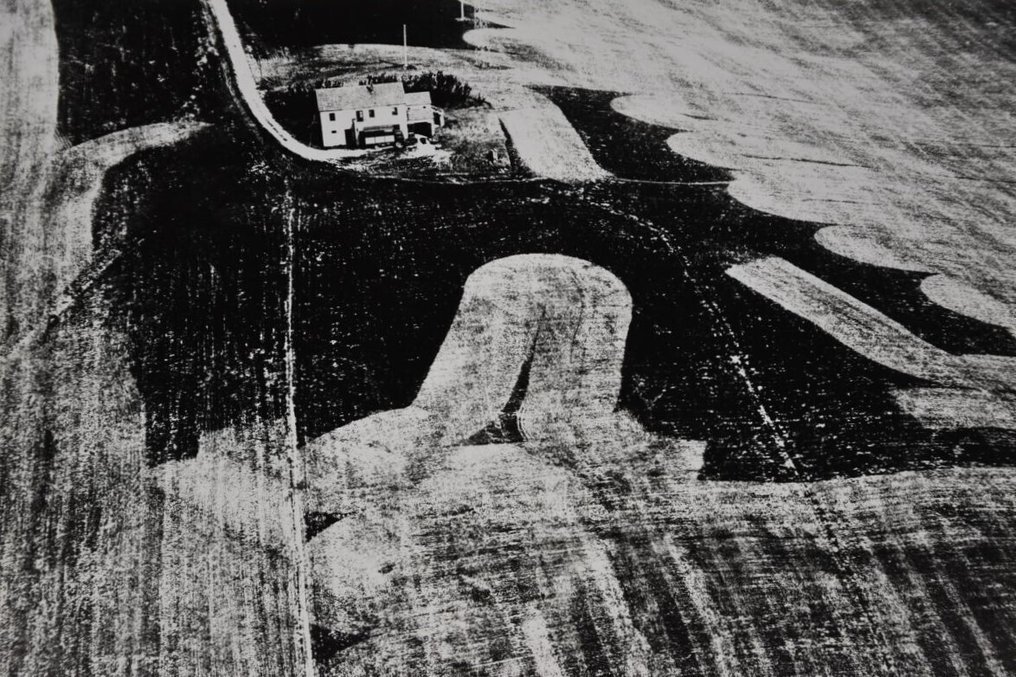
Mario Giacomelli (1925–2000) - "Storie di terra"


08
days
04
hours
10
minutes
21
seconds
Current bid
€ 190
Reserve price not met

Expert
Selected by Elena Vaninetti
Has over ten years of experience in art, specialising in post-war photography and contemporary art.
Estimate € 1,000 - € 1,200
14 other people are watching this object
 Bidder 3260 Bidder 3260 | €190 | |
|---|---|---|
| Bidder 7945 | €180 |
Catawiki Buyer Protection
Your payment’s safe with us until you receive your object.View details
Trustpilot 4.4 | 122473 reviews
Rated Excellent on Trustpilot.
Description from the seller
Mario Giacomelli, 'Stories of Earth'. Original silver salt print photograph. Aerial photo. Photographer's stamp. Stamp from the series 'Awakening to Nature' canceled by another stamp 'Stories of Earth from 1970 to today'. Date handwritten by Giacomelli in 1987. In excellent condition.
Mario Giacomelli (Senigallia, August 1, 1925 – Senigallia, November 25, 2000) was an Italian typographer, photographer, and painter.
Born in 1925 to Alfredo and Libera Guidini, a family of humble rural origins, he had two sisters. His origins remained a part of his inner self as a mark of belonging, influencing his photographic work and his perspective on the world and nature in relation to man. In 1935, he lost his father, a wound that would be very deep.
The historical period and the difficult family circumstances (orphaned from his father at just 9 years old) forced Mario to stop his studies and help his family as an apprentice at the Tipografia Giunchedi (only thirteen years old), while his mother worked as a laundress at the city's old people's home. After the war, he returned to the printing house, having participated in the reconstruction work after the bombings, as a typographer worker. In 1950, he decided to start his own business, supported by a significant step, with his savings lent by an elderly woman from the old people's home where his mother worked: thus, the Tipografia Marchigiana was born, under the Portici Ercolani, later moved to Via Mastai 5. Over the years, it became a point of reference and a meeting place with the photographer, who was known not to like traveling too far from his seaside town.
In 1953, Giacomelli purchased a Bencini Comet S (CMF) model from 1950, with an acromatic 1:11 lens, 127 film, shutter speeds of 1/50+B, and flash synchronization. It was Christmas, and he went to the beach, taking his first photo, 'The Landing,' the famous photograph of a shoe carried by the waves on the shoreline, which marked Giacomelli's decision to express himself through photography from that point on. He began photographing relatives, colleagues, and friends. During those years, he relied on the photography studio of Lanfranco Torcoletti on via Mastai for printing, who introduced him to Giuseppe Cavalli, an experienced photographer and a great theorist of photography. The frequent and intense contact with Cavalli, a reverential master/disciple friendship, was crucial for Giacomelli's cultural development.
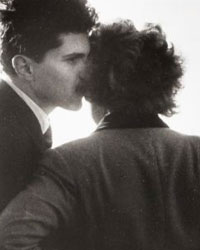
Mario Giacomelli, A Man, a Woman, a Love, 1960
For years, Cavalli was dedicated to creating a mapping of what photography was, firmly seeking an alternative to Neorealist photography, looking for young talents for a new vision of Italian photography after the war, for an 'artistic' photography, as it was called at the time. This was the reason why the amateur photography group La Bussola (Milan) was founded in 1947, complete with a programmatic manifesto (founders: Giuseppe Cavalli, Finazzi, Vender, Leiss, Luigi Veronesi). It also explains why, in December 1953, the Misa group was formed, registered on January 1, 1954, with FIAF under the name 'Associazione Fotografica Misa,' to renew the vision of photography from within the amateur photo community (also on the advice of Paolo Monti).
Under the guidance of Ferruccio Ferroni, the first 'student' of Cavalli, always under the supervision of the Master, Giacomelli delves into photographic technique. He participates in numerous Italian and international photography competitions (up to the late 1970s, thus even after gaining fame), where he stands out for originality and depth of language. In 1955, he wins the National Competition of Castelfranco Veneto, where he was acclaimed by critics. Paolo Monti, a jury member, wrote: 'Suddenly, among the thousands of prints that were crashing down on us, Giacomelli's photographs appeared. 'Appearance' is the most fitting word for our joy and emotion, because suddenly the presence of those images convinced us that a new photographer had been born.' During this period, he creates series with a reportage style, but Giacomelli was never a verist ('No image can be 'reality,' because reality happens only once before your eyes' [2]), as seen in Lourdes (1957), Scanno (1957/59), Puglia (1958, where he returned in 1982), [3] Zingari (1958), [4] Loreto (1959, where he returned in 1995), A Man, a Woman, a Love (1960/61), Mattatoio (1960), Pretini (1961/63), La buona terra (1964/66), and the very precious photographs taken at the Senigallia hospice titled Hospice (1954/56), Hospice Life (1956/57), Verrà la morte e avrà i tuoi occhi (1966/68).
The first publications in specialized photography magazines begin to appear. Continuing his research, the photographer starts asking farmers, paying them, to create precise marks on the land with their tractors, directly acting on the landscape to be photographed, and then emphasizing these marks in the print. Soon, Giacomelli will feel the strict stylistic rules of Cavalli as restrictive: he feels that gray tones are inappropriate to represent the impulse and tragedy he found instead in his strong—and at the time shocking—black and white contrasts, which he also found in Cavalli's fascinating antagonist, the founder of the photographic group La Gondola (Venice), and his friend Paolo Monti, as well as in the Subjektive Fotografie to which Giacomelli was so close that he was included in the 1960 exhibition 'Subjektive Photographie 3' (Varese), organized by Otto Steinert. On the other hand, the Misa group soon disbanded (in 1958) precisely due to differences in views.
Another important contact for Giacomelli's creative development was undoubtedly Luigi Crocenzi. Through Crocenzi, in 1961, Elio Vittorini asked Giacomelli for the image 'Gente del sud' (from the Puglia series) for the cover of the English edition of 'Conversation in Sicily.' In 1963, Piero Racanicchi, who, along with Turroni, was among the first critics to support Giacomelli's work, recommended the photographer to John Szarkowski, director of the Photography Department at MoMA in New York, who chose to exhibit one of his photographs at the exhibition 'The Photographer's Eye': the now famous and iconic photo of the boy from Scanno.
In 1964, Szarkowski would later acquire some images from the series Scanno and some from the series "I have no hands to caress my face." The latter work was initially titled "The Seminarians," but the same photographs could also carry the titles "Seminary" or "Little Priests." That same year, he participated in the Venice Biennale with the series The Hospice, Death Will Come, and Your Eyes Will Have Them. In 1965, while spending time with a farming family, he created one of his most well-known series, "The Good Earth," rediscovering the rhythm of his being and uncovering the spiritual side of those who, working the land, remained close to their roots, respecting the origin and the meaning of Humanity.
Under Crocenzi's influence, in 1967 Giacomelli considered creating a photographic series centered on storytelling, interpreting Caroline Branson from Edgar Lee Masters' Spoon River Anthology, with a scenario by Luigi Crocenzi. In the 1960s, he personally met Alberto Burri, aligning with the proximity to informality and abstraction. In 1968, he began a color photographic series, which would only be completed at the end of the 1980s, titled 'The Landscape Construction Site'.
In 1978, he participated in the Venice Biennale with photographs of Landscapes. In 1980, Arturo Carlo Quintavalle wrote an analytical book on the photographer's work, acquiring a significant number of his works for the CSAC center in Parma. In 1984, he met the poet Francesco Permunian, with whom he established a collaboration that resulted in the series The Snow Theater (1984/86) and I Have a Full Head, Mom (1985/87).
Between 1984 and 1985, after reading 'Il Canto dei Nuovi Migranti' by Calabrian poet Franco Costabile, he created a series of photographs in Calabria, inspired by the depopulation of inland villages and Calabrian emigration. The photos were taken in the towns of Tiriolo, San Giovanni in Fiore, Cutro, Santa Severina, Badolato, Seminara, Pentedattilo, Bova, Caraffa di Catanzaro, Amaroni; Cropani, Zagarise, Magisano, Vincolise, Cavallerizzo di Cerzeto, Sant’Andrea Apostolo dello Jonio, Cessaniti, San Marco, San Cono, Nao, Jonadi, and Pernocari. Regarding these photos, Giacomelli stated:
I wanted to, like Costabile, shout. I didn't make any landscape. Why? It's not that I did it on purpose; I wasn't inclined to do it, and I didn't do it. But now, I think, reflecting, reasoning about what they tell me: the land is beautiful but it's not theirs. That's why I wasn't attracted to make the land. I was looking for Costabile to say: I was looking for the real Calabrese. There are four who are doing well; I was looking for the others who are not doing well. I was trying to get into Costabile's world.
Between 1983 and 1987, he created 'The Sea of My Stories,' aerial photographs taken at the Senigallia beach. In the 1970s to 1990s, Giacomelli photographed the Adriatic coast near Senigallia, creating the series 'My Marche' and 'The Sea.' In 1983, he developed a series about seagulls inspired by his poem 'Nothing,' and as early as 1982, he used one of his poems for a color series titled 'Reality Overwhelms Me.' During the 1990s, he tirelessly worked on a substantial series that originated from the abandonment and subsequent demolition of a company owned by his friend Otello. In 1997, he created the subject for the well-known Illy coffee roastery's annual artistic cup service, called 'States of Mind,' part of the Illy Collection.
In the nineties, the series 'Vita' by the painter Bastari (1991/92), 'I Am Nobody' from a poem by Emily Dickinson, 'Poems in Search of an Author,' Bando (1997/99), December 31 (1997). Towards the end of August, he completed the series 'Return,' inspired by a poem by Giorgio Caproni. Mario Giacomelli died on November 25, 2000, in Senigallia, after a year of illness, while working on the series 'I Would Like to Tell This Memory' (2000), 'Memories of a Boy from '25,' and 'The First Sunday' (2000).
Starting from the year 2001, the Sannita Photography Club of Morcone in the province of Benevento establishes a photography award named in memory of Giacomelli.
Exhibitions (Selection)
Palazzo Sormani, Municipal Library, Milan (IT), 'Mario Giacomelli. Landscapes and Still Lifes,' 1959
Subjective Photography 3rd International Exhibition of Modern Photography, Palais des Beaux Arts, Brussels (BE), 1959
Aixelá, Rambla Catalunya, Barcelona (ES), 'Mario Giacomelli Exhibition', 1962
George Eastman House, Rochester, New York (US), 'Photography 63. An International Exhibition,' 1963
MoMA Museum of Modern Art, New York (US), 'The Photographer’s Eye', 1964
IX Yolo International Exhibition of Photography, University of California - Davis, California (US), Yolo County Fair, Woodland, California (US), University of California, Berkeley, California (US), University of Nevada, Reno, Nevada (US), 1964
VIII Biennale of the Federation of Photographic Art, Basel (DE), 1964
National Gallery of Canada, Ottawa (CA), "Photography in the Twentieth Century", 1967
MET The Metropolitan Museum of Art, New York (US), 'Photography in the Fine Arts Exhibition', 1967
SFMOMA San Francisco Museum of Modern Art, San Francisco (US), “Mario Giacomelli: Photographs”, 1970
National Library of France, Paris (FR), 1972
V&A Victoria and Albert Museum, London (UK), 'The Land', 1975
Bowdoin College Museum of Art, Brunswick, Maine (US), 'Mario Giacomelli', 1977
Studio du Passage 44, Brussels (BE), Academy of Fine Arts, Ghent (BE), Cultural Center, Hasselt (BE), Museum of Glass, Charleroi (BE), 'Images of Men. 18 European Photographers', 1978
Magazzini del sale, Venice (IT), 'Venice ’79. Photography: Contemporary Italian Photography', 1979
Carrillo Gil Art Museum, Mexico City (MX), '19 contemporary Italian photographers,' 1979
Museum of Art, Rhode Island School of Design, Providence (US), 'Mario Giacomelli: Photographs', 1980
MAC Museum of Contemporary Art, Montreal (CA), 'The Eye's Choices: Photography Since 1940', 1981
The Seibu Museum of Art, Tokyo (JP), 'Twentieth-Century Photographs from The Museum of Modern Art,' 1982
The Pushkin State Museum of Fine Arts, Moscow (RU), 'Maestri della fotografia creativa contemporanei in Italia', 1983
V&A Victoria and Albert Museum, London (UK), 'Personal Choice. A Celebration of Twentieth-Century Photographs, Selected and Introduced by Photographers, Painters and Writers,' 1983
University of Hawaii Art Gallery, Honolulu, Hawaii (US), 1983
Nicephore Niepce Museum, Chalon-sur-Saône (FR), 'The Photographs of Mario Giacomelli', 1984
Ravensbourne College of Art, Kent; Aberystwyth Arts Centre, Aberystwyth; Plymouth Arts Centre, Plymouth; Brewery Arts Centre, Kendal; Untitled Gallery, Sheffield (GB), 'Mario Giacomelli. A Retrospective 1955-1983', 1984
15th International Photography Encounters, Salle Capitulaire, Arles (FR)
Museum of Contemporary Art, Montreal (CA), 'The Twenty Years of the Museum Through Its Collection', 1985
Galleria d’Arte Moderna, Bologna (IT), 'Light Art. An abstraction between naturalism and poetry in the leopardian memory stored in the heart of creative intelligence', 1985
Museum of the History of Photography Fratelli Alinari, 'Italy: One Hundred Years of Photography', 1985
The Glasgow School of Art, Glasgow; Arts Council Gallery, Belfast; The Photography Gallery, Dublin; Carmarthenshire Museum, Carmarthen; Visual Art Department, Aberystwyth (Wales); Polytechnic of Central London, London (UK), 'Mario Giacomelli. A Retrospective 1955-1983', 1985
Museum Bowdoin College, Brunswick (US), 1986
Carmarthern Museum, Carmarthern (GB), 1986
Milwaukee Art Museum, Milwaukee (US), 'Of People and Places. The Floyd and Josephine Segel Collection of Photography', 1987
Pushkin State Museum of Fine Arts, Moscow (RU), 1987
Museum Kulturhaus, Graz (AT), 'Mario Giacomelli: On the Magic of the Everyday and Landscape Images,' 1987
Palais de Tokyo, Paris (FR), 'Mario Giacomelli', 1987
Museum of Fine Arts, Houston (US), “Evocative Presence: Twentieth-Century Photographs from Museum Collection”, 1988
ICP International Center of Photography, New York (US), “Celebrate ICP’s 14th Anniversary. Master Photographs from the Photography in the Fine Arts Exhibitions, 1959-1967”, 1988
Metropolitan Museum, Tokyo (JP), 1989
FOMU Fotomuseum province of Antwerp, Antwerp (BE), 'Mario Giacomelli. Retrospective', 1992
Castello di Rivoli, Museum of Contemporary Art, Turin (IT), 'Mario Giacomelli', 1992
Museum of Contemporary Art, Nice (FR), 'Mario Giacomelli', 1992
Peggy Guggenheim Collection, Venice (IT), 'Italian Images', 1993
Elysée Museum, Lausanne (CH), 'Mario Giacomelli. The Great Retrospective,' 1993
The Murray and Isabella Rayburn Foundation, New York (US), 'Immagini italiane', 1994
Guggenheim Museum, New York (US), 'The Italian Metamorphosis. 1943-1968', 1994
GAM Galleria of Modern Art, Bologna (IT), 'Mario Giacomelli', 1994
Palazzo di Beit Edine, Beirut (RL), 'Mario Giacomelli', 1994
Palacio de Bellas Artes, Museum of Decorative Arts, Castillo de la Real Fuerza, Havana (CU), 'Photographs by Mario Giacomelli', 1994
46th International Art Exhibition Venice Biennale / Venice Biennale, Venice (IT), 'The I and Its Double, a Century of Photographic Portraiture in Italy. 1885-1995', 1995
Museum Ludwig Cologne, Cologne (DE), “Mario Giacomelli – Photographs 1954-1995”, 1995
FFI Photography Forum International, Frankfurt / Main (DE), 'Mario Giacomelli. Photographs 1952-1995', 1996
Fratelli Alinari Museum of Photography, Palazzo Rucellai, Florence (IT), 'Forms of Light. The La Bussola Group and Aspects of Italian Photography of the Post-War Period', 1997
MoMA PS1, New York (US), 'The Promise of Photography: Selected Works from the DG Bank Collection', 1999
GAM Galleria d’Arte Moderna, Bologna (IT), 'The Nature of Still Life. From Fox Talbot to the Present Day,' 2001
Palazzo delle Esposizioni, Rome (IT), 'Mario Giacomelli', 2001
Museum of Fine Art, Santa Fe, New Mexico (US), 'Idea Photographic: After Modernism', 2002
Henri Cartier-Bresson Foundation, Paris (FR), 'Henri Cartier-Bresson's Selections', 2003
Galleria Civica, Palazzo Santa Margherita, Modena (IT), 'Modena for Photography. The Idea of Landscape in Italian Photography from 1850 to Today,' 2003
Museum of Photographic Arts, El Prado Balboa Park, San Diego (US) “Mario Giacomelli. A retrospective”, 2003
Museum of Capodimonte, Naples (IT), 'Mario Giacomelli. Life of the painter Bastari,' 2003
Scuderie del Quirinale, Rome (IT) 'Italy. Double Visions', 2004
MuFoCo Museum of Contemporary Photography, Milan (IT), 'The museum, the collections,' 2004
Peggy Guggenheim Collection, Venice (IT), 'Il Diaframma of Lanfranco Colombo. Masters of Photography', 2005
Castello di Rivoli, Museum of Contemporary Art, Turin (IT), “Faces in the Crowd. Picturing Modern Life from Manet to Today,” 2005
Royal Palace, Milan (IT), 'Annicinquanta', 2005
National Library of France, Paris (FR), “Mario Giacomelli. Metamorphoses”, 2005
MOPS The Museum of Photography, Seoul (KR), 'Mario Giacomelli', 2005
Photographic Center, Copenhagen (DK), 'Mario Giacomelli. Retrospective', 2005
MoMA The Museum of Modern Art, New York (US), 'Photography Collection: Rotation 4', 2006
MEP Maison Européenne de la Photographie, Paris (FR), “An Italian Summer. A Private History”, 2006
BUAG Boston University Art Gallery, Boston (US), "To Fly. Contemporary Aerial Photography", 2007
European House of Photography, Paris (FR), 'Italies. Doubles visions', 2007
Castello di Rivoli, Museum of Contemporary Art, Turin (IT), “From the Earth to the Moon: Metaphors for Travel (Part II)”, 2007
GAM, Civic Gallery of Modern and Contemporary Art, Turin (IT), 'For a Photography Collection'
MAMM Multimedia Art Museum, Moscow (RU), at Photobiennale 2008, 'Mario Giacomelli. Photographs. 1953-1990', 2008
Metropolitan Museum of Photography, Tokyo (JP), 'Mario Giacomelli', 2008
MuFoCo Museum of Contemporary Photography, Milan (IT), 'Abstract Photography. From the Avant-Garde to Digital', 2009
MEP Maison Européenne de la Photographie, Paris (FR), 'Autour de l’extrême', 2010
Les Rencontres de la Photographie Arles 2010, Chapelle Saint-Martin du Méjan, Arles (FR), “Mario Giacomelli. The black figure awaits the white”
Leopold Museum, Vienna (AT), 'Magic of the Object. Photography from Three Centuries,' 2011
Nicephore Niepce Museum, Chalon-sur-Saône (FR), 'New Frontiers. Landscape in Contemporary Photography,' 2011
Ducal Palace, Genoa (IT), 'Mario Giacomelli. A master of 20th-century photography,' 2012
Palazzo del Duca, Senigallia (IT), 'Mario Giacomelli. Beneath the skin of the real,' 2012
Centre Pompidou, Metz (FR), 'Views from Above', 2013
Tokyo Metropolitan Museum of Photography, Tokyo (JP), “Mario Giacomelli. The Black is Waiting for the White”
MOPS The Museum of Photography, Seoul (KR), 'The Masterpieces. The Museum of Photography Seoul Collection,' 2014
Palazzo della Ragione, Milan (IT), 'Italy Inside Out. The Italian Photographers', 2015
Yokohama Museum of Art, Yokohama (JP), 'Thinking with the Body: Ways of Relating to the Body in Contemporary Art,' 2015
WestLicht, venue for photography, Vienna (AT), 'Mario Giacomelli. Against Time', 2015
Le Château d’Eau, Photography Center, Toulouse (FR), 'Mario Giacomelli. I am not a photographer, I don't know how to do it', 2016
Monumental Complex of Astino, Bergamo (IT), 'Mario Giacomelli. Written Lands', 2017
MAMM Multimedia Art Museum, Moscow (RU), 'Mario Giacomelli. Poetry of Landscape'
Civic Museum Villa Colloredo Mels, Recanati (IT), 'Mario Giacomelli. Giacomo Leopardi, A Silvia, L’infinito', 2018
Munich City Museum, Monaco (DE), 'LAND__SCOPE. Photo works by Roni Horn to Thomas Ruff,' 2019
Jimei X Arles, Jimei District, Xiamen (CN), Museum of Photography Seoul (KR), 'Collector’s Tale. Brassaï, Koudelka, Giacomelli. Romantic Melancholy', 2019
Museum of Fine Art, Boston (US), 'Postwar Visions. European Photography, 1945–60', 2019
Palazzo del Duca, Senigallia (IT), 'Giacomelli / Burri. Photography and Material Imaginary', July 1 - September 28, 2021
Getty Center, Los Angeles (US), 'Mario Giacomelli: Figure/Ground', June 29 – October 10, 2021
Rocca di Lonato, Lonato del Garda (IT), 'Retrospective of Mario Giacomelli', July 7, 2023 - October 29, 2023
Mario Giacomelli, 'Stories of Earth'. Original silver salt print photograph. Aerial photo. Photographer's stamp. Stamp from the series 'Awakening to Nature' canceled by another stamp 'Stories of Earth from 1970 to today'. Date handwritten by Giacomelli in 1987. In excellent condition.
Mario Giacomelli (Senigallia, August 1, 1925 – Senigallia, November 25, 2000) was an Italian typographer, photographer, and painter.
Born in 1925 to Alfredo and Libera Guidini, a family of humble rural origins, he had two sisters. His origins remained a part of his inner self as a mark of belonging, influencing his photographic work and his perspective on the world and nature in relation to man. In 1935, he lost his father, a wound that would be very deep.
The historical period and the difficult family circumstances (orphaned from his father at just 9 years old) forced Mario to stop his studies and help his family as an apprentice at the Tipografia Giunchedi (only thirteen years old), while his mother worked as a laundress at the city's old people's home. After the war, he returned to the printing house, having participated in the reconstruction work after the bombings, as a typographer worker. In 1950, he decided to start his own business, supported by a significant step, with his savings lent by an elderly woman from the old people's home where his mother worked: thus, the Tipografia Marchigiana was born, under the Portici Ercolani, later moved to Via Mastai 5. Over the years, it became a point of reference and a meeting place with the photographer, who was known not to like traveling too far from his seaside town.
In 1953, Giacomelli purchased a Bencini Comet S (CMF) model from 1950, with an acromatic 1:11 lens, 127 film, shutter speeds of 1/50+B, and flash synchronization. It was Christmas, and he went to the beach, taking his first photo, 'The Landing,' the famous photograph of a shoe carried by the waves on the shoreline, which marked Giacomelli's decision to express himself through photography from that point on. He began photographing relatives, colleagues, and friends. During those years, he relied on the photography studio of Lanfranco Torcoletti on via Mastai for printing, who introduced him to Giuseppe Cavalli, an experienced photographer and a great theorist of photography. The frequent and intense contact with Cavalli, a reverential master/disciple friendship, was crucial for Giacomelli's cultural development.
Mario Giacomelli, A Man, a Woman, a Love, 1960
For years, Cavalli was dedicated to creating a mapping of what photography was, firmly seeking an alternative to Neorealist photography, looking for young talents for a new vision of Italian photography after the war, for an 'artistic' photography, as it was called at the time. This was the reason why the amateur photography group La Bussola (Milan) was founded in 1947, complete with a programmatic manifesto (founders: Giuseppe Cavalli, Finazzi, Vender, Leiss, Luigi Veronesi). It also explains why, in December 1953, the Misa group was formed, registered on January 1, 1954, with FIAF under the name 'Associazione Fotografica Misa,' to renew the vision of photography from within the amateur photo community (also on the advice of Paolo Monti).
Under the guidance of Ferruccio Ferroni, the first 'student' of Cavalli, always under the supervision of the Master, Giacomelli delves into photographic technique. He participates in numerous Italian and international photography competitions (up to the late 1970s, thus even after gaining fame), where he stands out for originality and depth of language. In 1955, he wins the National Competition of Castelfranco Veneto, where he was acclaimed by critics. Paolo Monti, a jury member, wrote: 'Suddenly, among the thousands of prints that were crashing down on us, Giacomelli's photographs appeared. 'Appearance' is the most fitting word for our joy and emotion, because suddenly the presence of those images convinced us that a new photographer had been born.' During this period, he creates series with a reportage style, but Giacomelli was never a verist ('No image can be 'reality,' because reality happens only once before your eyes' [2]), as seen in Lourdes (1957), Scanno (1957/59), Puglia (1958, where he returned in 1982), [3] Zingari (1958), [4] Loreto (1959, where he returned in 1995), A Man, a Woman, a Love (1960/61), Mattatoio (1960), Pretini (1961/63), La buona terra (1964/66), and the very precious photographs taken at the Senigallia hospice titled Hospice (1954/56), Hospice Life (1956/57), Verrà la morte e avrà i tuoi occhi (1966/68).
The first publications in specialized photography magazines begin to appear. Continuing his research, the photographer starts asking farmers, paying them, to create precise marks on the land with their tractors, directly acting on the landscape to be photographed, and then emphasizing these marks in the print. Soon, Giacomelli will feel the strict stylistic rules of Cavalli as restrictive: he feels that gray tones are inappropriate to represent the impulse and tragedy he found instead in his strong—and at the time shocking—black and white contrasts, which he also found in Cavalli's fascinating antagonist, the founder of the photographic group La Gondola (Venice), and his friend Paolo Monti, as well as in the Subjektive Fotografie to which Giacomelli was so close that he was included in the 1960 exhibition 'Subjektive Photographie 3' (Varese), organized by Otto Steinert. On the other hand, the Misa group soon disbanded (in 1958) precisely due to differences in views.
Another important contact for Giacomelli's creative development was undoubtedly Luigi Crocenzi. Through Crocenzi, in 1961, Elio Vittorini asked Giacomelli for the image 'Gente del sud' (from the Puglia series) for the cover of the English edition of 'Conversation in Sicily.' In 1963, Piero Racanicchi, who, along with Turroni, was among the first critics to support Giacomelli's work, recommended the photographer to John Szarkowski, director of the Photography Department at MoMA in New York, who chose to exhibit one of his photographs at the exhibition 'The Photographer's Eye': the now famous and iconic photo of the boy from Scanno.
In 1964, Szarkowski would later acquire some images from the series Scanno and some from the series "I have no hands to caress my face." The latter work was initially titled "The Seminarians," but the same photographs could also carry the titles "Seminary" or "Little Priests." That same year, he participated in the Venice Biennale with the series The Hospice, Death Will Come, and Your Eyes Will Have Them. In 1965, while spending time with a farming family, he created one of his most well-known series, "The Good Earth," rediscovering the rhythm of his being and uncovering the spiritual side of those who, working the land, remained close to their roots, respecting the origin and the meaning of Humanity.
Under Crocenzi's influence, in 1967 Giacomelli considered creating a photographic series centered on storytelling, interpreting Caroline Branson from Edgar Lee Masters' Spoon River Anthology, with a scenario by Luigi Crocenzi. In the 1960s, he personally met Alberto Burri, aligning with the proximity to informality and abstraction. In 1968, he began a color photographic series, which would only be completed at the end of the 1980s, titled 'The Landscape Construction Site'.
In 1978, he participated in the Venice Biennale with photographs of Landscapes. In 1980, Arturo Carlo Quintavalle wrote an analytical book on the photographer's work, acquiring a significant number of his works for the CSAC center in Parma. In 1984, he met the poet Francesco Permunian, with whom he established a collaboration that resulted in the series The Snow Theater (1984/86) and I Have a Full Head, Mom (1985/87).
Between 1984 and 1985, after reading 'Il Canto dei Nuovi Migranti' by Calabrian poet Franco Costabile, he created a series of photographs in Calabria, inspired by the depopulation of inland villages and Calabrian emigration. The photos were taken in the towns of Tiriolo, San Giovanni in Fiore, Cutro, Santa Severina, Badolato, Seminara, Pentedattilo, Bova, Caraffa di Catanzaro, Amaroni; Cropani, Zagarise, Magisano, Vincolise, Cavallerizzo di Cerzeto, Sant’Andrea Apostolo dello Jonio, Cessaniti, San Marco, San Cono, Nao, Jonadi, and Pernocari. Regarding these photos, Giacomelli stated:
I wanted to, like Costabile, shout. I didn't make any landscape. Why? It's not that I did it on purpose; I wasn't inclined to do it, and I didn't do it. But now, I think, reflecting, reasoning about what they tell me: the land is beautiful but it's not theirs. That's why I wasn't attracted to make the land. I was looking for Costabile to say: I was looking for the real Calabrese. There are four who are doing well; I was looking for the others who are not doing well. I was trying to get into Costabile's world.
Between 1983 and 1987, he created 'The Sea of My Stories,' aerial photographs taken at the Senigallia beach. In the 1970s to 1990s, Giacomelli photographed the Adriatic coast near Senigallia, creating the series 'My Marche' and 'The Sea.' In 1983, he developed a series about seagulls inspired by his poem 'Nothing,' and as early as 1982, he used one of his poems for a color series titled 'Reality Overwhelms Me.' During the 1990s, he tirelessly worked on a substantial series that originated from the abandonment and subsequent demolition of a company owned by his friend Otello. In 1997, he created the subject for the well-known Illy coffee roastery's annual artistic cup service, called 'States of Mind,' part of the Illy Collection.
In the nineties, the series 'Vita' by the painter Bastari (1991/92), 'I Am Nobody' from a poem by Emily Dickinson, 'Poems in Search of an Author,' Bando (1997/99), December 31 (1997). Towards the end of August, he completed the series 'Return,' inspired by a poem by Giorgio Caproni. Mario Giacomelli died on November 25, 2000, in Senigallia, after a year of illness, while working on the series 'I Would Like to Tell This Memory' (2000), 'Memories of a Boy from '25,' and 'The First Sunday' (2000).
Starting from the year 2001, the Sannita Photography Club of Morcone in the province of Benevento establishes a photography award named in memory of Giacomelli.
Exhibitions (Selection)
Palazzo Sormani, Municipal Library, Milan (IT), 'Mario Giacomelli. Landscapes and Still Lifes,' 1959
Subjective Photography 3rd International Exhibition of Modern Photography, Palais des Beaux Arts, Brussels (BE), 1959
Aixelá, Rambla Catalunya, Barcelona (ES), 'Mario Giacomelli Exhibition', 1962
George Eastman House, Rochester, New York (US), 'Photography 63. An International Exhibition,' 1963
MoMA Museum of Modern Art, New York (US), 'The Photographer’s Eye', 1964
IX Yolo International Exhibition of Photography, University of California - Davis, California (US), Yolo County Fair, Woodland, California (US), University of California, Berkeley, California (US), University of Nevada, Reno, Nevada (US), 1964
VIII Biennale of the Federation of Photographic Art, Basel (DE), 1964
National Gallery of Canada, Ottawa (CA), "Photography in the Twentieth Century", 1967
MET The Metropolitan Museum of Art, New York (US), 'Photography in the Fine Arts Exhibition', 1967
SFMOMA San Francisco Museum of Modern Art, San Francisco (US), “Mario Giacomelli: Photographs”, 1970
National Library of France, Paris (FR), 1972
V&A Victoria and Albert Museum, London (UK), 'The Land', 1975
Bowdoin College Museum of Art, Brunswick, Maine (US), 'Mario Giacomelli', 1977
Studio du Passage 44, Brussels (BE), Academy of Fine Arts, Ghent (BE), Cultural Center, Hasselt (BE), Museum of Glass, Charleroi (BE), 'Images of Men. 18 European Photographers', 1978
Magazzini del sale, Venice (IT), 'Venice ’79. Photography: Contemporary Italian Photography', 1979
Carrillo Gil Art Museum, Mexico City (MX), '19 contemporary Italian photographers,' 1979
Museum of Art, Rhode Island School of Design, Providence (US), 'Mario Giacomelli: Photographs', 1980
MAC Museum of Contemporary Art, Montreal (CA), 'The Eye's Choices: Photography Since 1940', 1981
The Seibu Museum of Art, Tokyo (JP), 'Twentieth-Century Photographs from The Museum of Modern Art,' 1982
The Pushkin State Museum of Fine Arts, Moscow (RU), 'Maestri della fotografia creativa contemporanei in Italia', 1983
V&A Victoria and Albert Museum, London (UK), 'Personal Choice. A Celebration of Twentieth-Century Photographs, Selected and Introduced by Photographers, Painters and Writers,' 1983
University of Hawaii Art Gallery, Honolulu, Hawaii (US), 1983
Nicephore Niepce Museum, Chalon-sur-Saône (FR), 'The Photographs of Mario Giacomelli', 1984
Ravensbourne College of Art, Kent; Aberystwyth Arts Centre, Aberystwyth; Plymouth Arts Centre, Plymouth; Brewery Arts Centre, Kendal; Untitled Gallery, Sheffield (GB), 'Mario Giacomelli. A Retrospective 1955-1983', 1984
15th International Photography Encounters, Salle Capitulaire, Arles (FR)
Museum of Contemporary Art, Montreal (CA), 'The Twenty Years of the Museum Through Its Collection', 1985
Galleria d’Arte Moderna, Bologna (IT), 'Light Art. An abstraction between naturalism and poetry in the leopardian memory stored in the heart of creative intelligence', 1985
Museum of the History of Photography Fratelli Alinari, 'Italy: One Hundred Years of Photography', 1985
The Glasgow School of Art, Glasgow; Arts Council Gallery, Belfast; The Photography Gallery, Dublin; Carmarthenshire Museum, Carmarthen; Visual Art Department, Aberystwyth (Wales); Polytechnic of Central London, London (UK), 'Mario Giacomelli. A Retrospective 1955-1983', 1985
Museum Bowdoin College, Brunswick (US), 1986
Carmarthern Museum, Carmarthern (GB), 1986
Milwaukee Art Museum, Milwaukee (US), 'Of People and Places. The Floyd and Josephine Segel Collection of Photography', 1987
Pushkin State Museum of Fine Arts, Moscow (RU), 1987
Museum Kulturhaus, Graz (AT), 'Mario Giacomelli: On the Magic of the Everyday and Landscape Images,' 1987
Palais de Tokyo, Paris (FR), 'Mario Giacomelli', 1987
Museum of Fine Arts, Houston (US), “Evocative Presence: Twentieth-Century Photographs from Museum Collection”, 1988
ICP International Center of Photography, New York (US), “Celebrate ICP’s 14th Anniversary. Master Photographs from the Photography in the Fine Arts Exhibitions, 1959-1967”, 1988
Metropolitan Museum, Tokyo (JP), 1989
FOMU Fotomuseum province of Antwerp, Antwerp (BE), 'Mario Giacomelli. Retrospective', 1992
Castello di Rivoli, Museum of Contemporary Art, Turin (IT), 'Mario Giacomelli', 1992
Museum of Contemporary Art, Nice (FR), 'Mario Giacomelli', 1992
Peggy Guggenheim Collection, Venice (IT), 'Italian Images', 1993
Elysée Museum, Lausanne (CH), 'Mario Giacomelli. The Great Retrospective,' 1993
The Murray and Isabella Rayburn Foundation, New York (US), 'Immagini italiane', 1994
Guggenheim Museum, New York (US), 'The Italian Metamorphosis. 1943-1968', 1994
GAM Galleria of Modern Art, Bologna (IT), 'Mario Giacomelli', 1994
Palazzo di Beit Edine, Beirut (RL), 'Mario Giacomelli', 1994
Palacio de Bellas Artes, Museum of Decorative Arts, Castillo de la Real Fuerza, Havana (CU), 'Photographs by Mario Giacomelli', 1994
46th International Art Exhibition Venice Biennale / Venice Biennale, Venice (IT), 'The I and Its Double, a Century of Photographic Portraiture in Italy. 1885-1995', 1995
Museum Ludwig Cologne, Cologne (DE), “Mario Giacomelli – Photographs 1954-1995”, 1995
FFI Photography Forum International, Frankfurt / Main (DE), 'Mario Giacomelli. Photographs 1952-1995', 1996
Fratelli Alinari Museum of Photography, Palazzo Rucellai, Florence (IT), 'Forms of Light. The La Bussola Group and Aspects of Italian Photography of the Post-War Period', 1997
MoMA PS1, New York (US), 'The Promise of Photography: Selected Works from the DG Bank Collection', 1999
GAM Galleria d’Arte Moderna, Bologna (IT), 'The Nature of Still Life. From Fox Talbot to the Present Day,' 2001
Palazzo delle Esposizioni, Rome (IT), 'Mario Giacomelli', 2001
Museum of Fine Art, Santa Fe, New Mexico (US), 'Idea Photographic: After Modernism', 2002
Henri Cartier-Bresson Foundation, Paris (FR), 'Henri Cartier-Bresson's Selections', 2003
Galleria Civica, Palazzo Santa Margherita, Modena (IT), 'Modena for Photography. The Idea of Landscape in Italian Photography from 1850 to Today,' 2003
Museum of Photographic Arts, El Prado Balboa Park, San Diego (US) “Mario Giacomelli. A retrospective”, 2003
Museum of Capodimonte, Naples (IT), 'Mario Giacomelli. Life of the painter Bastari,' 2003
Scuderie del Quirinale, Rome (IT) 'Italy. Double Visions', 2004
MuFoCo Museum of Contemporary Photography, Milan (IT), 'The museum, the collections,' 2004
Peggy Guggenheim Collection, Venice (IT), 'Il Diaframma of Lanfranco Colombo. Masters of Photography', 2005
Castello di Rivoli, Museum of Contemporary Art, Turin (IT), “Faces in the Crowd. Picturing Modern Life from Manet to Today,” 2005
Royal Palace, Milan (IT), 'Annicinquanta', 2005
National Library of France, Paris (FR), “Mario Giacomelli. Metamorphoses”, 2005
MOPS The Museum of Photography, Seoul (KR), 'Mario Giacomelli', 2005
Photographic Center, Copenhagen (DK), 'Mario Giacomelli. Retrospective', 2005
MoMA The Museum of Modern Art, New York (US), 'Photography Collection: Rotation 4', 2006
MEP Maison Européenne de la Photographie, Paris (FR), “An Italian Summer. A Private History”, 2006
BUAG Boston University Art Gallery, Boston (US), "To Fly. Contemporary Aerial Photography", 2007
European House of Photography, Paris (FR), 'Italies. Doubles visions', 2007
Castello di Rivoli, Museum of Contemporary Art, Turin (IT), “From the Earth to the Moon: Metaphors for Travel (Part II)”, 2007
GAM, Civic Gallery of Modern and Contemporary Art, Turin (IT), 'For a Photography Collection'
MAMM Multimedia Art Museum, Moscow (RU), at Photobiennale 2008, 'Mario Giacomelli. Photographs. 1953-1990', 2008
Metropolitan Museum of Photography, Tokyo (JP), 'Mario Giacomelli', 2008
MuFoCo Museum of Contemporary Photography, Milan (IT), 'Abstract Photography. From the Avant-Garde to Digital', 2009
MEP Maison Européenne de la Photographie, Paris (FR), 'Autour de l’extrême', 2010
Les Rencontres de la Photographie Arles 2010, Chapelle Saint-Martin du Méjan, Arles (FR), “Mario Giacomelli. The black figure awaits the white”
Leopold Museum, Vienna (AT), 'Magic of the Object. Photography from Three Centuries,' 2011
Nicephore Niepce Museum, Chalon-sur-Saône (FR), 'New Frontiers. Landscape in Contemporary Photography,' 2011
Ducal Palace, Genoa (IT), 'Mario Giacomelli. A master of 20th-century photography,' 2012
Palazzo del Duca, Senigallia (IT), 'Mario Giacomelli. Beneath the skin of the real,' 2012
Centre Pompidou, Metz (FR), 'Views from Above', 2013
Tokyo Metropolitan Museum of Photography, Tokyo (JP), “Mario Giacomelli. The Black is Waiting for the White”
MOPS The Museum of Photography, Seoul (KR), 'The Masterpieces. The Museum of Photography Seoul Collection,' 2014
Palazzo della Ragione, Milan (IT), 'Italy Inside Out. The Italian Photographers', 2015
Yokohama Museum of Art, Yokohama (JP), 'Thinking with the Body: Ways of Relating to the Body in Contemporary Art,' 2015
WestLicht, venue for photography, Vienna (AT), 'Mario Giacomelli. Against Time', 2015
Le Château d’Eau, Photography Center, Toulouse (FR), 'Mario Giacomelli. I am not a photographer, I don't know how to do it', 2016
Monumental Complex of Astino, Bergamo (IT), 'Mario Giacomelli. Written Lands', 2017
MAMM Multimedia Art Museum, Moscow (RU), 'Mario Giacomelli. Poetry of Landscape'
Civic Museum Villa Colloredo Mels, Recanati (IT), 'Mario Giacomelli. Giacomo Leopardi, A Silvia, L’infinito', 2018
Munich City Museum, Monaco (DE), 'LAND__SCOPE. Photo works by Roni Horn to Thomas Ruff,' 2019
Jimei X Arles, Jimei District, Xiamen (CN), Museum of Photography Seoul (KR), 'Collector’s Tale. Brassaï, Koudelka, Giacomelli. Romantic Melancholy', 2019
Museum of Fine Art, Boston (US), 'Postwar Visions. European Photography, 1945–60', 2019
Palazzo del Duca, Senigallia (IT), 'Giacomelli / Burri. Photography and Material Imaginary', July 1 - September 28, 2021
Getty Center, Los Angeles (US), 'Mario Giacomelli: Figure/Ground', June 29 – October 10, 2021
Rocca di Lonato, Lonato del Garda (IT), 'Retrospective of Mario Giacomelli', July 7, 2023 - October 29, 2023
Details
Date of print
1987
Artist
Mario Giacomelli (1925–2000)
Sold by
Gallery
Title of artwork
"Storie di terra"
Condition
Fine
Technique
Gelatin-silver print
Height
30 cm
Width
39.8 cm
Signature
Stamped
Genre
Fine art photography
Sold by