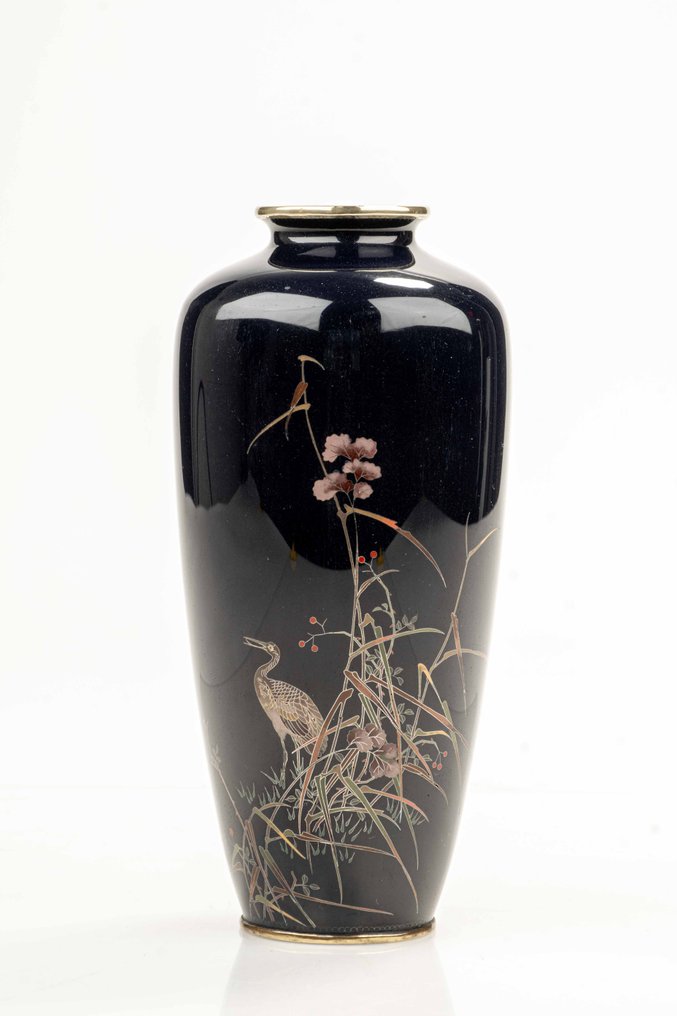
Vase - Enamel, A dark blue ground cloisonné vase with a crane and bamboo by a riverside. - Japan - Meiji period (late 19th century)


04
days
19
hours
20
minutes
30
seconds
Current bid
€ 2
Reserve price not met

Expert
Selected by Giovanni Bottero
Holds a master’s in Japanese art history with over 10 years’ expertise in Asian art.
Estimate € 800 - € 900
21 other people are watching this object
 Bidder 2566 Bidder 2566 | €2 | |
|---|---|---|
 Bidder 8800 Bidder 8800 | €1 |
Catawiki Buyer Protection
Your payment’s safe with us until you receive your object.View details
Trustpilot 4.4 | 122115 reviews
Rated Excellent on Trustpilot.
Cloisonné vase on a dark blue ground depicting a crane and bamboo by a riverside, Meiji period (late 19th century), Japan; dimensions 8.5 cm wide, 18 cm high, 8.5 cm deep; in very good condition with minor enamel wear on the neck.
AI-assisted summary
Description from the seller
Cloisonné vase with a dark blue background decorated with a crane on the banks of a watercourse, surrounded by bamboo and other marsh vegetation.
The decor is rendered with polychrome enamels defined by very fine silver threads.
The vase is in excellent condition. Small signs of enamel are present on the neck. Please refer to the images for further details.
The history of bronzes, silvers, and enamels is closely linked to that of an iconic figure of Japan: the Samurai. Throughout the Edo period, from 1603 to 1868, the actual ruling elite controlling the territory was precisely that of the Samurai. It was they who governed, under the guidance of the Daimyo, the various provinces of the country.
When the Edo period ended and the Meiji Restoration began, the social structure of Japan underwent a radical change.
On March 28, 1876, the Haitorei Edict was issued. This measure prohibited samurai from carrying swords in public, under penalty of confiscation.
This state of affairs threw metalworkers into despair, as they suddenly found themselves without trade.
This was only an initial phase, however, because within a short time the artisans themselves reinvented themselves. Over time, they had honed extraordinary artistic skills. Therefore, applying their mastery to alternative production was almost a natural consequence. No longer able to dedicate themselves to the production of armor accessories and swords, they began producing everyday objects, and in many cases, decorative objects.
It was the beginning of great success. Soon, the abundant artistic production received tangible recognition. In fact, it did not go unnoticed by foreign diplomats, travelers, and military advisors who were in Japan at that time.
But national borders were soon crossed, and Japan's participation in world fairs and exhibitions was not long in coming. Hence the veritable explosion of interest in these sublime works of art. This translated into increased demand from Europe and Anglo-Saxon countries in particular, which still today appreciate Japanese art.
We will pack your item with utmost care and entrust it to DHL or FedEx, who will ensure delivery within 1-3 days.
The authenticity certificate compiled by Luca Mastromauro, an expert in Japanese art, will be delivered to the buyer.
218
Seller's Story
Mastromauro Arte Giapponese, based in Milan, specializes in Japanese art, with particular attention to the Edo (1603–1868) and Meiji (1868–1912) periods, while also maintaining an open perspective on more contemporary works.
Here on Catawiki, they offer a part of their collection in every weekly auction.
Translated by Google TranslateCloisonné vase with a dark blue background decorated with a crane on the banks of a watercourse, surrounded by bamboo and other marsh vegetation.
The decor is rendered with polychrome enamels defined by very fine silver threads.
The vase is in excellent condition. Small signs of enamel are present on the neck. Please refer to the images for further details.
The history of bronzes, silvers, and enamels is closely linked to that of an iconic figure of Japan: the Samurai. Throughout the Edo period, from 1603 to 1868, the actual ruling elite controlling the territory was precisely that of the Samurai. It was they who governed, under the guidance of the Daimyo, the various provinces of the country.
When the Edo period ended and the Meiji Restoration began, the social structure of Japan underwent a radical change.
On March 28, 1876, the Haitorei Edict was issued. This measure prohibited samurai from carrying swords in public, under penalty of confiscation.
This state of affairs threw metalworkers into despair, as they suddenly found themselves without trade.
This was only an initial phase, however, because within a short time the artisans themselves reinvented themselves. Over time, they had honed extraordinary artistic skills. Therefore, applying their mastery to alternative production was almost a natural consequence. No longer able to dedicate themselves to the production of armor accessories and swords, they began producing everyday objects, and in many cases, decorative objects.
It was the beginning of great success. Soon, the abundant artistic production received tangible recognition. In fact, it did not go unnoticed by foreign diplomats, travelers, and military advisors who were in Japan at that time.
But national borders were soon crossed, and Japan's participation in world fairs and exhibitions was not long in coming. Hence the veritable explosion of interest in these sublime works of art. This translated into increased demand from Europe and Anglo-Saxon countries in particular, which still today appreciate Japanese art.
We will pack your item with utmost care and entrust it to DHL or FedEx, who will ensure delivery within 1-3 days.
The authenticity certificate compiled by Luca Mastromauro, an expert in Japanese art, will be delivered to the buyer.
218
Seller's Story
Mastromauro Arte Giapponese, based in Milan, specializes in Japanese art, with particular attention to the Edo (1603–1868) and Meiji (1868–1912) periods, while also maintaining an open perspective on more contemporary works.
Here on Catawiki, they offer a part of their collection in every weekly auction.
Translated by Google TranslateDetails
Era
1400-1900
Country of Origin
Japan
Material
A dark blue ground cloisonné vase with a crane and bamboo by a riverside., Enamel
Dynastic Style/Period
Meiji period (late 19th century)
Condition
Excellent condition: barely used with minimal signs of wear
Height
18 cm
Width
8.5 cm
Depth
8.5 cm
Estimated period
1850-1900
Sold by
