Philip Kelly (1950–2010) - NO RESERVE - Interior with green window



07
days
17
hours
03
minutes
42
seconds

24 other people are watching this object
 Bidder 9067 Bidder 9067 | €6 | |
|---|---|---|
 Bidder 5252 Bidder 5252 | €5 |
Catawiki Buyer Protection
Your payment’s safe with us until you receive your object.View details
Trustpilot 4.4 | 123053 reviews
Rated Excellent on Trustpilot.
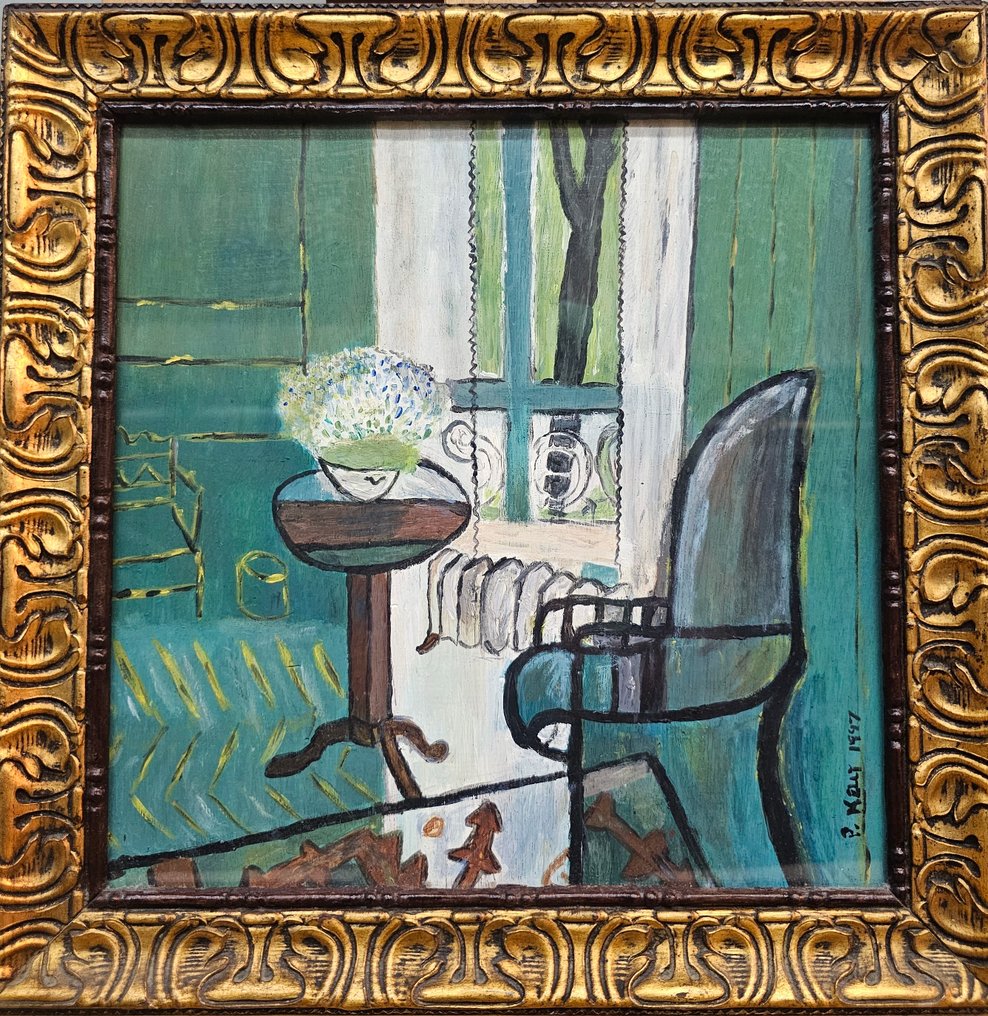
NO RESERVE - Interior with green window is an original oil on panel by Philip Kelly (1950–2010), dated 1997, 38 × 38 cm framed, depicting an illuminated interior in a Fauvist/post-impressionist manner and signed by hand.
AI-assisted summary
Description from the seller
Interior with a green window
Technical Data Sheet
Author: Philip Kelly (1950–2010); bottom right signature and dated 1997.
Chronology: 1997
Technique: Oil on panel
Measurements: 30 × 30 cm (artwork) · 38 × 38 cm (framed).
Support: fabric-covered panel on a frame, protected by glass.
Style: Post-Impressionism Fauvist with Matissean resonances.
Condition: excellent; vivid and balanced surface; golden frame with artistic design and strong visual presence.
Compositional and iconographic description
The painting depicts an indoor domestic scene flooded with light, where an armchair, a table with flowers, and a window open to the outside structure the space in planes of vibrant color.
The color palette dominated by emerald greens, blues, and ochre touches creates a modern sense of serenity.
The black stroke that defines contours and the simplification of volumes evoke the graphic synthesis of French Fauvism, while the interplay between interior and exterior enhances the sense of luminous intimacy.
The radiator, the translucent curtain, and the linear details of the furniture create a dynamic visual rhythm that combines order and spontaneity, reminiscent of the poetic interiors of Henri Matisse.
Style, Context, and Comparative Valuation
Philip Kelly, an Irish-born artist with roots in contemporary European art, developed a language of pure color and rhythmic composition that aligns with the principles of Raoul Dufy, Pierre Bonnard, and Jean Metzinger.
In this work, the artist achieves a masterful balance between geometric structure and chromatic lyricism, transforming an everyday corner into a celebration of light and form.
The date of 1997 places the piece in its mature stylistic phase, where Kelly consolidates an intimate and sophisticated aesthetic.
Due to its compositional refinement, the solidity of its stroke, and its affinity with the French Fauvist legacy, Interior with Green Window can be considered a work of high aesthetic and collector interest, representative of European modern sensitivity in the second half of the 20th century.
Seller's Story
At Barcelona Art Gallery, we are a large family of art collectors in Barcelona who have been acquiring all kinds of paintings for 2 centuries.
Headquartered in the Les Corts neighborhood of Barcelona.
We offer part of our private collection for auction: high period and modern paintings that we have been acquiring over time, mainly from art galleries, antique dealers, auctions, private collections and very diverse origins.
Translated by Google TranslateInterior with a green window
Technical Data Sheet
Author: Philip Kelly (1950–2010); bottom right signature and dated 1997.
Chronology: 1997
Technique: Oil on panel
Measurements: 30 × 30 cm (artwork) · 38 × 38 cm (framed).
Support: fabric-covered panel on a frame, protected by glass.
Style: Post-Impressionism Fauvist with Matissean resonances.
Condition: excellent; vivid and balanced surface; golden frame with artistic design and strong visual presence.
Compositional and iconographic description
The painting depicts an indoor domestic scene flooded with light, where an armchair, a table with flowers, and a window open to the outside structure the space in planes of vibrant color.
The color palette dominated by emerald greens, blues, and ochre touches creates a modern sense of serenity.
The black stroke that defines contours and the simplification of volumes evoke the graphic synthesis of French Fauvism, while the interplay between interior and exterior enhances the sense of luminous intimacy.
The radiator, the translucent curtain, and the linear details of the furniture create a dynamic visual rhythm that combines order and spontaneity, reminiscent of the poetic interiors of Henri Matisse.
Style, Context, and Comparative Valuation
Philip Kelly, an Irish-born artist with roots in contemporary European art, developed a language of pure color and rhythmic composition that aligns with the principles of Raoul Dufy, Pierre Bonnard, and Jean Metzinger.
In this work, the artist achieves a masterful balance between geometric structure and chromatic lyricism, transforming an everyday corner into a celebration of light and form.
The date of 1997 places the piece in its mature stylistic phase, where Kelly consolidates an intimate and sophisticated aesthetic.
Due to its compositional refinement, the solidity of its stroke, and its affinity with the French Fauvist legacy, Interior with Green Window can be considered a work of high aesthetic and collector interest, representative of European modern sensitivity in the second half of the 20th century.
Seller's Story
At Barcelona Art Gallery, we are a large family of art collectors in Barcelona who have been acquiring all kinds of paintings for 2 centuries.
Headquartered in the Les Corts neighborhood of Barcelona.
We offer part of our private collection for auction: high period and modern paintings that we have been acquiring over time, mainly from art galleries, antique dealers, auctions, private collections and very diverse origins.
Translated by Google TranslateDetails
Artist
Philip Kelly (1950–2010)
Sold with frame
Yes
Sold by
Gallery
Edition
Original
Title of artwork
NO RESERVE - Interior with green window
Technique
Oil painting
Signature
Hand signed
Country of Origin
Mexico
Condition
Excellent condition
Height
38 cm
Width
38 cm
Weight
2 kg
Depiction/Theme
Interior scene
Style
Fauvism
Period
1990-2000
Sold by
