Philip Kelly (1950–2010) - The Red House



10
days
00
hours
22
minutes
01
second

No bids placed
Catawiki Buyer Protection
Your payment’s safe with us until you receive your object.View details
Trustpilot 4.4 | 121899 reviews
Rated Excellent on Trustpilot.
Description from the seller
Spring Path towards the Red House
Philip Kelly (1950–2010)
Technical sheet
Author: Philip Kelly (1950–2010)
Spring Path towards the Red House
Chronology: 1994
Technique: Mixed media on paper (watercolor, ink, and gouache)
Measurements: 12 × 16 cm (artwork) — 20 × 24 cm (with frame)
Support: Fine fiber paper, framed and protected by glass.
Style: Contemporary Expressionism of Fauvist origin.
Condition: Excellent, vibrant colors and stable paper.
2. Compositional and iconographic description
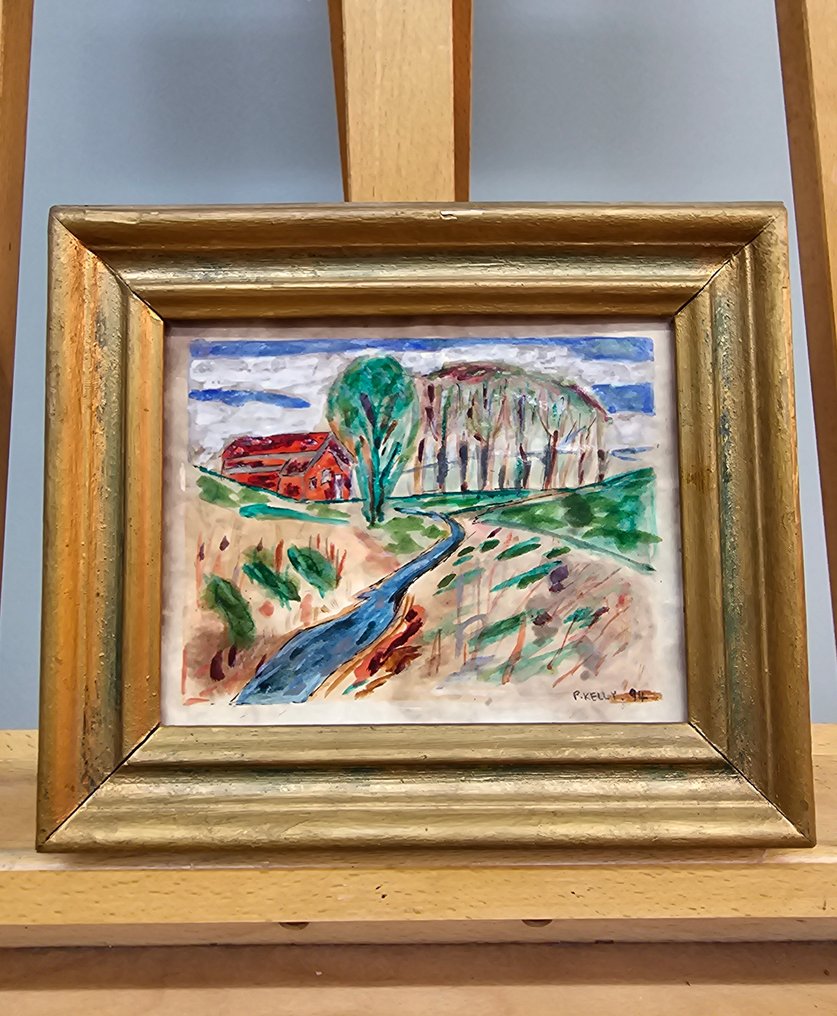
The work presents a vibrant and lyrical landscape, articulated through a winding path that leads to a red house, a frequent motif in Philip Kelly's more gestural work. The brushwork is loose, nervous, and full of intention, with a marked economy of detail that emphasizes the atmospheric sensation over literal description.
The chromaticism—dominated by emerald greens, damp blues, and intense reds—reveals the direct influence of Fauvism (Derain, Matisse), but filtered through Kelly's unmistakable character: a warm, almost musical spontaneity. The vertical trees occupying the middle zone of the painting form a rhythmic screen, while the central path acts as both a narrative and visual axis.
The set creates an impression of movement, transparency, and freshness, as if the landscape were observed in a fleeting and emotional moment.
3. Style, Comparison, and Assessment
The piece fully fits within the contemporary expressionist-fauvist language that characterizes Philip Kelly, with stylistic affinities to artists such as Oskar Kokoschka, Raoul Dufy, and certain late works of Emil Nolde, especially in chromatic freedom and motif synthesis.
Unlike the great Fauves, Kelly brings a particular, intimate, almost domestic lyricism that gives this small format an unexpected strength. In the contemporary art market, Kelly's works on paper — especially those from the 1990s, a period of maturity — are highly valued for their spontaneity and chromatic strength.
This work, due to its vibrant colors, compositional harmony, and excellent condition, constitutes a magnificent example of the artist and an attractive collectible within modern European art.
Seller's Story
At Barcelona Art Gallery, we are a large family of art collectors in Barcelona who have been acquiring all kinds of paintings for 2 centuries.
Headquartered in the Les Corts neighborhood of Barcelona.
We offer part of our private collection for auction: high period and modern paintings that we have been acquiring over time, mainly from art galleries, antique dealers, auctions, private collections and very diverse origins.
Translated by Google TranslateSpring Path towards the Red House
Philip Kelly (1950–2010)
Technical sheet
Author: Philip Kelly (1950–2010)
Spring Path towards the Red House
Chronology: 1994
Technique: Mixed media on paper (watercolor, ink, and gouache)
Measurements: 12 × 16 cm (artwork) — 20 × 24 cm (with frame)
Support: Fine fiber paper, framed and protected by glass.
Style: Contemporary Expressionism of Fauvist origin.
Condition: Excellent, vibrant colors and stable paper.
2. Compositional and iconographic description
The work presents a vibrant and lyrical landscape, articulated through a winding path that leads to a red house, a frequent motif in Philip Kelly's more gestural work. The brushwork is loose, nervous, and full of intention, with a marked economy of detail that emphasizes the atmospheric sensation over literal description.
The chromaticism—dominated by emerald greens, damp blues, and intense reds—reveals the direct influence of Fauvism (Derain, Matisse), but filtered through Kelly's unmistakable character: a warm, almost musical spontaneity. The vertical trees occupying the middle zone of the painting form a rhythmic screen, while the central path acts as both a narrative and visual axis.
The set creates an impression of movement, transparency, and freshness, as if the landscape were observed in a fleeting and emotional moment.
3. Style, Comparison, and Assessment
The piece fully fits within the contemporary expressionist-fauvist language that characterizes Philip Kelly, with stylistic affinities to artists such as Oskar Kokoschka, Raoul Dufy, and certain late works of Emil Nolde, especially in chromatic freedom and motif synthesis.
Unlike the great Fauves, Kelly brings a particular, intimate, almost domestic lyricism that gives this small format an unexpected strength. In the contemporary art market, Kelly's works on paper — especially those from the 1990s, a period of maturity — are highly valued for their spontaneity and chromatic strength.
This work, due to its vibrant colors, compositional harmony, and excellent condition, constitutes a magnificent example of the artist and an attractive collectible within modern European art.
Seller's Story
At Barcelona Art Gallery, we are a large family of art collectors in Barcelona who have been acquiring all kinds of paintings for 2 centuries.
Headquartered in the Les Corts neighborhood of Barcelona.
We offer part of our private collection for auction: high period and modern paintings that we have been acquiring over time, mainly from art galleries, antique dealers, auctions, private collections and very diverse origins.
Translated by Google TranslateDetails
Artist
Philip Kelly (1950–2010)
Sold with frame
Yes
Sold by
Gallery
Edition
Original
Title of artwork
The Red House
Technique
Mixed media
Signature
Hand signed
Country of Origin
Mexico
Sold with stand
No
Condition
Excellent condition
Height
38 cm
Width
38 cm
Weight
2 kg
Depiction/Theme
Plants and flowers
Style
Fauvism
Period
1990-2000
Sold by
