Karl Klaus Körner - Die glatte Vorderlader-Artillerie der k.k. Marine 1750 - 1866/375 Abbildungen - 2015



02
days
13
hours
30
minutes
08
seconds

11 other people are watching this object
 Bidder 1111 Bidder 1111 | €23 | |
|---|---|---|
 Bidder 7891 Bidder 7891 | €18 | |
| Bidder 7891 | €8 | |
Catawiki Buyer Protection
Your payment’s safe with us until you receive your object.View details
Trustpilot 4.4 | 122190 reviews
Rated Excellent on Trustpilot.
Description from the seller
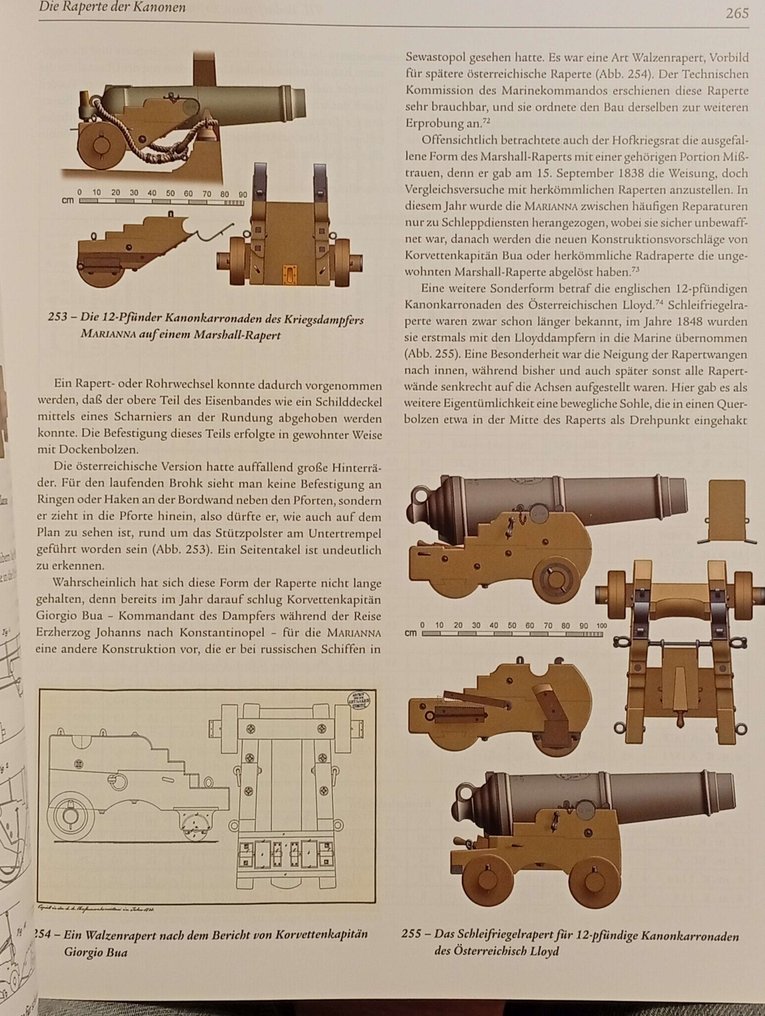
The smoothbore front-line artillery: the k. k. Navy 1750 – 1866
With 480 images, mostly color photos/color sketches.
This 480-page illustrated volume describes the armament of the Austrian fleet with ship guns and its development from the second half of the 18th century to the introduction of rifled cannons for ship artillery. The author, Dr. Karl Klaus Körner, presents a unique source work after more than 40 years of research in Austrian and foreign archives, which not only fills significant gaps but also provides, for the first time, a deep insight into the weapon technology development of the Austrian Navy. A warship is not an end in itself. Its weapons are the means to achieve set goals. While ship artillery from the first rifled cannons of the 19th century is generally well documented, comprehensive accounts of smoothbore muzzle loaders were missing—even among the great lake nations—until recent times. For the k.k. Navy, such accounts did not exist and still do not. This may be related to the fact that Austria’s early naval tradition was subjected to two major disruptions. The incorporation of the remnants of the Venetian fleets in 1798, along with unsuitable naval artillery, was more of a burden than an advantage. After losing access to the sea in 1809, the political reorganization following the Napoleonic Wars left the k.k. Navy with a rich legacy of ships and usable artillery material. Austria relied on this for the next decades and only very late was forced to equip its naval forces with the necessary means from its own resources. During the era of smoothbore muzzle loaders, the naval artillery was a hodgepodge of different systems, designs, and origins. This book traces all these traces.
Condition: light signs of use and aging on the SU, inside: clean and with a firm binding.
The smoothbore front-line artillery: the k. k. Navy 1750 – 1866
With 480 images, mostly color photos/color sketches.
This 480-page illustrated volume describes the armament of the Austrian fleet with ship guns and its development from the second half of the 18th century to the introduction of rifled cannons for ship artillery. The author, Dr. Karl Klaus Körner, presents a unique source work after more than 40 years of research in Austrian and foreign archives, which not only fills significant gaps but also provides, for the first time, a deep insight into the weapon technology development of the Austrian Navy. A warship is not an end in itself. Its weapons are the means to achieve set goals. While ship artillery from the first rifled cannons of the 19th century is generally well documented, comprehensive accounts of smoothbore muzzle loaders were missing—even among the great lake nations—until recent times. For the k.k. Navy, such accounts did not exist and still do not. This may be related to the fact that Austria’s early naval tradition was subjected to two major disruptions. The incorporation of the remnants of the Venetian fleets in 1798, along with unsuitable naval artillery, was more of a burden than an advantage. After losing access to the sea in 1809, the political reorganization following the Napoleonic Wars left the k.k. Navy with a rich legacy of ships and usable artillery material. Austria relied on this for the next decades and only very late was forced to equip its naval forces with the necessary means from its own resources. During the era of smoothbore muzzle loaders, the naval artillery was a hodgepodge of different systems, designs, and origins. This book traces all these traces.
Condition: light signs of use and aging on the SU, inside: clean and with a firm binding.
Details
Number of Books
1
Subject
History, Military, Ships and seafaring, War history
Book Title
Die glatte Vorderlader-Artillerie der k.k. Marine 1750 - 1866/375 Abbildungen
Author/ Illustrator
Karl Klaus Körner
Condition
Good
Publication year oldest item
2015
Edition
Illustrated Edition
Language
German
Original language
Yes
Binding/ Material
Hardback
Number of pages
480
