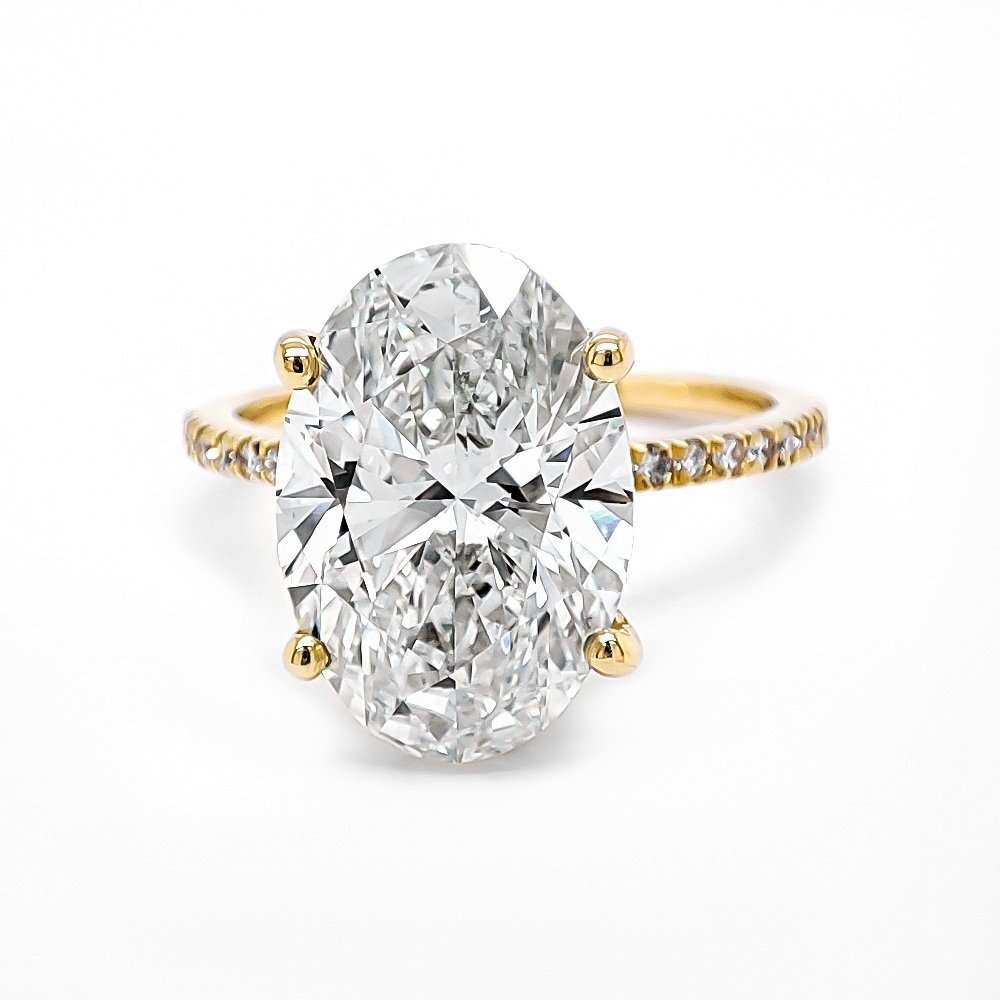
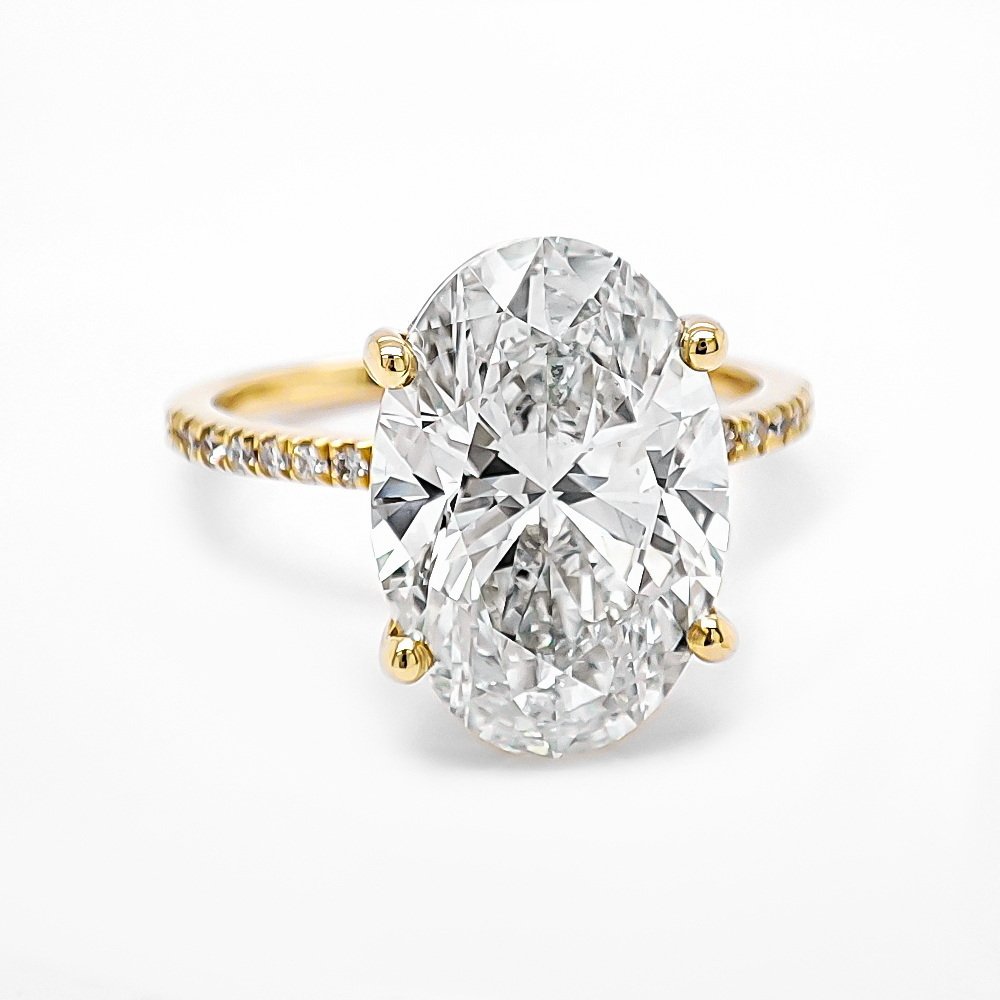
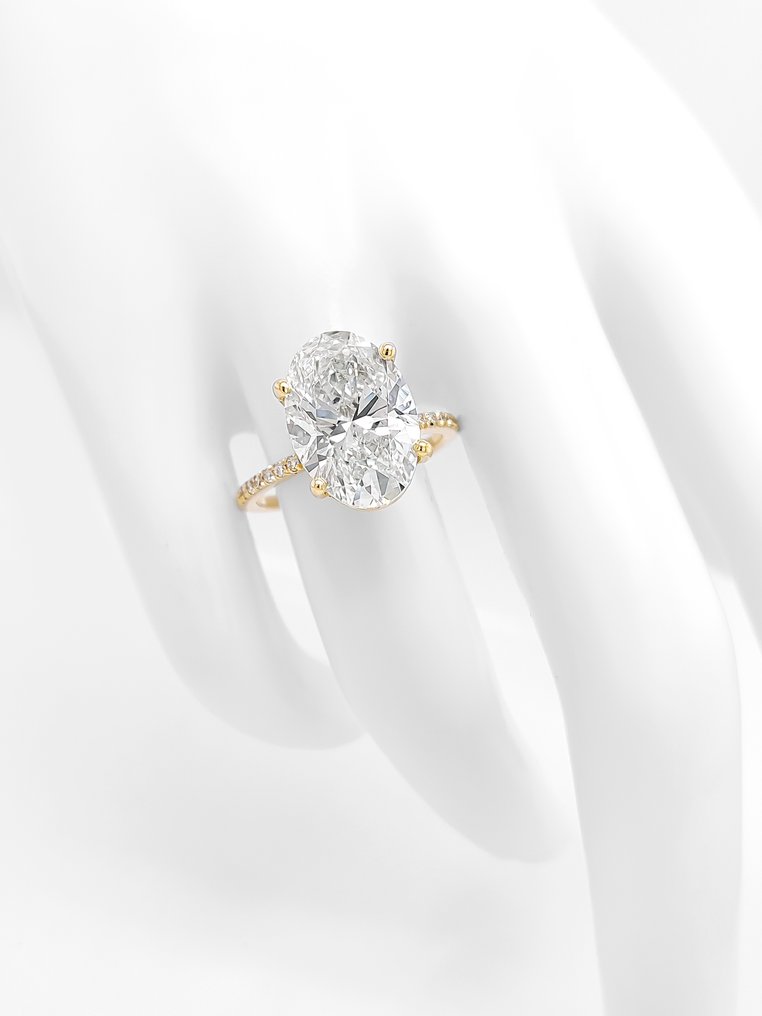
Ring - 14 kt. F/VVS2, Yellow gold - 6.17ct. tw. Diamond (Lab-grown) - Diamond - IGI Certified


01
day
00
hours
51
minutes
02
seconds
Current bid
€ 1,480
Reserve price not met

Expert
Selected by Chumeng Weng
Holds a master’s in contemporary jewellery design and certified pearl specialist.
Retail Estimate € 12,000 - € 14,000
14 other people are watching this object
 Bidder 4339 Bidder 4339 | €1,480 | |
|---|---|---|
| Bidder 4339 | €1,280 | |
| Bidder 4339 | €380 | |
Catawiki Buyer Protection
Your payment’s safe with us until you receive your object.View details
Trustpilot 4.4 | 122473 reviews
Rated Excellent on Trustpilot.
A 14 kt yellow gold ring (4.10 g, size 55 EU) featuring a 6.01 ct lab-grown oval brilliant main diamond (color F, clarity VVS2) with 18 lab-grown round brilliant surrounding stones totaling 0.16 ct, IGI certified.
AI-assisted summary
Description from the seller
Diamond Information:
______________________
Stones Type: Lab-Grown Diamond
Shape: Oval Brilliant
Carat Weight: 6.01 Carat
Color: F
Clarity: VVS2
Polish: Excellent
Symmetry: Excellent
Sides Diamond Information:
______________________
Stones Type: Lab-Grown Diamond
Shape: Round Brilliant
Carat Weight: 0.16 Carat
Quantity: 18
Ring Information:
____________________
Gold Type: 14 kt / stamped 14k
Gold Color: Yellow
Weight: 4.10 gr
Ring Size: 55 mm / 17.50 mm / 7.25 us
★ Shipments are insured and tracked by FedEx or DHL.
★ IGI certificate LG681573135 included and a luxury box.
➤ PLEASE NOTE
_________________
* Your country of residence may impose additional VAT, customs, and import fees which are the sole responsibility of the buyer.
* In Hong Kong the VAT is 0%.
* If the winning bidder decides to cancel/withdraw they will bear the risk, cost of all shipping, and return import duties of the seller.
---French and Portuguese bidders---
Please be aware that you may need a customs broker, which will be solely your responsibility.
In case you need any help with that, don't hesitate to get in touch with us.
---Chinese bidders---
Please note that your purchase can be sent only to Hong Kong or Macao.
What are lab-grown Diamonds?
Lab-grown diamonds are diamonds produced by scientists using technology that recreates the conditions under which diamonds form deep in the earth. A lab-grown diamond is chemically, physically, and optically identical to diamonds that formed naturally - the only factor that makes them different from a natural diamond is that they originate from a lab. For that reason, lab-grown diamonds cannot be considered ‘rare’ or ‘unique’ and as such they represent a more affordable option when compared to natural diamonds and are valued at a considerable lower price per carat.
Diamond Information:
______________________
Stones Type: Lab-Grown Diamond
Shape: Oval Brilliant
Carat Weight: 6.01 Carat
Color: F
Clarity: VVS2
Polish: Excellent
Symmetry: Excellent
Sides Diamond Information:
______________________
Stones Type: Lab-Grown Diamond
Shape: Round Brilliant
Carat Weight: 0.16 Carat
Quantity: 18
Ring Information:
____________________
Gold Type: 14 kt / stamped 14k
Gold Color: Yellow
Weight: 4.10 gr
Ring Size: 55 mm / 17.50 mm / 7.25 us
★ Shipments are insured and tracked by FedEx or DHL.
★ IGI certificate LG681573135 included and a luxury box.
➤ PLEASE NOTE
_________________
* Your country of residence may impose additional VAT, customs, and import fees which are the sole responsibility of the buyer.
* In Hong Kong the VAT is 0%.
* If the winning bidder decides to cancel/withdraw they will bear the risk, cost of all shipping, and return import duties of the seller.
---French and Portuguese bidders---
Please be aware that you may need a customs broker, which will be solely your responsibility.
In case you need any help with that, don't hesitate to get in touch with us.
---Chinese bidders---
Please note that your purchase can be sent only to Hong Kong or Macao.
What are lab-grown Diamonds?
Lab-grown diamonds are diamonds produced by scientists using technology that recreates the conditions under which diamonds form deep in the earth. A lab-grown diamond is chemically, physically, and optically identical to diamonds that formed naturally - the only factor that makes them different from a natural diamond is that they originate from a lab. For that reason, lab-grown diamonds cannot be considered ‘rare’ or ‘unique’ and as such they represent a more affordable option when compared to natural diamonds and are valued at a considerable lower price per carat.
Details
Era
After 2000
Shape of surrounding stones
Round
Total carat weight of all stones
6.17
Diamond type of main stone
Lab-grown
Laboratory Report
International Gemological Institute (IGI)
Diamond type of surrounding stones
Lab-grown
Diamond colour grade of main stone
F
Cutting style of surrounding stones
Brilliant cut
Fineness
14 kt.
Brand jewellery
No
Number of diamonds surrounding stones
18
Number of diamonds main stone
1
Metal
F/VVS2, Yellow gold
Total carat weight of surrounding stones
0.16
Total carat weight of main stone(s)
6.01
Main Stone
Diamond
Diamond clarity grade of main stone
VVS2
Surrounding Stones
Diamond
Total weight
4.1 g
Condition
New
Gender
Women
Title additional information
IGI Certified
Shape of main stone
Oval
Cutting style of main stone
Brilliant cut
Ring size
55 (EU) / 15 (IT) / 7 ¼ (US)
Sold by
Disclaimer
Catawiki always aims to offer you the best possible buying experience. Our experts virtually review and select every object in line with our submission guidelines. While we strive to provide a detailed description and photographs of each jewellery object, discrepancies or inaccuracies may occur. It is your responsibility to review all of the information provided about an object, including the condition and description, before placing an order. Sellers are responsible for the information, pictures and description provided, including the quality, quantity and nature of the jewellery supplied. A small imperfection that cannot be seen in the photo but is included in the description is not a non-conformity. What are lab-grown diamonds? Lab-grown diamonds are diamonds produced by scientists using technology that recreates the conditions under which diamonds form deep in the earth. A lab-grown diamond is chemically, physically, and optically identical to diamonds that formed naturally - the only factor that makes them different from a natural diamond is that they originate from a lab. For that reason, lab-grown diamonds cannot be considered ‘rare’ or ‘unique’ and as such they represent a more affordable option when compared to natural diamonds and are valued at a considerably lower price per carat. Due to their availability and evolving market dynamics, lab-grown diamonds may not retain value over time and typically do not carry much resale value. A Laboratory Report is not a guarantee, valuation or appraisal regarding the articles described therein. A Laboratory Report contains only the characteristics of an article described after it has been graded, tested, examined, and analysed using the techniques and equipment used at the time of the examination from that specific Gemological Laboratory. The results of any other examination performed on the article may differ depending when, how, by whom and with which grading standard the article is examined. In addition, any changes and improvements in techniques and equipment that may have occurred which may enable the examiner to detect, among other things, the use of processes for altering the characteristics of an article which use was previously undetectable, does not automatically mean the object does not conform to its description.
Catawiki always aims to offer you the best possible buying experience. Our experts virtually review and select every object in line with our submission guidelines. While we strive to provide a detailed description and photographs of each jewellery object, discrepancies or inaccuracies may occur. It is your responsibility to review all of the information provided about an object, including the condition and description, before placing an order. Sellers are responsible for the information, pictures and description provided, including the quality, quantity and nature of the jewellery supplied. A small imperfection that cannot be seen in the photo but is included in the description is not a non-conformity. What are lab-grown diamonds? Lab-grown diamonds are diamonds produced by scientists using technology that recreates the conditions under which diamonds form deep in the earth. A lab-grown diamond is chemically, physically, and optically identical to diamonds that formed naturally - the only factor that makes them different from a natural diamond is that they originate from a lab. For that reason, lab-grown diamonds cannot be considered ‘rare’ or ‘unique’ and as such they represent a more affordable option when compared to natural diamonds and are valued at a considerably lower price per carat. Due to their availability and evolving market dynamics, lab-grown diamonds may not retain value over time and typically do not carry much resale value. A Laboratory Report is not a guarantee, valuation or appraisal regarding the articles described therein. A Laboratory Report contains only the characteristics of an article described after it has been graded, tested, examined, and analysed using the techniques and equipment used at the time of the examination from that specific Gemological Laboratory. The results of any other examination performed on the article may differ depending when, how, by whom and with which grading standard the article is examined. In addition, any changes and improvements in techniques and equipment that may have occurred which may enable the examiner to detect, among other things, the use of processes for altering the characteristics of an article which use was previously undetectable, does not automatically mean the object does not conform to its description.