Henri Auguste Alban Moral (1840–1889) - Light at the Edge of the Forest


01
day
08
hours
03
minutes
51
seconds

20 other people are watching this object
 Bidder 9082 Bidder 9082 | €400 | |
|---|---|---|
| Bidder 9082 | €360 | |
| Bidder 9082 | €320 | |
Catawiki Buyer Protection
Your payment’s safe with us until you receive your object.View details
Trustpilot 4.4 | 122190 reviews
Rated Excellent on Trustpilot.
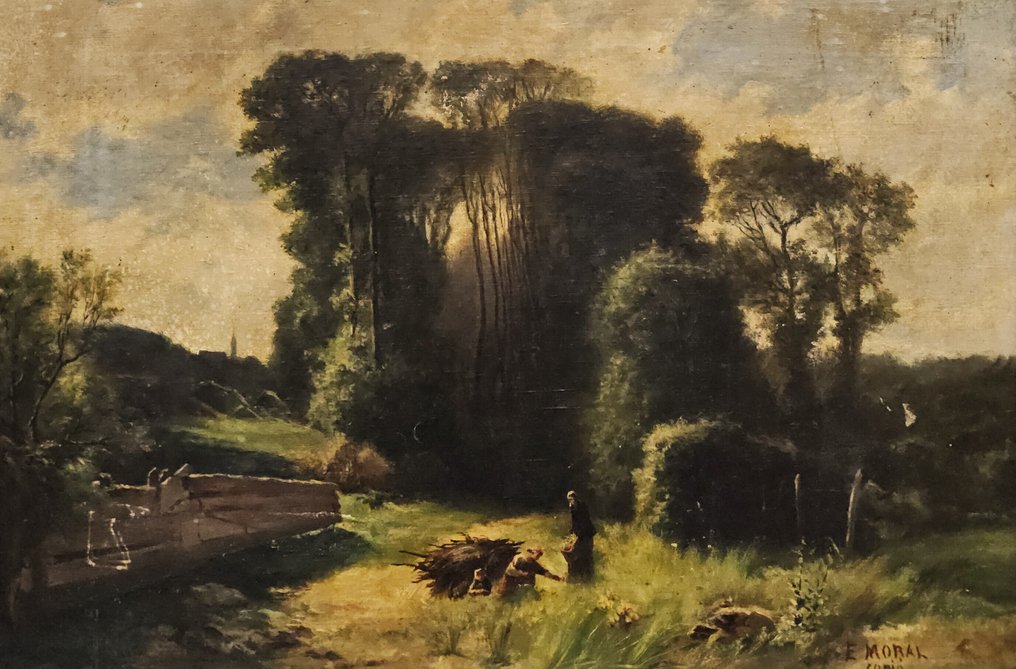
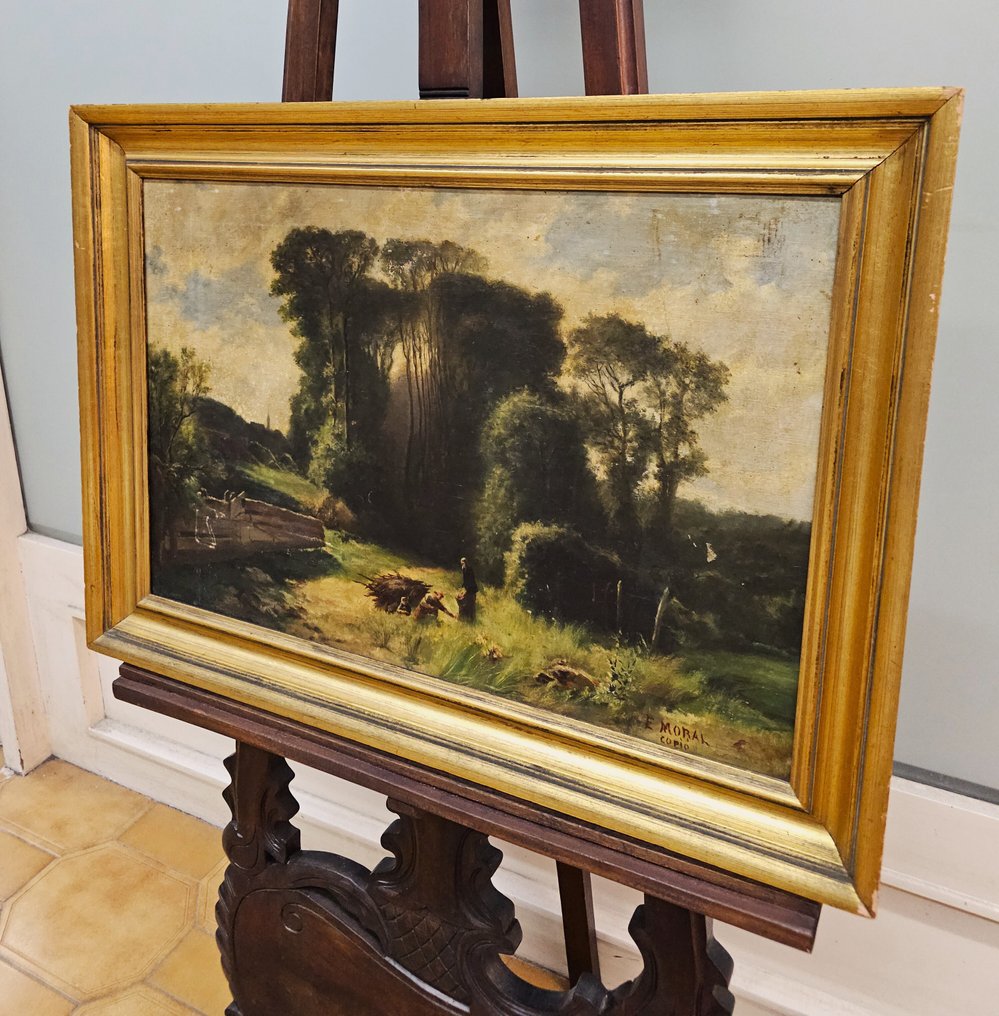
Light at the Edge of the Forest, a 19th‑century oil on panel painting from France, sold with frame.
AI-assisted summary
Description from the seller
Light at the End of the Forest
Technical sheet
Author: Henri Auguste Alban Moral (1840–1889)
Light at the End of the Forest
Chronology: circa 1875–1885
Technique: Oil on panel
Measurements: 45 × 68 cm (panel) • 57 × 80 cm (with frame)
School: Late Barbizon-inspired realistic French school.
Conservation status: Good, with minor losses and superficial craquelure typical of its age.
2. Compositional and iconographic description
The scene depicts a wooded clearing illuminated by twilight light filtering through a dense wall of trees, creating a luminous axis that organizes the entire composition. In the foreground, a group of peasants—a woman, a child, and a man carrying a bundle of branches—introduces a folkloric reading that connects the work to the French naturalist tradition.
Depth is built through a wise alternation of shadowed areas and luminous openings, a typical feature of the Barbizon school. The chromaticism, dominated by ochres, moist greens, and earthy shadows, gives the landscape a silent, intimate, and almost spiritual atmosphere, where light acts as a symbol of transition and hope.
3. Style, Context, and Comparisons
Alban Moral develops a poetic realism, a direct heir of Théodore Rousseau and Charles-François Daubigny, but with more intimate accents and a more blended brushstroke, closer to the sensitivity of Jules Dupré. The presence of peasant figures also recalls Julien Dupré or Léon Lhermitte, although treated with greater narrative discretion.
The work shares qualities with French landscapes from the last third of the 19th century, which are currently highly sought after in the market: the dense atmospheres of Daubigny, the dramatic forests of Karl Daubigny, or the luminous clearings of Henri Harpignies. Light at the End of the Forest stands out for its remarkable theatrical luminosity and its deeply balanced composition, attributes that enhance its aesthetic and collector value.
Seller's Story
At Barcelona Art Gallery, we are a large family of art collectors in Barcelona who have been acquiring all kinds of paintings for 2 centuries.
Headquartered in the Les Corts neighborhood of Barcelona.
We offer part of our private collection for auction: high period and modern paintings that we have been acquiring over time, mainly from art galleries, antique dealers, auctions, private collections and very diverse origins.
Translated by Google TranslateLight at the End of the Forest
Technical sheet
Author: Henri Auguste Alban Moral (1840–1889)
Light at the End of the Forest
Chronology: circa 1875–1885
Technique: Oil on panel
Measurements: 45 × 68 cm (panel) • 57 × 80 cm (with frame)
School: Late Barbizon-inspired realistic French school.
Conservation status: Good, with minor losses and superficial craquelure typical of its age.
2. Compositional and iconographic description
The scene depicts a wooded clearing illuminated by twilight light filtering through a dense wall of trees, creating a luminous axis that organizes the entire composition. In the foreground, a group of peasants—a woman, a child, and a man carrying a bundle of branches—introduces a folkloric reading that connects the work to the French naturalist tradition.
Depth is built through a wise alternation of shadowed areas and luminous openings, a typical feature of the Barbizon school. The chromaticism, dominated by ochres, moist greens, and earthy shadows, gives the landscape a silent, intimate, and almost spiritual atmosphere, where light acts as a symbol of transition and hope.
3. Style, Context, and Comparisons
Alban Moral develops a poetic realism, a direct heir of Théodore Rousseau and Charles-François Daubigny, but with more intimate accents and a more blended brushstroke, closer to the sensitivity of Jules Dupré. The presence of peasant figures also recalls Julien Dupré or Léon Lhermitte, although treated with greater narrative discretion.
The work shares qualities with French landscapes from the last third of the 19th century, which are currently highly sought after in the market: the dense atmospheres of Daubigny, the dramatic forests of Karl Daubigny, or the luminous clearings of Henri Harpignies. Light at the End of the Forest stands out for its remarkable theatrical luminosity and its deeply balanced composition, attributes that enhance its aesthetic and collector value.
Seller's Story
At Barcelona Art Gallery, we are a large family of art collectors in Barcelona who have been acquiring all kinds of paintings for 2 centuries.
Headquartered in the Les Corts neighborhood of Barcelona.
We offer part of our private collection for auction: high period and modern paintings that we have been acquiring over time, mainly from art galleries, antique dealers, auctions, private collections and very diverse origins.
Translated by Google TranslateDetails
Artist
Henri Auguste Alban Moral (1840–1889)
Sold with frame
Yes
Title of artwork
Light at the Edge of the Forest
Technique
Oil painting
Signature
Hand signed
Country of Origin
France
Year
1880
Condition
Fair condition
Height
57 cm
Width
80 cm
Weight
4 kg
Depiction/Theme
Landscape
Style
Barbizon school
Period
19th century
Sold by
