Daprés Van Gogh (XX) - The return home



09
days
19
hours
02
minutes
31
seconds

No bids placed
Catawiki Buyer Protection
Your payment’s safe with us until you receive your object.View details
Trustpilot 4.4 | 121899 reviews
Rated Excellent on Trustpilot.
The return home, 1980-1990, oil painting from France by Daprés Van Gogh (XX), sold with frame.
AI-assisted summary
Description from the seller
After Vincent van Gogh — European School, Second Half of the 20th Century
Technical sheet
The Return Home
Artist: Anonymous, after Vincent van Gogh
Chronology: Second half of the 20th century
Technique: oil on canvas
Measurements: 28 × 46 cm (unframed) — 38 × 56 cm (framed)
Support: Canvas coated with a material
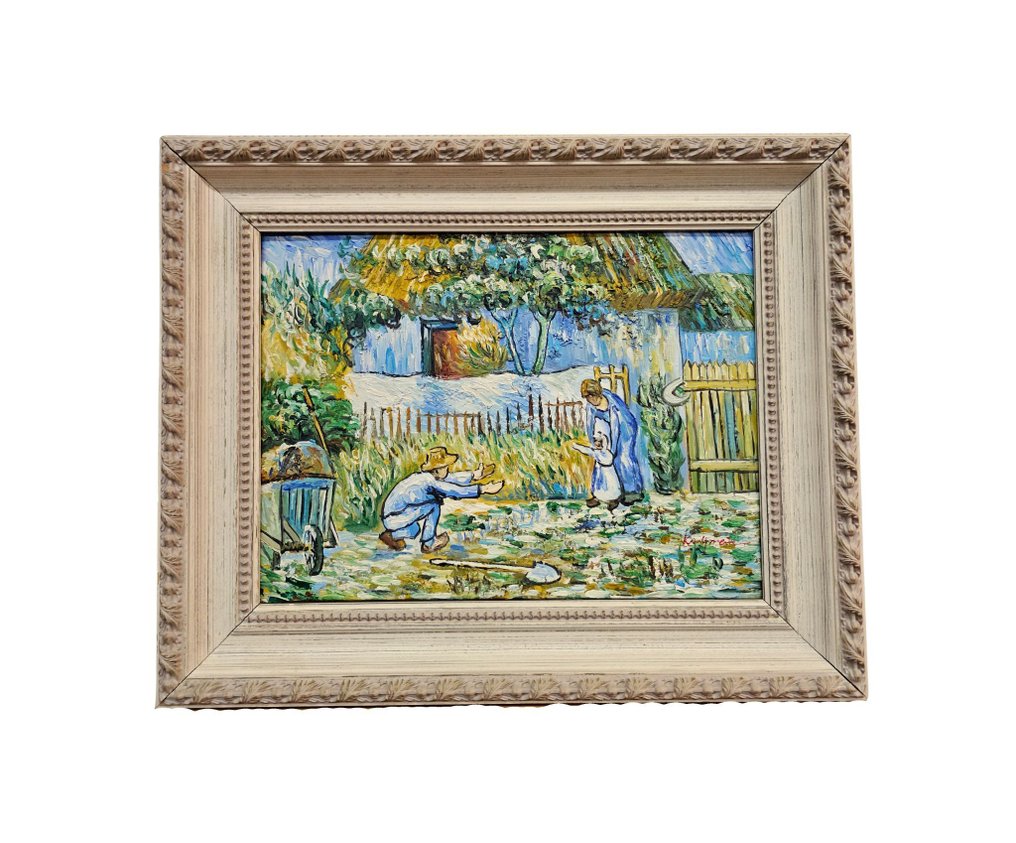
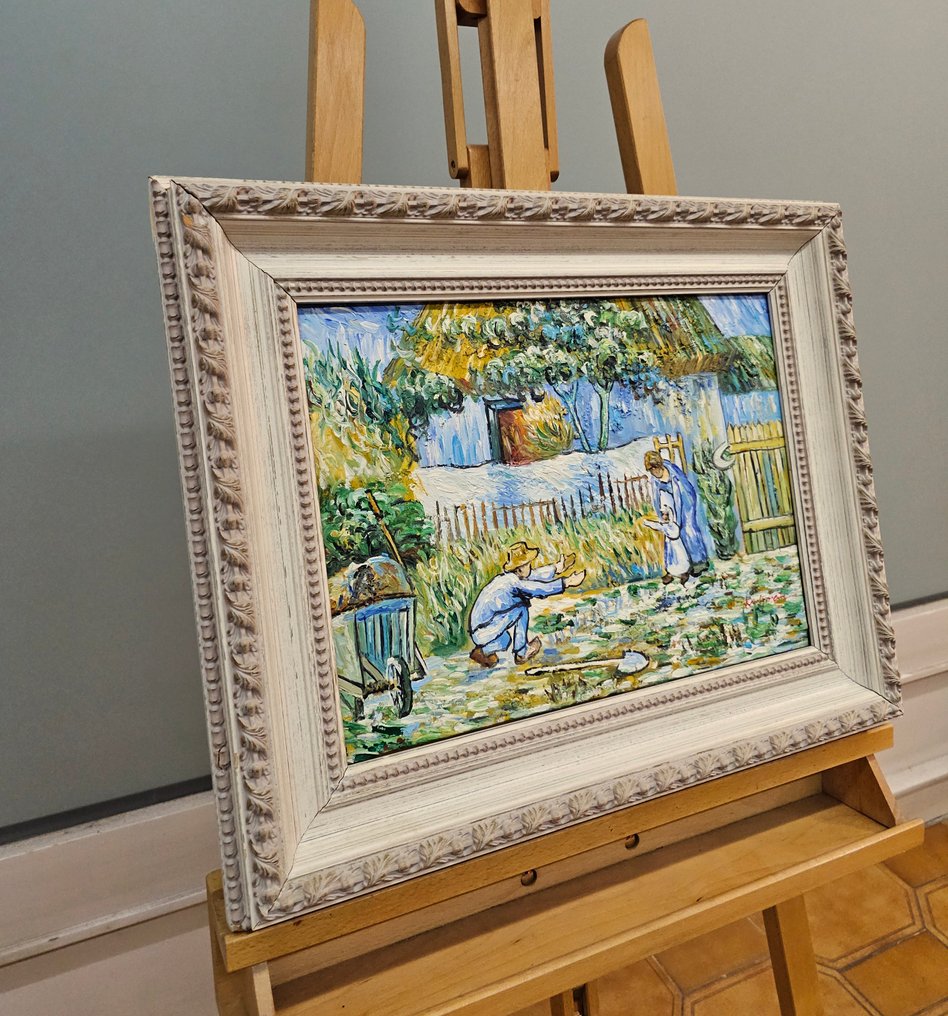
Beautiful wooden framed frame carved in wood, patinated in ivory and pearl gray tones, with raised vegetal details that add elegance and aesthetic coherence to the overall piece.
Style: Neo-postimpressionism; expressive reinterpretation of Van Gogh's pictorial universe.
Company: visible in the lower right corner.
Condition: Good
2. Compositional and iconographic description
The work reinterprets Van Gogh's rural universe with warmth and vibrant color, using energetic, thick, and nervous brushstrokes that directly evoke the style of the Dutch master. The composition depicts a domestic scene: a peasant kneeling with arms outstretched toward his young son, guided by the maternal figure, in a gesture of tenderness that humanizes the landscape.
The scene opens before a house with white walls and a thatched roof, surrounded by vibrant vegetation applied in dense layers of yellow, green, and blue. The short, rhythmic, and multidirectional brushstroke recalls both Ruen's White House and Van Gogh's Gardens of Arles, while the human expressiveness connects with the peasant scenes of The Potato Eaters.
The treatment of light enhances the warm and familiar atmosphere, accentuated by small touches of pure color. The space, slightly tilted and dynamic, responds to the emotional and subjective character inherited from Van Gogh.
3. STYLE, CONTEXT AND EVALUATION
The painting clearly belongs to the lineage of modern reinterpretations of Van Gogh carried out during the second half of the 20th century, a period in which numerous artists adopted his vibrant style and peasant-themed subject matter. The work relates to neo-postimpressionism and to the decorative market's interest in recovering the master's affective and popular iconography.
Compared to the studies after Van Gogh conducted by artists such as Émile Schuffenecker or Jacob Baart de la Faille, as well as highly valued contemporary reinterpretations in the European market.
Its expressive strength, luminous color, and emotional family narrative give it aesthetic value and commercial appeal, especially enhanced by the elegant carved frame that highlights the scene as a decorative and collectible piece.
Seller's Story
At Barcelona Art Gallery, we are a large family of art collectors in Barcelona who have been acquiring all kinds of paintings for 2 centuries.
Headquartered in the Les Corts neighborhood of Barcelona.
We offer part of our private collection for auction: high period and modern paintings that we have been acquiring over time, mainly from art galleries, antique dealers, auctions, private collections and very diverse origins.
Translated by Google Translate
After Vincent van Gogh — European School, Second Half of the 20th Century
Technical sheet
The Return Home
Artist: Anonymous, after Vincent van Gogh
Chronology: Second half of the 20th century
Technique: oil on canvas
Measurements: 28 × 46 cm (unframed) — 38 × 56 cm (framed)
Support: Canvas coated with a material
Beautiful wooden framed frame carved in wood, patinated in ivory and pearl gray tones, with raised vegetal details that add elegance and aesthetic coherence to the overall piece.
Style: Neo-postimpressionism; expressive reinterpretation of Van Gogh's pictorial universe.
Company: visible in the lower right corner.
Condition: Good
2. Compositional and iconographic description
The work reinterprets Van Gogh's rural universe with warmth and vibrant color, using energetic, thick, and nervous brushstrokes that directly evoke the style of the Dutch master. The composition depicts a domestic scene: a peasant kneeling with arms outstretched toward his young son, guided by the maternal figure, in a gesture of tenderness that humanizes the landscape.
The scene opens before a house with white walls and a thatched roof, surrounded by vibrant vegetation applied in dense layers of yellow, green, and blue. The short, rhythmic, and multidirectional brushstroke recalls both Ruen's White House and Van Gogh's Gardens of Arles, while the human expressiveness connects with the peasant scenes of The Potato Eaters.
The treatment of light enhances the warm and familiar atmosphere, accentuated by small touches of pure color. The space, slightly tilted and dynamic, responds to the emotional and subjective character inherited from Van Gogh.
3. STYLE, CONTEXT AND EVALUATION
The painting clearly belongs to the lineage of modern reinterpretations of Van Gogh carried out during the second half of the 20th century, a period in which numerous artists adopted his vibrant style and peasant-themed subject matter. The work relates to neo-postimpressionism and to the decorative market's interest in recovering the master's affective and popular iconography.
Compared to the studies after Van Gogh conducted by artists such as Émile Schuffenecker or Jacob Baart de la Faille, as well as highly valued contemporary reinterpretations in the European market.
Its expressive strength, luminous color, and emotional family narrative give it aesthetic value and commercial appeal, especially enhanced by the elegant carved frame that highlights the scene as a decorative and collectible piece.
Seller's Story
At Barcelona Art Gallery, we are a large family of art collectors in Barcelona who have been acquiring all kinds of paintings for 2 centuries.
Headquartered in the Les Corts neighborhood of Barcelona.
We offer part of our private collection for auction: high period and modern paintings that we have been acquiring over time, mainly from art galleries, antique dealers, auctions, private collections and very diverse origins.
Translated by Google TranslateDetails
Artist
Daprés Van Gogh (XX)
Sold with frame
Yes
Sold by
Gallery
Edition
Original
Title of artwork
The return home
Technique
Oil painting
Signature
Hand signed
Country of Origin
France
Condition
Good condition
Height
38 cm
Width
56 cm
Weight
3 kg
Depiction/Theme
Landscape
Style
Post-Impressionism
Period
1980-1990
Sold by
