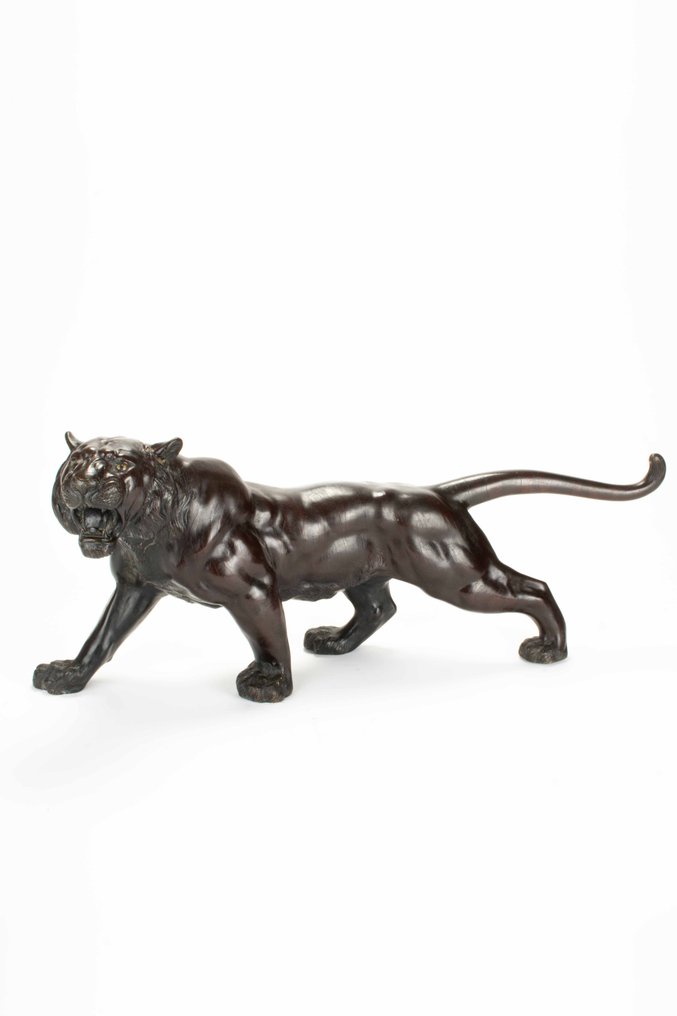
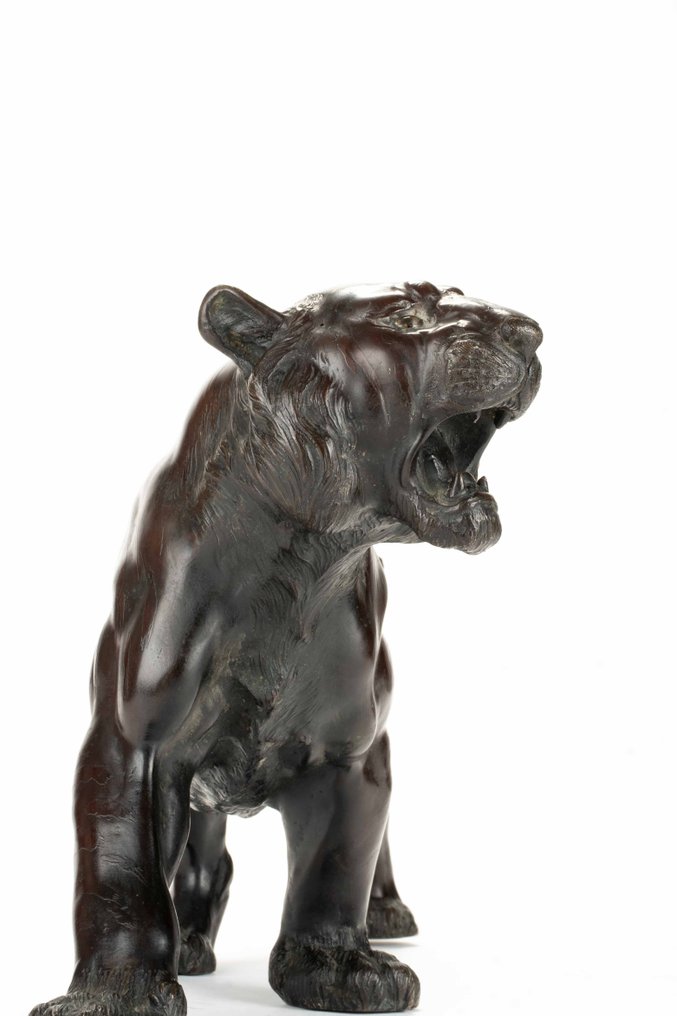
Bronze - A large and powerful bronze sculpture of a roaring tiger with the stripes highlighted. - Meiji period (1868-1912)


05
days
05
hours
42
minutes
45
seconds
Current bid
€ 450
Reserve price not met

Expert
Selected by Giovanni Bottero
Holds a master’s in Japanese art history with over 10 years’ expertise in Asian art.
Estimate € 1,800 - € 2,000
13 other people are watching this object
 Bidder 5621 Bidder 5621 | €450 | |
|---|---|---|
 Bidder 4700 Bidder 4700 | €100 | |
| Bidder 4700 | €1 |
Catawiki Buyer Protection
Your payment’s safe with us until you receive your object.View details
Trustpilot 4.4 | 122630 reviews
Rated Excellent on Trustpilot.
A large patinated bronze sculpture of a powerful roaring tiger from Japan, Meiji period (1868–1912), with a signature incised under the belly, dimensions 63 cm wide by 26 cm high by 14 cm deep, in excellent condition.
AI-assisted summary
Description from the seller
Bronze sculpture with a patina depicting a powerful roaring tiger.
The animal's posture is engaging, with its hind legs bent, tail curled upward along the final part, and its body positioned obliquely, ending with the head slightly turned to the left.
Marking incised below the belly.
---The okimono is in excellent condition. There is minimal wear consistent with its age. Please refer to the images for further details.
The word 'Okimono' derives from Japanese and literally means 'object to be placed,' composed of the kanji 'oki' (置き), which means 'to place,' and 'mono' (物), which means 'object.'
These decorative sculptures were particularly appreciated during the Meiji period towards the end of the 19th century, thanks to the strong demand from Western countries.
Japanese sculptors and artisans had already demonstrated their skill in working with materials such as lacquers, bronzes, and netsuke, thanks to their excellent carving and inlay techniques. Subsequently, some of them dedicated themselves to sculpting ivory, horn, and blocks of wood, particularly boxwood.
Among the most important sculpture schools is the Tokyo School founded by Ishikawa Komei, as well as notable sculptors such as Shimamura Shunmei and Yoshida Homei.
We will pack your item with utmost care and entrust it to DHL or FedEx, who will ensure delivery within 1-3 days.
The authenticity certificate compiled by Luca Mastromauro, an expert in Japanese art, will be delivered to the buyer.
084
Seller's Story
Mastromauro Arte Giapponese, based in Milan, specializes in Japanese art, with particular attention to the Edo (1603–1868) and Meiji (1868–1912) periods, while also maintaining an open perspective on more contemporary works.
Here on Catawiki, they offer a part of their collection in every weekly auction.
Translated by Google TranslateBronze sculpture with a patina depicting a powerful roaring tiger.
The animal's posture is engaging, with its hind legs bent, tail curled upward along the final part, and its body positioned obliquely, ending with the head slightly turned to the left.
Marking incised below the belly.
---The okimono is in excellent condition. There is minimal wear consistent with its age. Please refer to the images for further details.
The word 'Okimono' derives from Japanese and literally means 'object to be placed,' composed of the kanji 'oki' (置き), which means 'to place,' and 'mono' (物), which means 'object.'
These decorative sculptures were particularly appreciated during the Meiji period towards the end of the 19th century, thanks to the strong demand from Western countries.
Japanese sculptors and artisans had already demonstrated their skill in working with materials such as lacquers, bronzes, and netsuke, thanks to their excellent carving and inlay techniques. Subsequently, some of them dedicated themselves to sculpting ivory, horn, and blocks of wood, particularly boxwood.
Among the most important sculpture schools is the Tokyo School founded by Ishikawa Komei, as well as notable sculptors such as Shimamura Shunmei and Yoshida Homei.
We will pack your item with utmost care and entrust it to DHL or FedEx, who will ensure delivery within 1-3 days.
The authenticity certificate compiled by Luca Mastromauro, an expert in Japanese art, will be delivered to the buyer.
084
Seller's Story
Mastromauro Arte Giapponese, based in Milan, specializes in Japanese art, with particular attention to the Edo (1603–1868) and Meiji (1868–1912) periods, while also maintaining an open perspective on more contemporary works.
Here on Catawiki, they offer a part of their collection in every weekly auction.
Translated by Google TranslateDetails
Dynastic Style/Period
Meiji period (1868-1912)
Country of Origin
Japan
Material
Bronze
Condition
Excellent condition
Title of artwork
A large and powerful bronze sculpture of a roaring tiger with the stripes highlighted.
Height
26 cm
Width
63 cm
Depth
14 cm
Sold by
