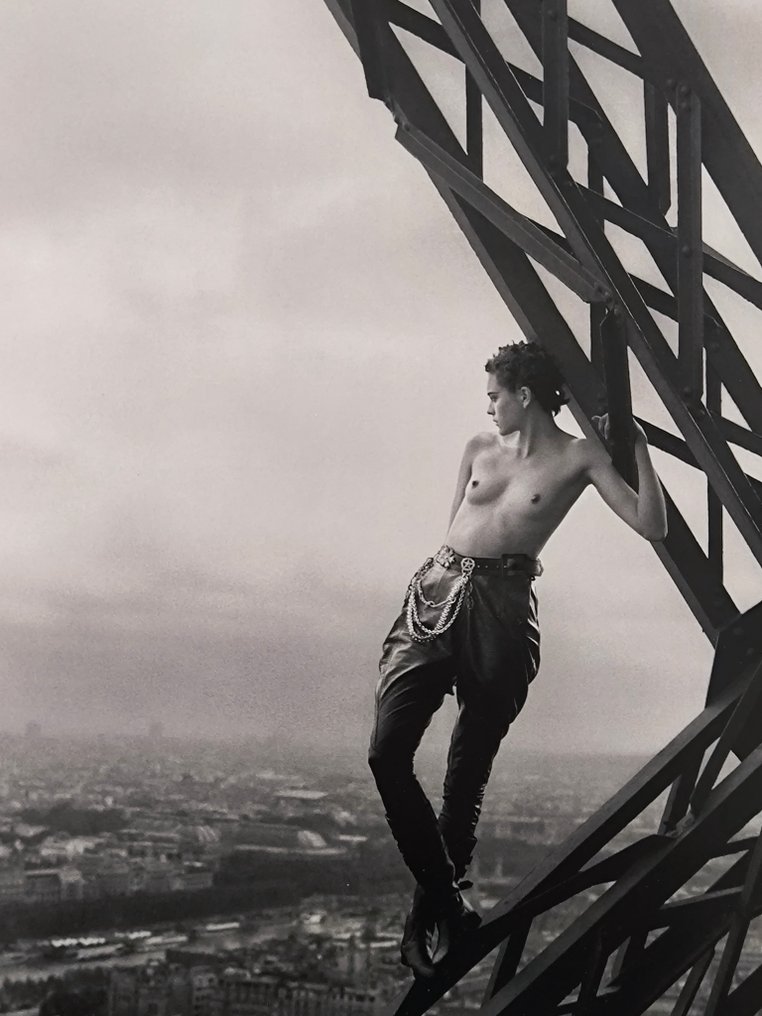
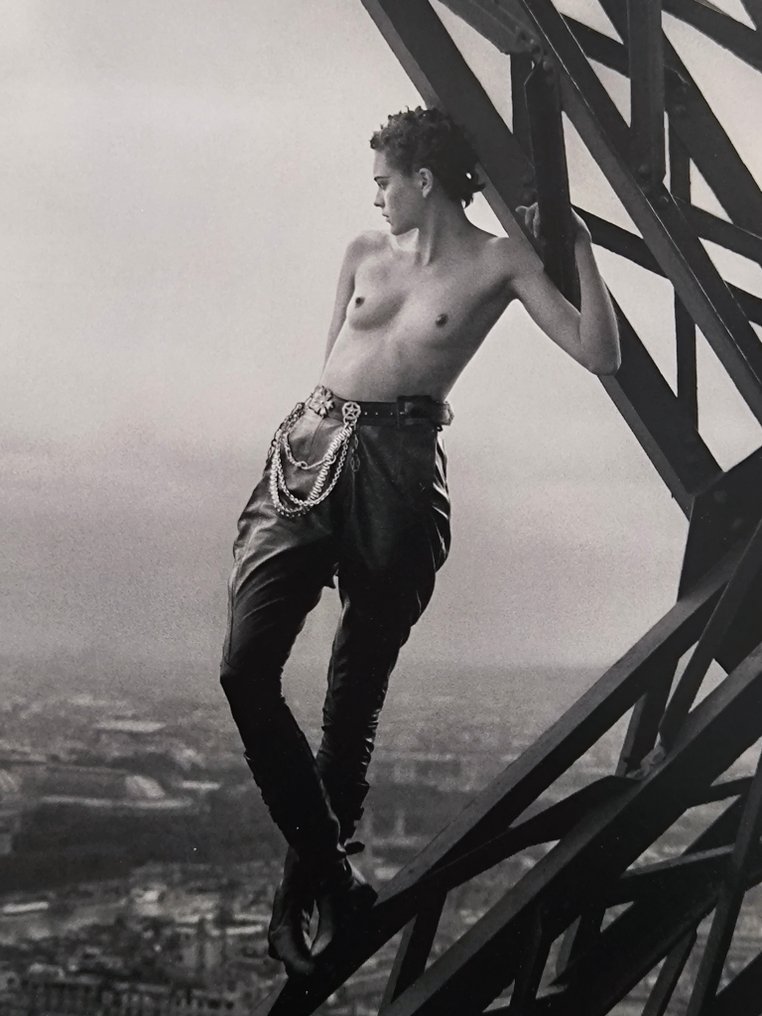
Peter Lindbergh - Mathilde, Torre Eiffel, Rolling Stone, 1989
06
days
03
hours
33
minutes
41
seconds

9 other people are watching this object
 Bidder 2895 Bidder 2895 | €15 | |
|---|---|---|
 Bidder 5273 Bidder 5273 | €10 | |
| Bidder 2895 | €9 | |
Catawiki Buyer Protection
Your payment’s safe with us until you receive your object.View details
Trustpilot 4.4 | 122630 reviews
Rated Excellent on Trustpilot.
Description from the seller
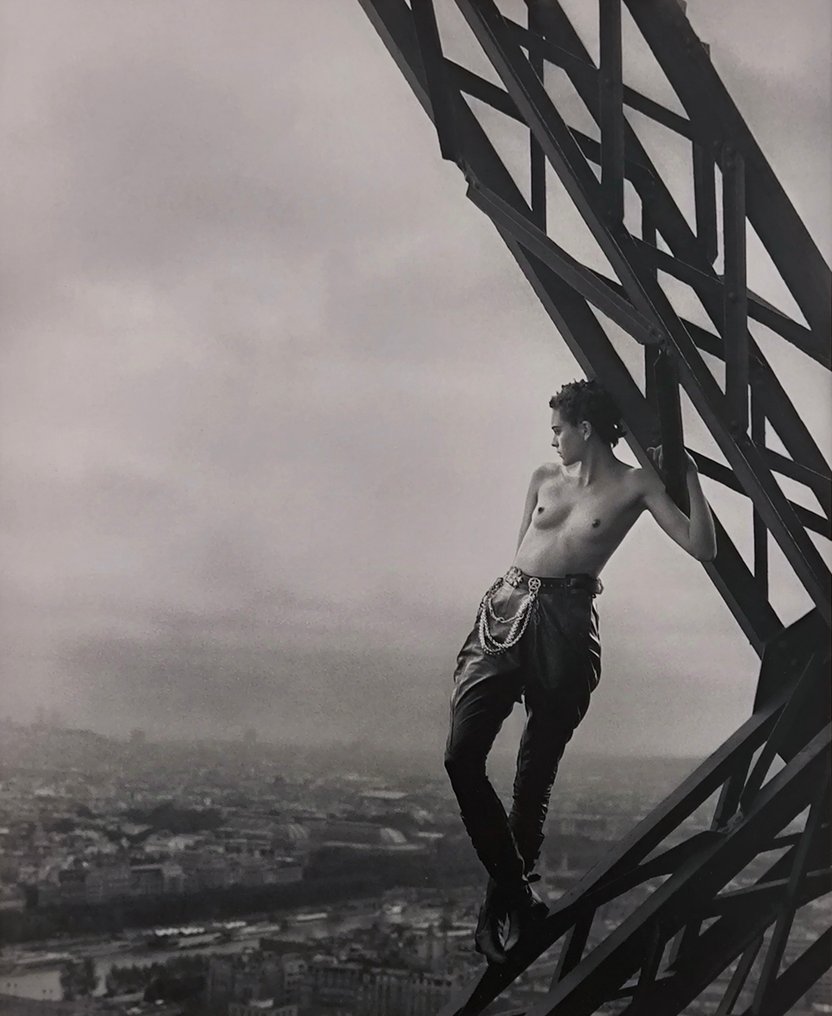
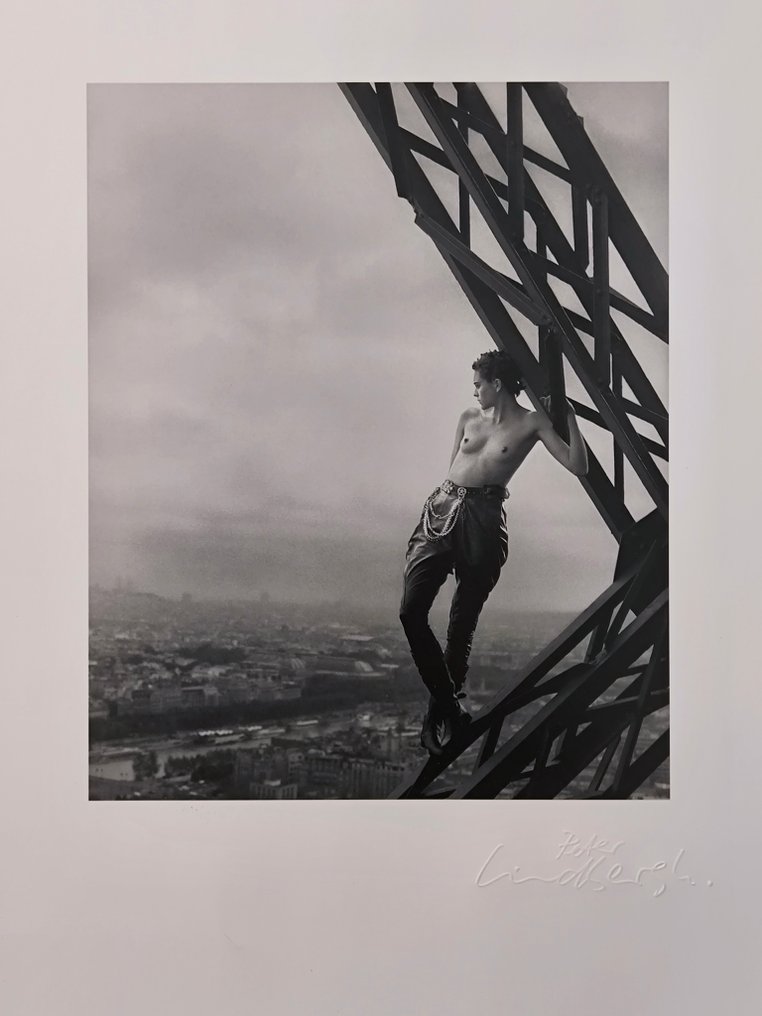
Peter Lindbergh. Mathilde, Torre Eiffel, Rolling Stone, 1989.
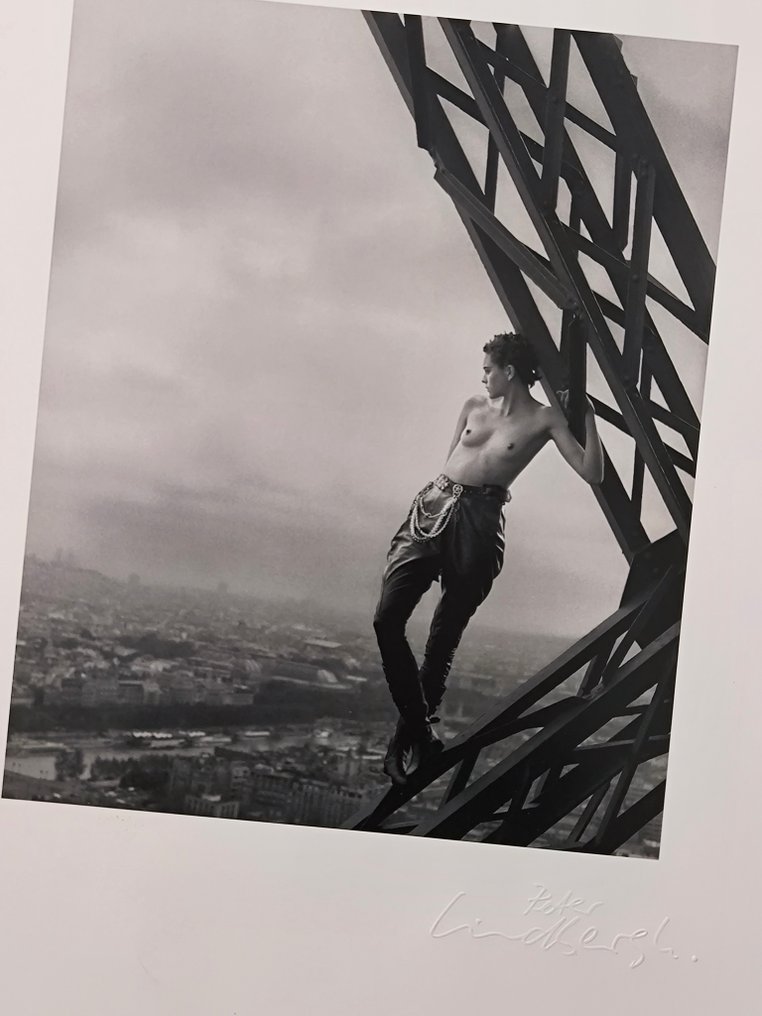
'Copyright 2006 Peter Lindbergh' on the back of the image. Artist's dry stamp in the lower right corner of the image. Total dimensions: 41,5 x 31,5 cm on semi-gloss paper. Fine condition. Printed Lated, 2000's.
In this photograph created for Rolling Stone in 1989, Peter Lindbergh pays a direct and deliberate homage to one of the great visual icons of the 20th century: Marc Riboud’s Eiffel Tower Painter (1953). If Riboud transformed the suspended worker into a symbol of balance, risk, and modernity, Lindbergh reimagines the scene with a different kind of boldness: replacing the laborer with the poised, statuesque figure of model Mathilde, perched on the iron lattice above Paris with effortless composure.
Here, the Tower becomes a temporal hinge —a structure linking the humanist gaze of the postwar era with the cleaner, cinematic, and minimalist aesthetic that defines Lindbergh’s work. The model’s body aligns with the strict geometry of the metal beams, while the city unfolds in a soft, misty horizon. The resulting image becomes a dialogue between fragility and strength, the human figure and architectural iconography. It encapsulates Lindbergh’s visual philosophy: beauty without artifice, clean light, emotional truth.
Peter Lindbergh is one of the most influential fashion photographers of the 20th century, largely responsible for the rise of the supermodel phenomenon and for shifting fashion photography away from glossy glamour toward a more honest, intimate, and timeless representation of women. His work for Vogue, Harper’s Bazaar, Rolling Stone, and Interview reshaped editorial portraiture from the late 1980s onward.
He stands among the essential photographers of his era, alongside: Man Ray, Helmut Newton, Richard Avedon, Irving Penn, Horst P. Horst, Edward Weston, Diane Arbus, Robert Mapplethorpe, Elliott Erwitt, Marc Riboud, Robert Doisneau, Steve McCurry, Sebastião Salgado, Werner Bischof, Henri Cartier-Bresson, Ansel Adams, Eugene Smith, Alfred Stieglitz, Cindy Sherman, and Guy Bourdin, among many others.
A visually striking and emotionally resonant piece, emblematic of Lindbergh’s elegant and stripped-down style —and directly connected to one of the most iconic photographic archetypes of the 20th century: the human silhouette suspended above the city of Paris.
Peter Lindbergh. Mathilde, Torre Eiffel, Rolling Stone, 1989.
'Copyright 2006 Peter Lindbergh' on the back of the image. Artist's dry stamp in the lower right corner of the image. Total dimensions: 41,5 x 31,5 cm on semi-gloss paper. Fine condition. Printed Lated, 2000's.
In this photograph created for Rolling Stone in 1989, Peter Lindbergh pays a direct and deliberate homage to one of the great visual icons of the 20th century: Marc Riboud’s Eiffel Tower Painter (1953). If Riboud transformed the suspended worker into a symbol of balance, risk, and modernity, Lindbergh reimagines the scene with a different kind of boldness: replacing the laborer with the poised, statuesque figure of model Mathilde, perched on the iron lattice above Paris with effortless composure.
Here, the Tower becomes a temporal hinge —a structure linking the humanist gaze of the postwar era with the cleaner, cinematic, and minimalist aesthetic that defines Lindbergh’s work. The model’s body aligns with the strict geometry of the metal beams, while the city unfolds in a soft, misty horizon. The resulting image becomes a dialogue between fragility and strength, the human figure and architectural iconography. It encapsulates Lindbergh’s visual philosophy: beauty without artifice, clean light, emotional truth.
Peter Lindbergh is one of the most influential fashion photographers of the 20th century, largely responsible for the rise of the supermodel phenomenon and for shifting fashion photography away from glossy glamour toward a more honest, intimate, and timeless representation of women. His work for Vogue, Harper’s Bazaar, Rolling Stone, and Interview reshaped editorial portraiture from the late 1980s onward.
He stands among the essential photographers of his era, alongside: Man Ray, Helmut Newton, Richard Avedon, Irving Penn, Horst P. Horst, Edward Weston, Diane Arbus, Robert Mapplethorpe, Elliott Erwitt, Marc Riboud, Robert Doisneau, Steve McCurry, Sebastião Salgado, Werner Bischof, Henri Cartier-Bresson, Ansel Adams, Eugene Smith, Alfred Stieglitz, Cindy Sherman, and Guy Bourdin, among many others.
A visually striking and emotionally resonant piece, emblematic of Lindbergh’s elegant and stripped-down style —and directly connected to one of the most iconic photographic archetypes of the 20th century: the human silhouette suspended above the city of Paris.
Details
Artist
Peter Lindbergh
Sold by
Owner or reseller
Title of artwork
Mathilde, Torre Eiffel, Rolling Stone, 1989
Condition
Fine
Technique
Photolithography
Height
415 mm
Edition
© 2006 Peter Lindbergh
Width
315 mm
Signature
Plate signed
Genre
Fashion
Sold by