Spanish contemporary school (XX) - Symphony of bodies in transparency


01
day
06
hours
35
minutes
16
seconds

36 other people are watching this object
| Bidder 1012 | €220 | |
|---|---|---|
 Bidder 7515 Bidder 7515 | €200 | |
| Bidder 1012 | €190 | |
Catawiki Buyer Protection
Your payment’s safe with us until you receive your object.View details
Trustpilot 4.4 | 122529 reviews
Rated Excellent on Trustpilot.
Description from the seller
Symphony of Bodies in Transparency
Contemporary Spanish School (1960s–1980s)
Mixed media on canvas · 100 x 80 cm
Technical sheet
Symphony of Bodies in Transparency
Contemporary Spanish School (attributable to the Basque/Madrid environment, second half of the 20th century)
Chronology: circa 1970–1990
Technique: Mixed on canvas (fluid painting similar to gouache/watercolor + expressive line in oil/acrylic)
Measurements: 102 × 83 cm
Signed: Arrue?
Support: raw canvas with visible texture.
Style: Neo-figurative expressionism with Fauvist and pop influences.
Condition: Excellent; bright colors, firm fabric, and stable surface.
2. Compositional and iconographic description
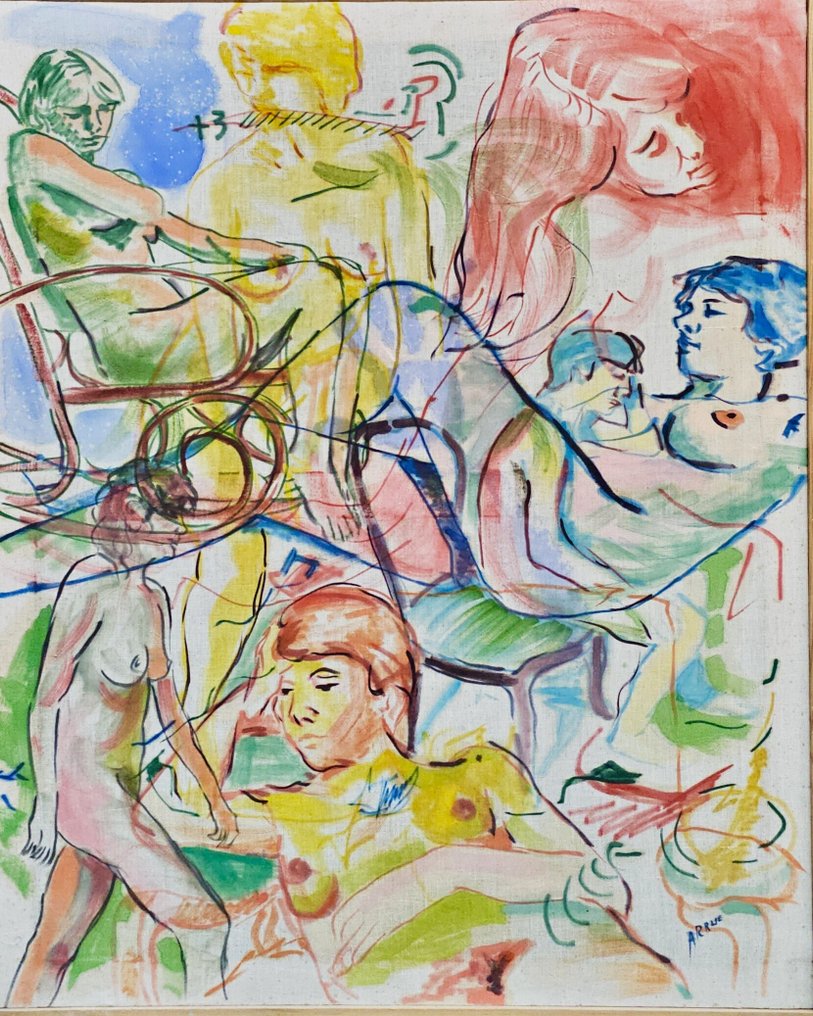
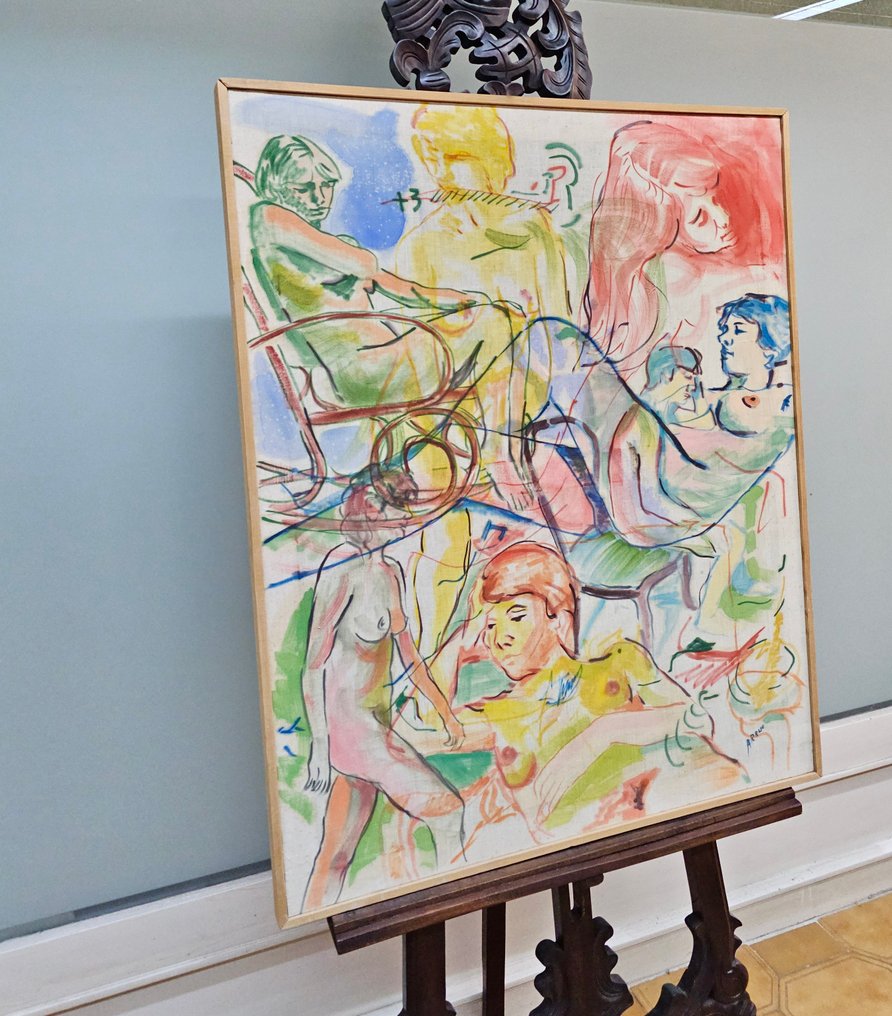
The work presents a choreography of overlapping female nudity, executed with expressive gestures that envelop the canvas in a vibrant rhythm.
The figures, drawn with quick, continuous lines, unfold in transparent layers reminiscent of Egon Schiele's emotional drawing and Klimt's study notes, while the vibrant palette — greens, yellows, pinks, and blues — evokes the luminous spontaneity of French Fauvism.
The background is built as a dynamic field of watery stains and colorful glazes, typical of lyrical expressionism, where bodies merge and separate in an atmosphere that oscillates between the dreamlike and the sensual.
The composition is a mosaic of female poses resolved with great freshness and contemporaneity, bringing its spirit closer to Spanish artists of the New Figuration, such as Arranz-Bravo, Saura, or the Catalan School of Color.
3. Style, Context, and Artistic Valuation
The piece is fully aligned with Spanish neo-figurativism from the 70s to 90s, a period when many artists reclaimed the figure through gesture, color, and emotion, after decades dominated by abstraction.
The free line, the polyphonic structure, and the superposition of figures connect with the tradition of European expressionist drawing, while also adopting a visual language very close to the pop and psychedelic currents of the period.
The result is a highly expressive, modern, and unique work that converges references to Matisse, Dufy, Nolde, Schiele, and contemporary Spanish figuration.
Its large format, visual energy, and richness of its mixed technique make it a piece with a strong decorative presence and notable collector's interest within modern figurative art.
Seller's Story
At Barcelona Art Gallery, we are a large family of art collectors in Barcelona who have been acquiring all kinds of paintings for 2 centuries.
Headquartered in the Les Corts neighborhood of Barcelona.
We offer part of our private collection for auction: high period and modern paintings that we have been acquiring over time, mainly from art galleries, antique dealers, auctions, private collections and very diverse origins.
Translated by Google TranslateSymphony of Bodies in Transparency
Contemporary Spanish School (1960s–1980s)
Mixed media on canvas · 100 x 80 cm
Technical sheet
Symphony of Bodies in Transparency
Contemporary Spanish School (attributable to the Basque/Madrid environment, second half of the 20th century)
Chronology: circa 1970–1990
Technique: Mixed on canvas (fluid painting similar to gouache/watercolor + expressive line in oil/acrylic)
Measurements: 102 × 83 cm
Signed: Arrue?
Support: raw canvas with visible texture.
Style: Neo-figurative expressionism with Fauvist and pop influences.
Condition: Excellent; bright colors, firm fabric, and stable surface.
2. Compositional and iconographic description
The work presents a choreography of overlapping female nudity, executed with expressive gestures that envelop the canvas in a vibrant rhythm.
The figures, drawn with quick, continuous lines, unfold in transparent layers reminiscent of Egon Schiele's emotional drawing and Klimt's study notes, while the vibrant palette — greens, yellows, pinks, and blues — evokes the luminous spontaneity of French Fauvism.
The background is built as a dynamic field of watery stains and colorful glazes, typical of lyrical expressionism, where bodies merge and separate in an atmosphere that oscillates between the dreamlike and the sensual.
The composition is a mosaic of female poses resolved with great freshness and contemporaneity, bringing its spirit closer to Spanish artists of the New Figuration, such as Arranz-Bravo, Saura, or the Catalan School of Color.
3. Style, Context, and Artistic Valuation
The piece is fully aligned with Spanish neo-figurativism from the 70s to 90s, a period when many artists reclaimed the figure through gesture, color, and emotion, after decades dominated by abstraction.
The free line, the polyphonic structure, and the superposition of figures connect with the tradition of European expressionist drawing, while also adopting a visual language very close to the pop and psychedelic currents of the period.
The result is a highly expressive, modern, and unique work that converges references to Matisse, Dufy, Nolde, Schiele, and contemporary Spanish figuration.
Its large format, visual energy, and richness of its mixed technique make it a piece with a strong decorative presence and notable collector's interest within modern figurative art.
Seller's Story
At Barcelona Art Gallery, we are a large family of art collectors in Barcelona who have been acquiring all kinds of paintings for 2 centuries.
Headquartered in the Les Corts neighborhood of Barcelona.
We offer part of our private collection for auction: high period and modern paintings that we have been acquiring over time, mainly from art galleries, antique dealers, auctions, private collections and very diverse origins.
Translated by Google TranslateDetails
Artist
Spanish contemporary school (XX)
Sold with frame
Yes
Sold by
Gallery
Edition
Original
Title of artwork
Symphony of bodies in transparency
Technique
Oil painting
Signature
Hand signed
Country of Origin
Spain
Condition
Good condition
Height
102 cm
Width
83 cm
Weight
3 kg
Style
Post-Impressionism
Period
1960-1970
Sold by
