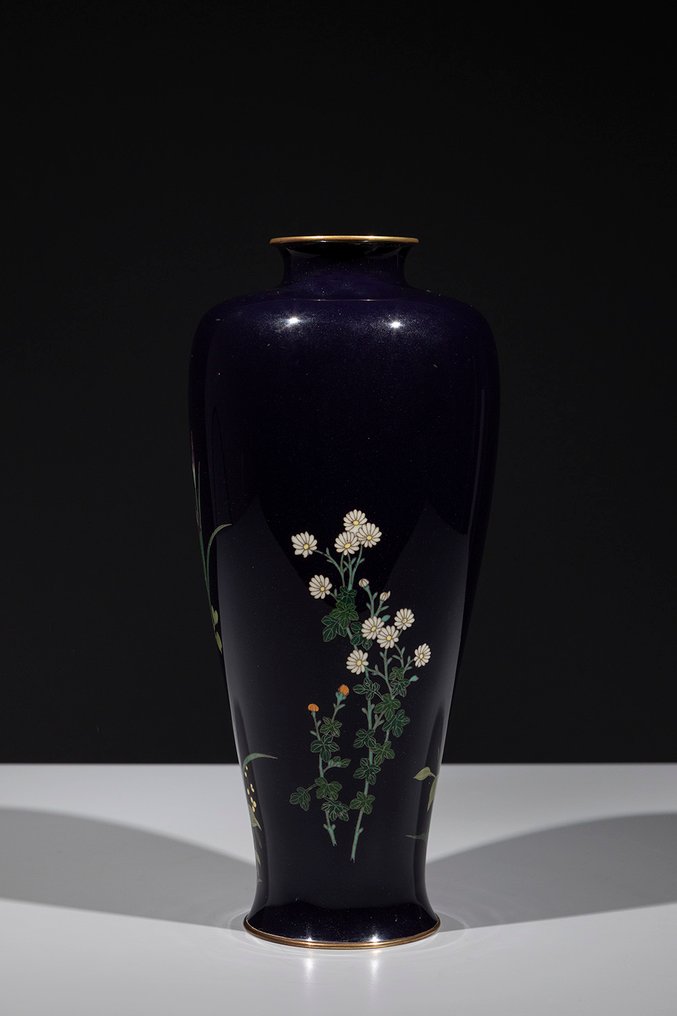
Vase - Enamel, An elegant cloisonné vase depicting a composition of irises and aquatic plants. - Japan - Meiji period (late 19th century)

Opens tomorrow
Starting bid
€ 1

Add to your favourites to get an alert when the auction starts.

Giovanni Bottero
Expert
Selected by Giovanni Bottero

Holds a master’s in Japanese art history with over 10 years’ expertise in Asian art.

Estimate  € 1,800 - € 2,000
Catawiki Buyer Protection

Your payment’s safe with us until you receive your object.View details

Trustpilot 4.4 | 122529 reviews

Rated Excellent on Trustpilot.

Description from the seller

A cloisonné vase in polychrome enamels and silver wires, of slender shape, decorated with a dense composition of aquatic flowers and irises.

The irises rise gracefully among the green leaves reaching upward. At the base, small lotus leaves can be seen, while on the back, in a small area free from the main decoration, branches of chrysanthemum bloom.

The iris (菖蒲, shōbu) is a symbol of protection and purity, and is associated with strength and courage.
The chrysanthemum (菊, kiku), emblematic flower of the Imperial House of Japan, represents longevity, renewal, and perfection.
The lotus (蓮, hasu), closely linked to Buddhism, symbolizes spiritual purity, enlightenment, and rebirth.

---The vase is in excellent condition. Please refer to the pictures for further details.

The item will be carefully packed and shipped via DHL or FedEx, accompanied by the original certificate of authenticity issued by Mastromauro Japanese art gallery based in Milan, Italy.
288

Seller's Story

Mastromauro Arte Giapponese, based in Milan, specializes in Japanese art, with particular attention to the Edo (1603–1868) and Meiji (1868–1912) periods, while also maintaining an open perspective on more contemporary works. Here on Catawiki, they offer a part of their collection in every weekly auction.
Translated by Google Translate

A cloisonné vase in polychrome enamels and silver wires, of slender shape, decorated with a dense composition of aquatic flowers and irises.

The irises rise gracefully among the green leaves reaching upward. At the base, small lotus leaves can be seen, while on the back, in a small area free from the main decoration, branches of chrysanthemum bloom.

The iris (菖蒲, shōbu) is a symbol of protection and purity, and is associated with strength and courage.
The chrysanthemum (菊, kiku), emblematic flower of the Imperial House of Japan, represents longevity, renewal, and perfection.
The lotus (蓮, hasu), closely linked to Buddhism, symbolizes spiritual purity, enlightenment, and rebirth.

---The vase is in excellent condition. Please refer to the pictures for further details.

The item will be carefully packed and shipped via DHL or FedEx, accompanied by the original certificate of authenticity issued by Mastromauro Japanese art gallery based in Milan, Italy.
288

Seller's Story

Mastromauro Arte Giapponese, based in Milan, specializes in Japanese art, with particular attention to the Edo (1603–1868) and Meiji (1868–1912) periods, while also maintaining an open perspective on more contemporary works. Here on Catawiki, they offer a part of their collection in every weekly auction.
Translated by Google Translate

Details

Era
1400-1900
Country of Origin
Japan
Material
An elegant cloisonné vase depicting a composition of irises and aquatic plants., Enamel
Dynastic Style/Period
Meiji period (late 19th century)
Condition
Excellent condition: barely used with minimal signs of wear
Height
24.5 cm
Width
11 cm
Depth
11 cm
Estimated period
1850-1900
ItalyVerified
1871
Objects sold
100%
protop

Similar objects

For you in

Japanese Art