Renato Borsato (1927-2013) - Composizione Acquatica N.1, Collezione Deana,


05
days
04
hours
59
minutes
13
seconds
Current bid
€ 110
Reserve price not met

Expert
Selected by Giulia Couzzi
Master’s in culture and arts innovation, with a decade in 20th-21st century Italian art.
Estimate € 900 - € 1,100
12 other people are watching this object
 Bidder 8498 Bidder 8498 | €110 | |
|---|---|---|
| Bidder 0561 | €100 | |
| Bidder 3838 | €35 | |
Catawiki Buyer Protection
Your payment’s safe with us until you receive your object.View details
Trustpilot 4.4 | 122630 reviews
Rated Excellent on Trustpilot.
Renato Borsato (1927‑2013), Composizione Acquatica N.1, Collezione Deana, oil on canvas, Original edition, dated to the 1960s, 140 × 100 cm, Italy, Abstract style, sold with frame by Galleria.
AI-assisted summary
Description from the seller
Origin
The artwork comes from the furnishings of the historic Venetian hotel Bonvecchiati, founded in the 1950s, whose paintings were part of the Deana collection. The hotel was established by the Venetian entrepreneur and collector Arturo Deana, a well-known cultural figure in the city, who in 1929 purchased what would become the famous restaurant 'La Colomba'. It would be nothing unusual if not for the fact that among the patrons were names like Tosi, Morandi, De Pisis, Chagall, Kokoshka, and Picasso.
It was a wonderful time for art in Venice, thanks also to the presence of Peggy Gugghnheim. Arturo Deana became increasingly passionate about painting, also thanks to his close friendship with the poet Diego Valeri and the gallerist Carlo Cardazzo, founder and owner of the Galleria del Cavallino since 1942, a historic Venetian gallery and one of the most renowned in Italy in the second half of the 20th century.
Deana's passion for art led him to enhance the Bonvecchiati hotel with part of his private collection and to establish in 1946 the 'La Colomba Painting Prize', after the interruption of the Venice Biennale due to wartime reasons. The event's success was such that it was dubbed the 'Little Biennale'. In 1953, the 'International Competition for a La Colomba Menu' was born, with its first edition attracting as many as 300 artists.
Author
Renato Borsat (1927-2013) was an Italian painter. Born in Venice in 1927, he emerged as one of the most representative figures of the lagoon painting of the second half of the twentieth century, embodying a deep and visceral connection with his hometown. His rise in the art world was rapid and marked by early recognitions: indeed, in the 1950s, he drew critical attention by winning the prestigious Premio Burano in 1953 and participating, still very young, in the Venice Biennale. During this crucial period, Borsato was able to develop an autonomous language that, while engaging with the avant-garde and the effervescence of Veneto Spatialism, rejected pure abstraction to maintain a poetic contact with reality, reinterpreting it through a modern and rigorous formal synthesis.
His artistic maturity was enriched by numerous trips across Europe, especially to Paris, London, and Switzerland, experiences that ignited his palette with new chromatic suggestions and a more cosmopolitan light. Despite these international influences, his preferred subjects remained rooted in an intimate view of nature and urban spaces: his famous Venetian views, snowy squares, and lush gardens were not merely landscape descriptions but dreamlike evocations filled with matter and color. Over time, his brushwork became increasingly dense and vibrant, building space through sharp tonal contrasts that transformed the canvas into a sensory experience, where the melancholy of the lagoon merged with an almost expressionist vitality.
In addition to his prolific painting production, Borsato was an active figure in Venetian cultural life, serving for years as President of the Fondazione Bevilacqua La Masa and becoming a reference point for new generations of artists. He remained in this role until his passing in 2013.
Description
"Water Composition No.1", oil on canvas, 140*100cm with frame, 110*75cm canvas only, datable to the early 1960s, signed lower right. On the back, an inventory label from the Albergo Bonvecchiati from which the work originates.
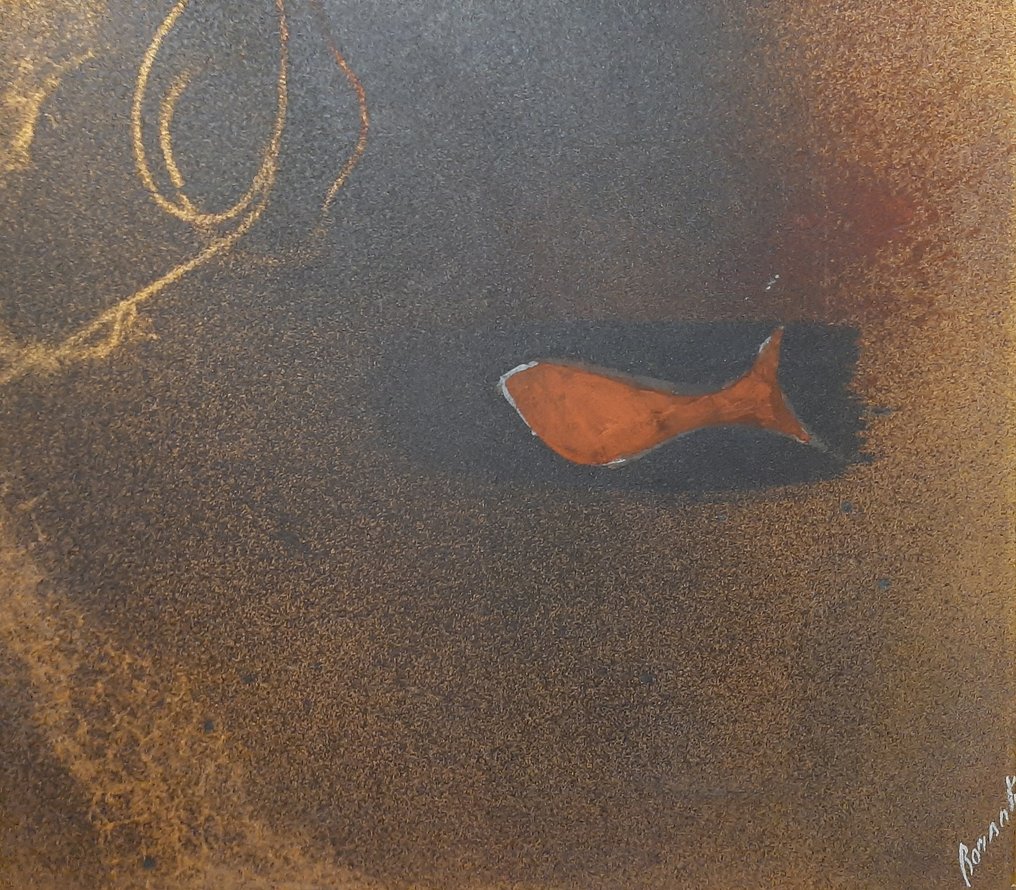
The canvas immerses us in a rarefied and silent underwater dimension, where figurative narration is reduced to the essentials. At the center of an unfathomable dark seabed, a fish floats caught in its solitary swim. On the left side of the canvas, the composition is balanced by a tangle of golden, filamentous lines that extend vertically, forming the meshes of a fishing net—elements that anchor the dreamlike vision to a tangible, lived reality.
The pictorial surface is dominated by a dense, almost grainy material. The brushwork constructs space not through traditional perspective but through layering dark tones: deep browns, bituminous blacks, and plum grays create a vibrant, magmatic 'void.' In this dark field, light plays a crucial role through contrast: it violently emerges with a tactile quality in the orange pigment of the animal subject and in the gold linear graphics on the sides, which seem engraved into the paint. The compositional balance is asymmetrical yet harmonious, based on the tension between the static background and the implicit dynamism of the curved lines.
The painting reveals the assimilation of the spatialist lesson in the structural use of matter and in the attention to pictorial gesture, but it clearly marks the boundary that the artist chooses not to cross: the rejection of radical abstraction. The aquatic element and lagoon fauna are not formal pretexts but visceral evocations of his Venice, interpreted not as an external view but as a primordial, mysterious, and organic feeling, in perfect harmony with his vision of modernity that does not renounce nature. A work of skillful composition and refined aesthetic impact.
Condition Report
The overall condition is excellent. The painting is intact in every part, with vivid and clearly visible colors and brushwork. The frame is to be understood as a gift.
Tracked and insured shipment with adequate packaging.
Origin
The artwork comes from the furnishings of the historic Venetian hotel Bonvecchiati, founded in the 1950s, whose paintings were part of the Deana collection. The hotel was established by the Venetian entrepreneur and collector Arturo Deana, a well-known cultural figure in the city, who in 1929 purchased what would become the famous restaurant 'La Colomba'. It would be nothing unusual if not for the fact that among the patrons were names like Tosi, Morandi, De Pisis, Chagall, Kokoshka, and Picasso.
It was a wonderful time for art in Venice, thanks also to the presence of Peggy Gugghnheim. Arturo Deana became increasingly passionate about painting, also thanks to his close friendship with the poet Diego Valeri and the gallerist Carlo Cardazzo, founder and owner of the Galleria del Cavallino since 1942, a historic Venetian gallery and one of the most renowned in Italy in the second half of the 20th century.
Deana's passion for art led him to enhance the Bonvecchiati hotel with part of his private collection and to establish in 1946 the 'La Colomba Painting Prize', after the interruption of the Venice Biennale due to wartime reasons. The event's success was such that it was dubbed the 'Little Biennale'. In 1953, the 'International Competition for a La Colomba Menu' was born, with its first edition attracting as many as 300 artists.
Author
Renato Borsat (1927-2013) was an Italian painter. Born in Venice in 1927, he emerged as one of the most representative figures of the lagoon painting of the second half of the twentieth century, embodying a deep and visceral connection with his hometown. His rise in the art world was rapid and marked by early recognitions: indeed, in the 1950s, he drew critical attention by winning the prestigious Premio Burano in 1953 and participating, still very young, in the Venice Biennale. During this crucial period, Borsato was able to develop an autonomous language that, while engaging with the avant-garde and the effervescence of Veneto Spatialism, rejected pure abstraction to maintain a poetic contact with reality, reinterpreting it through a modern and rigorous formal synthesis.
His artistic maturity was enriched by numerous trips across Europe, especially to Paris, London, and Switzerland, experiences that ignited his palette with new chromatic suggestions and a more cosmopolitan light. Despite these international influences, his preferred subjects remained rooted in an intimate view of nature and urban spaces: his famous Venetian views, snowy squares, and lush gardens were not merely landscape descriptions but dreamlike evocations filled with matter and color. Over time, his brushwork became increasingly dense and vibrant, building space through sharp tonal contrasts that transformed the canvas into a sensory experience, where the melancholy of the lagoon merged with an almost expressionist vitality.
In addition to his prolific painting production, Borsato was an active figure in Venetian cultural life, serving for years as President of the Fondazione Bevilacqua La Masa and becoming a reference point for new generations of artists. He remained in this role until his passing in 2013.
Description
"Water Composition No.1", oil on canvas, 140*100cm with frame, 110*75cm canvas only, datable to the early 1960s, signed lower right. On the back, an inventory label from the Albergo Bonvecchiati from which the work originates.
The canvas immerses us in a rarefied and silent underwater dimension, where figurative narration is reduced to the essentials. At the center of an unfathomable dark seabed, a fish floats caught in its solitary swim. On the left side of the canvas, the composition is balanced by a tangle of golden, filamentous lines that extend vertically, forming the meshes of a fishing net—elements that anchor the dreamlike vision to a tangible, lived reality.
The pictorial surface is dominated by a dense, almost grainy material. The brushwork constructs space not through traditional perspective but through layering dark tones: deep browns, bituminous blacks, and plum grays create a vibrant, magmatic 'void.' In this dark field, light plays a crucial role through contrast: it violently emerges with a tactile quality in the orange pigment of the animal subject and in the gold linear graphics on the sides, which seem engraved into the paint. The compositional balance is asymmetrical yet harmonious, based on the tension between the static background and the implicit dynamism of the curved lines.
The painting reveals the assimilation of the spatialist lesson in the structural use of matter and in the attention to pictorial gesture, but it clearly marks the boundary that the artist chooses not to cross: the rejection of radical abstraction. The aquatic element and lagoon fauna are not formal pretexts but visceral evocations of his Venice, interpreted not as an external view but as a primordial, mysterious, and organic feeling, in perfect harmony with his vision of modernity that does not renounce nature. A work of skillful composition and refined aesthetic impact.
Condition Report
The overall condition is excellent. The painting is intact in every part, with vivid and clearly visible colors and brushwork. The frame is to be understood as a gift.
Tracked and insured shipment with adequate packaging.
Details
Artist
Renato Borsato (1927-2013)
Sold with frame
Yes
Sold by
Gallery
Edition
Original
Title of artwork
Composizione Acquatica N.1, Collezione Deana,
Technique
Oil painting
Signature
Signed
Country of Origin
Italy
Condition
Excellent condition
Height
140 cm
Width
100 cm
Style
Abstract
Period
1960-1970
Sold by
