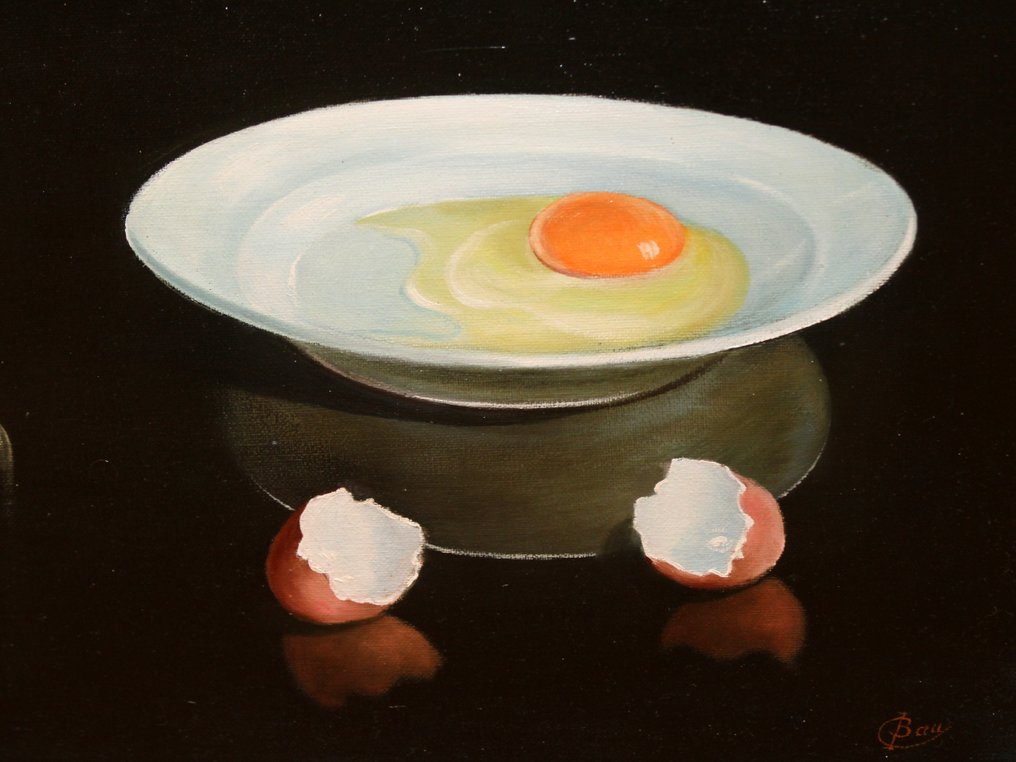
Josep Bau (XX) - NO RESERVE - Bodegón hiperrealista con huevo




07
days
09
hours
39
minutes
25
seconds

23 other people are watching this object
 Bidder 6243 Bidder 6243 | €35 | |
|---|---|---|
 Bidder 2029 Bidder 2029 | €26 | |
| Bidder 7557 | €25 | |
Catawiki Buyer Protection
Your payment’s safe with us until you receive your object.View details
Trustpilot 4.4 | 122630 reviews
Rated Excellent on Trustpilot.
NO RESERVE - Hyperrealist still life with an egg, oil on canvas by Josep Bau (Spain), 1980–1990, original edition, sold with frame.
AI-assisted summary
Description from the seller
It is signed by the artist at the bottom, and on the back, it is signed again and titled.
The work is presented framed.
Good condition of the painting.
Work measurements: 35 x 46 cm
Frame size: 60 x 67 cm
:::::::::::::::::::::::::::::::::::::::::::::::::::::::::::::::::::::::::::::::
Artist biography
Josep Bau was an imaginary painter born in 1942 in a small industrial town in Catalonia, within a working-class family with limited ties to the art world. From childhood, he showed an almost obsessive fascination with copying from life the everyday objects he found in his home kitchen: glasses, plates, eggs, or fruits arranged on the table. That early fascination with shiny surfaces and reflections would shape his entire subsequent career.
In the 1960s, he studied at the Barcelona School of Fine Arts, where he came into contact with the informalist and conceptual currents that dominated the environment. However, Bau felt detached from those trends and decided to follow a personal path based on meticulous drawing and an oil technique built up through multiple glazes. While many of his contemporaries bet on abstraction, he patiently worked on still lifes with almost photographic precision, which earned him the nickname of 'domestic hyperrealist painter'.
His iconography focused on very sober scenes: a freshly cracked egg on a white plate, an empty glass against a black background, a spoon, a simple piece of bread, or an orange illuminated by a raking light. In his paintings, more than the object itself, what mattered was the silence surrounding it and the tension between fragility and permanence, between the shine of glass and the soft matter of food. This poetics of the minimal led some critics to associate him with the Spanish still life tradition, but updated to the cold and precise language of hyperrealism.
From the 1980s onwards, he exhibited regularly in galleries in Barcelona, Valencia, and Madrid, and participated in several art fairs, although he never achieved widespread fame. His paintings, very laborious, were produced in small series and were appreciated by collectors who valued their serenity and exquisite technical finish. In the last years of his life, troubled by vision problems, he reduced the size of his works and focused on even more refined, almost ascetic compositions, where the black background and the reflection of the object became the protagonists.
Josep Bau passed away in the 21st century, leaving behind a relatively small but highly coherent body of hyper-realistic still life paintings. Today, his figure could be understood as that of a cult artist, discreet and reserved, who chose to view the most humble objects of the domestic environment with poetic intensity. His canvases, with their silent atmosphere and almost surgical precision, remind us that even a simple egg on a plate can become a subject worthy of prolonged contemplation.
It is signed by the artist at the bottom, and on the back, it is signed again and titled.
The work is presented framed.
Good condition of the painting.
Work measurements: 35 x 46 cm
Frame size: 60 x 67 cm
:::::::::::::::::::::::::::::::::::::::::::::::::::::::::::::::::::::::::::::::
Artist biography
Josep Bau was an imaginary painter born in 1942 in a small industrial town in Catalonia, within a working-class family with limited ties to the art world. From childhood, he showed an almost obsessive fascination with copying from life the everyday objects he found in his home kitchen: glasses, plates, eggs, or fruits arranged on the table. That early fascination with shiny surfaces and reflections would shape his entire subsequent career.
In the 1960s, he studied at the Barcelona School of Fine Arts, where he came into contact with the informalist and conceptual currents that dominated the environment. However, Bau felt detached from those trends and decided to follow a personal path based on meticulous drawing and an oil technique built up through multiple glazes. While many of his contemporaries bet on abstraction, he patiently worked on still lifes with almost photographic precision, which earned him the nickname of 'domestic hyperrealist painter'.
His iconography focused on very sober scenes: a freshly cracked egg on a white plate, an empty glass against a black background, a spoon, a simple piece of bread, or an orange illuminated by a raking light. In his paintings, more than the object itself, what mattered was the silence surrounding it and the tension between fragility and permanence, between the shine of glass and the soft matter of food. This poetics of the minimal led some critics to associate him with the Spanish still life tradition, but updated to the cold and precise language of hyperrealism.
From the 1980s onwards, he exhibited regularly in galleries in Barcelona, Valencia, and Madrid, and participated in several art fairs, although he never achieved widespread fame. His paintings, very laborious, were produced in small series and were appreciated by collectors who valued their serenity and exquisite technical finish. In the last years of his life, troubled by vision problems, he reduced the size of his works and focused on even more refined, almost ascetic compositions, where the black background and the reflection of the object became the protagonists.
Josep Bau passed away in the 21st century, leaving behind a relatively small but highly coherent body of hyper-realistic still life paintings. Today, his figure could be understood as that of a cult artist, discreet and reserved, who chose to view the most humble objects of the domestic environment with poetic intensity. His canvases, with their silent atmosphere and almost surgical precision, remind us that even a simple egg on a plate can become a subject worthy of prolonged contemplation.
Details
Artist
Josep Bau (XX)
Sold with frame
Yes
Sold by
Gallery
Edition
Original
Title of artwork
NO RESERVE - Bodegón hiperrealista con huevo
Technique
Oil painting
Signature
Hand signed
Country of Origin
Spain
Condition
Good condition
Height
60 cm
Width
67 cm
Depiction/Theme
Still life
Period
1980-1990
Sold by
