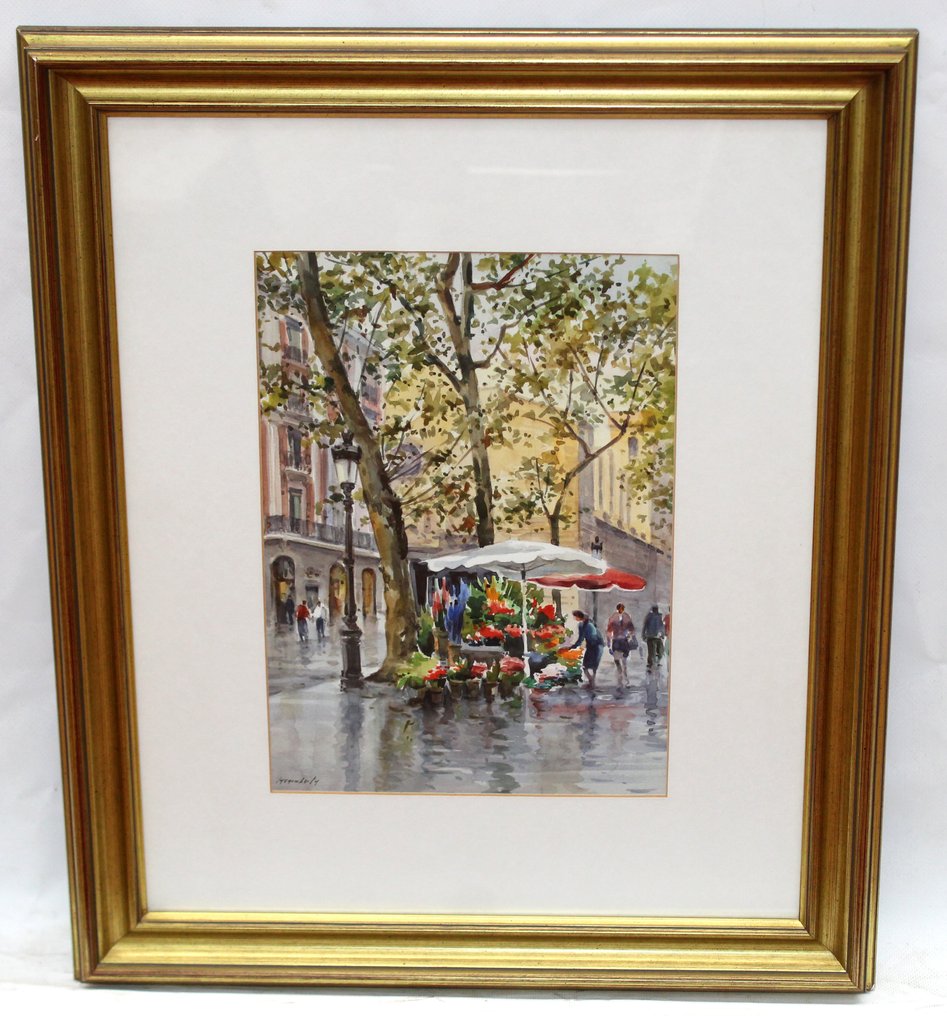
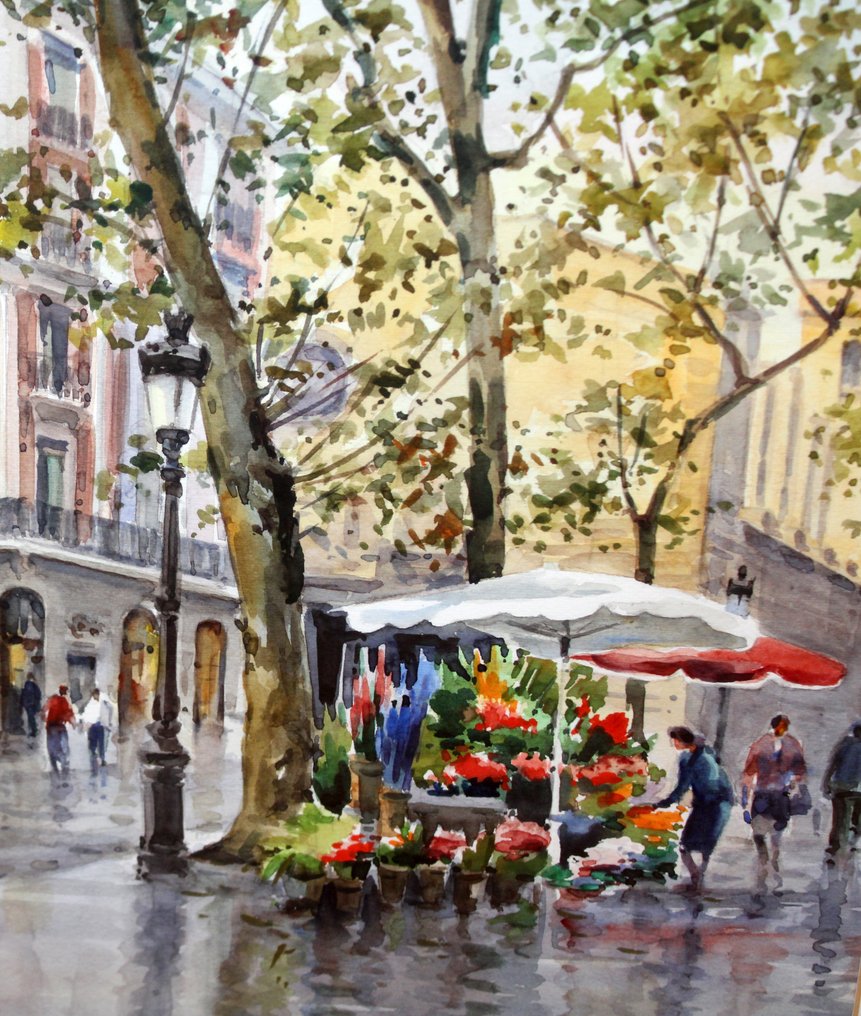
Jaume Casacuberta i Roma (1932 - 2020) - NO RESERVE - Rambla de las flores (Barcelona)



09
days
07
hours
36
minutes
44
seconds

9 other people are watching this object
 Bidder 9186 Bidder 9186 | €30 | |
|---|---|---|
 Bidder 7045 Bidder 7045 | €25 | |
| Bidder 7045 | €7 | |
Catawiki Buyer Protection
Your payment’s safe with us until you receive your object.View details
Trustpilot 4.4 | 122529 reviews
Rated Excellent on Trustpilot.
Hand-signed watercolor by Jaume Casacuberta i Roma (1932–2020), titled NO RESERVE - Rambla de las flores (Barcelona), created in Spain in 1980–1990, framed, with the image measuring 35 × 25 cm and the frame 54 × 42 cm.
AI-assisted summary
Description from the seller
It is signed by the artist at the bottom.
The work is presented framed.
Good condition of the painting.
Work measurements: 35 x 25 cm
Frame measurements: 54 x 42 cm
:::::::::::::::::::::::::::::::::::::::::::::::::::::::::::::::::::::::::::::::
Artist biography
Jaume Casacuberta i Roma (Viladecavalls de Calders, 1932 – Manresa, 2020) was a landscape painter from Manresa who cultivated various artistic techniques such as drawing, watercolor, and oil painting.
Born in the Colonia Jorba de Calders, his artistic vocation was evident from a young age; as his daughter recounts, when he was a boy and ill, the only thing he asked for was some pencils and paper to draw and ease his discomfort. At fourteen, he moved to Manresa, where he would reside until the end of his days. There, he trained at the academy run by painter Evarist Basiana and later expanded his artistic studies through correspondence courses from the Parramón school in Barcelona, where he achieved great mastery of drawing and compositional technique. Beyond this academic learning, he was always a self-taught painter who refined his technique through effort and exchange of experiences with other colleagues, both from the Manresa circle and from different parts of Catalonia, thanks to the numerous competitions he entered across the country.
His style always revolved within the realm of impressionist printmaking realism. He always claimed to make a kind of painting 'without too many complications,' faithful to the direct experience of the senses, which is why he preferred easel painting. The bolder, more temperamental brushstrokes of his early years became more gentle, nuanced, and restrained over time. Although he always cultivated oil painting with great skill, in recent years he greatly refined his watercolor technique, following the mastery of renowned watercolorists such as Guillem Fresquet, Josep Maria Martínez Lozano, and Ceferino Olivé. Regarding themes, he was always faithful to the landscape genre, depicting the environments of Manresa and its surroundings, as well as various Catalan locations he reproduced in numerous quick painting competitions he participated in. He also explored portraiture and still life in a more intimate and family-oriented sphere.
Throughout his artistic career, he was awarded numerous honors and prizes both within and outside his city, such as the Autumn Salon of Manresa (1965), the Manolo Hugué competition of Caldes de Montbui, the National Roses of Sant Feliu del Llobregat (1969), or a medal from the Real Cercle Artí. He was always a very restless person artistically, which led him to visit many exhibitions throughout his life and to connect with a large number of artistic personalities and groups. In Manresa, he was one of the most active members of the city's Artistic Circle and one of the founders of Grupo 13. For many years, he had his studio in the Vell neighborhood of Manresa, on Santa Maria street, where he spent long hours working each day. Casacuberta always made a living from painting, with his artworks and also as a decorative painter in his youth, and later at Jorba warehouses, as part of the design and advertising team. In the last years of his life, he also engaged in teaching at various institutions and facilities in Manresa. Besides the capital of Bages, he always maintained a close bond with the municipality of Moià and its Artistic Circle, where he exhibited his works annually in several shows.
His first exhibition was at the Galería de Arte Ciudad, from March 23 to April 5, 1968, and subsequently, he held up to 23 solo exhibitions in Manresa and various Catalan towns such as Moià, Vic, Igualada, and Calders, among others, in addition to dozens of group exhibitions and Catalan shows. His work was always highly appreciated, and throughout his career, he sold many pieces and received numerous commissions from both companies and individuals. In the capital of Bages, he repeatedly exhibited at the Xipell and Símbol galleries, as well as at the Círculo Artístico de Manresa, where in 2017 he held a thematic show of watercolors dedicated to the Ignatian spaces of the city. In 2013, the Centro Cultural El Casino dedicated an anthological exhibition to him on the occasion of his 50 years of artistic activity. The last exhibition he participated in was the 43rd edition of the annual charity auction against cancer in Manresa. On Epiphany Day 2020, he died in Manresa at the age of 87, practically, as if to say, with the brush in hand.
His work can be seen at the Museum of the Diputación de Barcelona, the Comarcal Museum of Manresa, the Museum of Sant Pol de Mar, and in numerous private collections throughout central Catalonia and the entire Principality.
It is signed by the artist at the bottom.
The work is presented framed.
Good condition of the painting.
Work measurements: 35 x 25 cm
Frame measurements: 54 x 42 cm
:::::::::::::::::::::::::::::::::::::::::::::::::::::::::::::::::::::::::::::::
Artist biography
Jaume Casacuberta i Roma (Viladecavalls de Calders, 1932 – Manresa, 2020) was a landscape painter from Manresa who cultivated various artistic techniques such as drawing, watercolor, and oil painting.
Born in the Colonia Jorba de Calders, his artistic vocation was evident from a young age; as his daughter recounts, when he was a boy and ill, the only thing he asked for was some pencils and paper to draw and ease his discomfort. At fourteen, he moved to Manresa, where he would reside until the end of his days. There, he trained at the academy run by painter Evarist Basiana and later expanded his artistic studies through correspondence courses from the Parramón school in Barcelona, where he achieved great mastery of drawing and compositional technique. Beyond this academic learning, he was always a self-taught painter who refined his technique through effort and exchange of experiences with other colleagues, both from the Manresa circle and from different parts of Catalonia, thanks to the numerous competitions he entered across the country.
His style always revolved within the realm of impressionist printmaking realism. He always claimed to make a kind of painting 'without too many complications,' faithful to the direct experience of the senses, which is why he preferred easel painting. The bolder, more temperamental brushstrokes of his early years became more gentle, nuanced, and restrained over time. Although he always cultivated oil painting with great skill, in recent years he greatly refined his watercolor technique, following the mastery of renowned watercolorists such as Guillem Fresquet, Josep Maria Martínez Lozano, and Ceferino Olivé. Regarding themes, he was always faithful to the landscape genre, depicting the environments of Manresa and its surroundings, as well as various Catalan locations he reproduced in numerous quick painting competitions he participated in. He also explored portraiture and still life in a more intimate and family-oriented sphere.
Throughout his artistic career, he was awarded numerous honors and prizes both within and outside his city, such as the Autumn Salon of Manresa (1965), the Manolo Hugué competition of Caldes de Montbui, the National Roses of Sant Feliu del Llobregat (1969), or a medal from the Real Cercle Artí. He was always a very restless person artistically, which led him to visit many exhibitions throughout his life and to connect with a large number of artistic personalities and groups. In Manresa, he was one of the most active members of the city's Artistic Circle and one of the founders of Grupo 13. For many years, he had his studio in the Vell neighborhood of Manresa, on Santa Maria street, where he spent long hours working each day. Casacuberta always made a living from painting, with his artworks and also as a decorative painter in his youth, and later at Jorba warehouses, as part of the design and advertising team. In the last years of his life, he also engaged in teaching at various institutions and facilities in Manresa. Besides the capital of Bages, he always maintained a close bond with the municipality of Moià and its Artistic Circle, where he exhibited his works annually in several shows.
His first exhibition was at the Galería de Arte Ciudad, from March 23 to April 5, 1968, and subsequently, he held up to 23 solo exhibitions in Manresa and various Catalan towns such as Moià, Vic, Igualada, and Calders, among others, in addition to dozens of group exhibitions and Catalan shows. His work was always highly appreciated, and throughout his career, he sold many pieces and received numerous commissions from both companies and individuals. In the capital of Bages, he repeatedly exhibited at the Xipell and Símbol galleries, as well as at the Círculo Artístico de Manresa, where in 2017 he held a thematic show of watercolors dedicated to the Ignatian spaces of the city. In 2013, the Centro Cultural El Casino dedicated an anthological exhibition to him on the occasion of his 50 years of artistic activity. The last exhibition he participated in was the 43rd edition of the annual charity auction against cancer in Manresa. On Epiphany Day 2020, he died in Manresa at the age of 87, practically, as if to say, with the brush in hand.
His work can be seen at the Museum of the Diputación de Barcelona, the Comarcal Museum of Manresa, the Museum of Sant Pol de Mar, and in numerous private collections throughout central Catalonia and the entire Principality.
Details
Artist
Jaume Casacuberta i Roma (1932 - 2020)
Sold with frame
Yes
Sold by
Gallery
Edition
Original
Title of artwork
NO RESERVE - Rambla de las flores (Barcelona)
Technique
Watercolour painting
Signature
Hand signed
Country of Origin
Spain
Condition
Good condition
Height
54 cm
Width
42 cm
Period
1980-1990
Sold by
