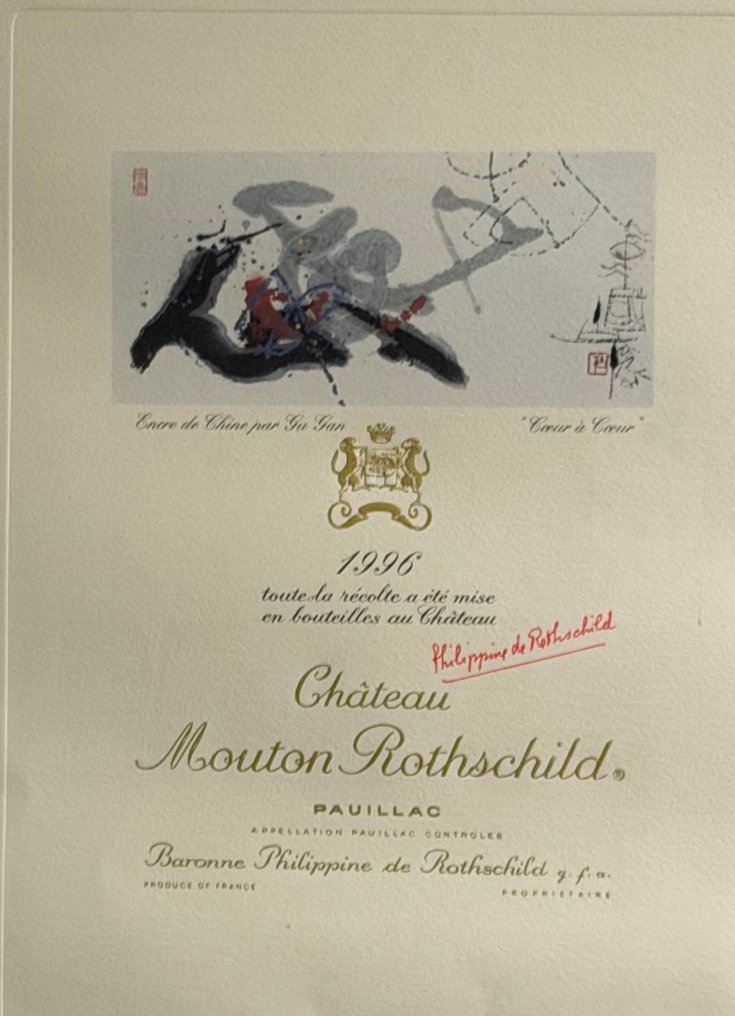
Gu Gan - Mouton Rothschild wine label from 1996



04
days
19
hours
20
minutes
46
seconds

No bids placed
Catawiki Buyer Protection
Your payment’s safe with us until you receive your object.View details
Trustpilot 4.4 | 122290 reviews
Rated Excellent on Trustpilot.
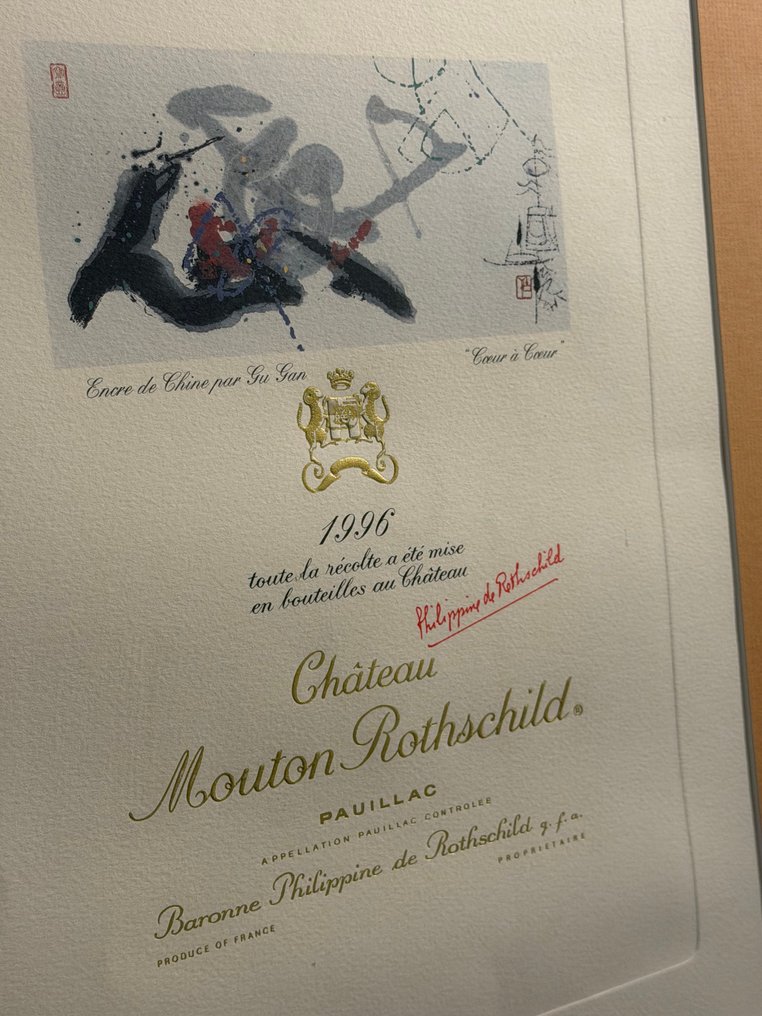
Gu Gan, Mouton Rothschild wine label from 1996, lithography, 56.5 cm by 43.6 cm, in excellent condition, France origin, limited edition, signed in the plate, professionally framed in a gold brushed frame.
AI-assisted summary
Description from the seller
professionally framed in a high-quality frame
The frame has a gold color with a brushed texture.
GU GAN
Born in 1942 in Changsha, the capital of Hunan province, the Chinese painter and calligrapher Gu Gan attended art school in Beijing (Peking) in the early 1960s. Forced to interrupt his studies due to health issues, he nonetheless managed to secure a position with the Beijing city authorities. Removed from his job during the Cultural Revolution, he was compelled to work as a laborer in the printing industry for ten years. The death of Mao and the fall of the Gang of Four in 1976 finally allowed him to return to his art. At the same time, he passionately explored the works of Kandinsky, Klee, and Miró, who were then virtually unknown in China.
One of the promoters of the 'Modern Calligraphy' exhibition held in Beijing in 1985, he soon became better known in the West, following visits to Germany in 1987 and 1989.
A major exhibition of his works was held in Cologne in 1993. He now lives in Beijing and is the Chairman of the Association of Chinese Modern Painters and Calligraphers. His works are displayed in many museums both in China and the West, including the British Museum and the Museum for Far-Eastern Art in Cologne.
Chinese calligraphy, of pictographic origin, has remained unchanged since 2000 BC. At once language and art, the formulation of meaning continues.
Hand in hand with a constant and exacting sense of aesthetics, Gu Gan seeks to remain true to this tradition while also adopting a profoundly innovative approach. Thus, he has introduced colour into calligraphy, shaking off traditional restraints and the insistence on balance, and adds ornamental seals to the actual drawing.
Author of The Three Steps of Modern Calligraphy, published in 1990, Gu Gan is now regarded not only as a master but also as a leading theorist of his art. His work bears witness to the idea that calligraphy can be a link between his own culture and Western abstract art.
For Mouton 1996, Gu Gan has assembled in a single drawing five ideograms, all representing the heart, each varying in color and stroke. This powerful yet subtle composition, which he has titled 'Coeur à Coeur' (Heart to Heart), is intended as an act of faith in universal harmony.
professionally framed in a high-quality frame
The frame has a gold color with a brushed texture.
GU GAN
Born in 1942 in Changsha, the capital of Hunan province, the Chinese painter and calligrapher Gu Gan attended art school in Beijing (Peking) in the early 1960s. Forced to interrupt his studies due to health issues, he nonetheless managed to secure a position with the Beijing city authorities. Removed from his job during the Cultural Revolution, he was compelled to work as a laborer in the printing industry for ten years. The death of Mao and the fall of the Gang of Four in 1976 finally allowed him to return to his art. At the same time, he passionately explored the works of Kandinsky, Klee, and Miró, who were then virtually unknown in China.
One of the promoters of the 'Modern Calligraphy' exhibition held in Beijing in 1985, he soon became better known in the West, following visits to Germany in 1987 and 1989.
A major exhibition of his works was held in Cologne in 1993. He now lives in Beijing and is the Chairman of the Association of Chinese Modern Painters and Calligraphers. His works are displayed in many museums both in China and the West, including the British Museum and the Museum for Far-Eastern Art in Cologne.
Chinese calligraphy, of pictographic origin, has remained unchanged since 2000 BC. At once language and art, the formulation of meaning continues.
Hand in hand with a constant and exacting sense of aesthetics, Gu Gan seeks to remain true to this tradition while also adopting a profoundly innovative approach. Thus, he has introduced colour into calligraphy, shaking off traditional restraints and the insistence on balance, and adds ornamental seals to the actual drawing.
Author of The Three Steps of Modern Calligraphy, published in 1990, Gu Gan is now regarded not only as a master but also as a leading theorist of his art. His work bears witness to the idea that calligraphy can be a link between his own culture and Western abstract art.
For Mouton 1996, Gu Gan has assembled in a single drawing five ideograms, all representing the heart, each varying in color and stroke. This powerful yet subtle composition, which he has titled 'Coeur à Coeur' (Heart to Heart), is intended as an act of faith in universal harmony.
Details
Artist
Gu Gan
Sold by
Owner or reseller
Edition
Limited edition
Title of artwork
Mouton Rothschild wine label from 1996
Technique
Lithograph
Signature
Plate signed
Country of Origin
France
Year
1996
Condition
Excellent condition
Height
56.5 cm
Width
43.6 cm
Style
Abstract
Period
1990-2000
Sold with frame
Yes
Sold by