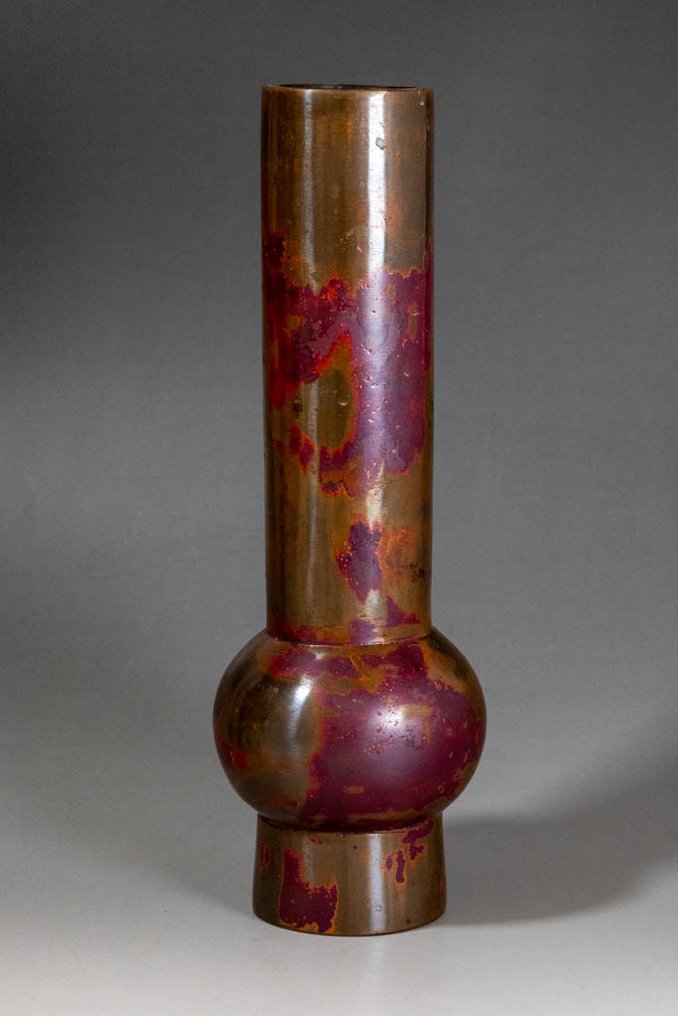
Wax-Cast Hanshido Copper Vase - Bronze - Third-Generation Seiun – Hara Soemon / 三代目晴雲 原惣右衛門 - Japan - Shōwa period (1926-1989)



07
days
16
hours
57
minutes
34
seconds
Starting bid
€ 1
Reserve price not met

Expert
Selected by Surya Rutten
Has over 25 years' experience in Asian art and owned an art gallery.
Estimate € 200 - € 300
No bids placed
Catawiki Buyer Protection
Your payment’s safe with us until you receive your object.View details
Trustpilot 4.4 | 122385 reviews
Rated Excellent on Trustpilot.
Wax-Cast Hanshido copper vase in bronze, by Third-Generation Seiun – Hara Soemon (三代目晴雲 原惣右衛門), from the Shōwa period (1926–1989) in Japan, with height 23 cm, width 8 cm, depth 8 cm, weight 640 g, condition Fair, including tomobako and accompanying documents.
AI-assisted summary
Description from the seller
Reddish-purple currents bloom across burnished copper, rising along a slender neck as if shaped by quiet, steady flame.
Description:
This vase was created by Third-Generation Seiun, Hara Soemon, a maker of wax-cast bronze works in Okubo, Kashiwazaki, Niigata. The Hanshido technique used here originates from the first-generation Seiun, who studied the method under Hara Tokusai, an early transmitter of wax-casting and Hanshido surface coloration in the region.
The tall cylindrical form rising from a rounded body is enriched with the distinctive reddish-purple mottling produced by the Hanshido oxidation process. The surface reveals naturally developed tonal shifts created through controlled firing and the inherent properties of the alloy.
The piece comes with its original wooden box and an explanatory sheet issued by Hara Soemon, detailing the history and characteristics of wax-cast Hanshido copper.
Dimensions:
Height: 23 cm
Width: 8 cm
Depth: 8 cm
Weight: 640 g
Condition:
Minor surface wear visible.
No chips, cracks or restorations.
Includes:
Tomobako (signed wooden storage box with artist's signature and seal)
Documents regarding the work
Box Inscription:
斑紫銅花瓶 晴雲 原惣右衛門作 [seal]
Artist Profile:
Hara Soemon, the third-generation artist bearing the name “Seiun,” was a metalworker from Okubo in Kashiwazaki City, Niigata Prefecture, known for creating bronze works using the traditional wax-cast Hanshido technique.
This method originates from the first-generation Seiun, who learned it directly from Hara Tokusai, a key figure in establishing wax-cast bronze production and the characteristic Hanshido surface in the region.
Over three generations, the Seiun workshop exhibited works at numerous expositions and exhibitions, receiving repeated selections and awards. During wartime, the workshop was designated as a holder of important craft techniques, and in 1978 (Shōwa 53), the Hanshido tradition was officially recognized as an Intangible Cultural Property of Niigata Prefecture.
Works by the third-generation Seiun are noted for their dignified, robust surfaces and the distinctive red-purple tonal variations produced through the Hanshido oxidation process.
Hara Tokusai was a highly skilled metalworker from the Okubo district of Kashiwazaki City, belonging to a family of traditional mold-carvers and bronze casters.
Historical records attribute to him a number of distinguished works—including Buddhist figures, ritual vessels, copper water containers, decorative objects, and the large bronze lantern at Geitsu Shrine—each demonstrating exceptional craftsmanship regarded as “master-level” artistry.
His technical achievements played a formative role in the regional metal-casting tradition, particularly in the development of wax-cast bronze and the Hanshido surface. The first-generation Seiun (Soemon) studied under Hara Tokusai, and this lineage became the foundation of the Seiun family’s bronze-casting tradition that continues today.
Additional Notes
Please review all photos carefully as they are part of the item description.
Shipping Information
All items are shipped from Japan via DHL or Japan Post, depending on the destination.
Each piece is packed with great care using professional materials suitable for fine art shipping.
A tracking number will be provided once the shipment has been dispatched.
We cannot under-declare item values or mark shipments as gifts.
Import Duties & Taxes
Import duties, VAT, and any additional customs or processing fees are not included in the auction price.
These charges are the responsibility of the buyer.
Please check with your local customs office for details before bidding.
Customs Communication
Customs or the shipping carrier may contact you for additional information (such as ID verification or payment of duties).
Please respond promptly to avoid delays or returns.
Thank you very much for your understanding and cooperation.
Seller's Story
J ANTIQUE ART -YOKOHAMA-
Where Japan’s quiet traditions meet the sensitivity of contemporary craftsmanship.
We curate antiques and contemporary works that embody the essence of Japanese aesthetics — pieces shaped by time, intention, and the intimate dialogue between human hands and natural materials. Every work is selected for its authenticity, balance, and the quiet presence it holds.
Our focus is not quantity but meaning. We present ceramics, lacquer, metalwork, and hand-crafted objects that speak softly yet carry the depth of Japanese beauty expressed through restraint and simplicity.
For contemporary pieces, we collaborate directly with artists and workshops whose dedication to technique and material reflects the highest standards of Japanese craft. For antiques, we look beyond surface appearance to the traces of use, devotion, and history that form their true character.
As licensed art dealers based in Yokohama, we are committed to clarity, accuracy, and respect in every transaction. Each piece is photographed and described with care, shipped worldwide with secure packaging, and handled personally to ensure it reaches collectors with confidence.
To collect from us is to join in the quiet preservation of culture — one work at a time, carried from our hands to yours.
Reddish-purple currents bloom across burnished copper, rising along a slender neck as if shaped by quiet, steady flame.
Description:
This vase was created by Third-Generation Seiun, Hara Soemon, a maker of wax-cast bronze works in Okubo, Kashiwazaki, Niigata. The Hanshido technique used here originates from the first-generation Seiun, who studied the method under Hara Tokusai, an early transmitter of wax-casting and Hanshido surface coloration in the region.
The tall cylindrical form rising from a rounded body is enriched with the distinctive reddish-purple mottling produced by the Hanshido oxidation process. The surface reveals naturally developed tonal shifts created through controlled firing and the inherent properties of the alloy.
The piece comes with its original wooden box and an explanatory sheet issued by Hara Soemon, detailing the history and characteristics of wax-cast Hanshido copper.
Dimensions:
Height: 23 cm
Width: 8 cm
Depth: 8 cm
Weight: 640 g
Condition:
Minor surface wear visible.
No chips, cracks or restorations.
Includes:
Tomobako (signed wooden storage box with artist's signature and seal)
Documents regarding the work
Box Inscription:
斑紫銅花瓶 晴雲 原惣右衛門作 [seal]
Artist Profile:
Hara Soemon, the third-generation artist bearing the name “Seiun,” was a metalworker from Okubo in Kashiwazaki City, Niigata Prefecture, known for creating bronze works using the traditional wax-cast Hanshido technique.
This method originates from the first-generation Seiun, who learned it directly from Hara Tokusai, a key figure in establishing wax-cast bronze production and the characteristic Hanshido surface in the region.
Over three generations, the Seiun workshop exhibited works at numerous expositions and exhibitions, receiving repeated selections and awards. During wartime, the workshop was designated as a holder of important craft techniques, and in 1978 (Shōwa 53), the Hanshido tradition was officially recognized as an Intangible Cultural Property of Niigata Prefecture.
Works by the third-generation Seiun are noted for their dignified, robust surfaces and the distinctive red-purple tonal variations produced through the Hanshido oxidation process.
Hara Tokusai was a highly skilled metalworker from the Okubo district of Kashiwazaki City, belonging to a family of traditional mold-carvers and bronze casters.
Historical records attribute to him a number of distinguished works—including Buddhist figures, ritual vessels, copper water containers, decorative objects, and the large bronze lantern at Geitsu Shrine—each demonstrating exceptional craftsmanship regarded as “master-level” artistry.
His technical achievements played a formative role in the regional metal-casting tradition, particularly in the development of wax-cast bronze and the Hanshido surface. The first-generation Seiun (Soemon) studied under Hara Tokusai, and this lineage became the foundation of the Seiun family’s bronze-casting tradition that continues today.
Additional Notes
Please review all photos carefully as they are part of the item description.
Shipping Information
All items are shipped from Japan via DHL or Japan Post, depending on the destination.
Each piece is packed with great care using professional materials suitable for fine art shipping.
A tracking number will be provided once the shipment has been dispatched.
We cannot under-declare item values or mark shipments as gifts.
Import Duties & Taxes
Import duties, VAT, and any additional customs or processing fees are not included in the auction price.
These charges are the responsibility of the buyer.
Please check with your local customs office for details before bidding.
Customs Communication
Customs or the shipping carrier may contact you for additional information (such as ID verification or payment of duties).
Please respond promptly to avoid delays or returns.
Thank you very much for your understanding and cooperation.
Seller's Story
J ANTIQUE ART -YOKOHAMA-
Where Japan’s quiet traditions meet the sensitivity of contemporary craftsmanship.
We curate antiques and contemporary works that embody the essence of Japanese aesthetics — pieces shaped by time, intention, and the intimate dialogue between human hands and natural materials. Every work is selected for its authenticity, balance, and the quiet presence it holds.
Our focus is not quantity but meaning. We present ceramics, lacquer, metalwork, and hand-crafted objects that speak softly yet carry the depth of Japanese beauty expressed through restraint and simplicity.
For contemporary pieces, we collaborate directly with artists and workshops whose dedication to technique and material reflects the highest standards of Japanese craft. For antiques, we look beyond surface appearance to the traces of use, devotion, and history that form their true character.
As licensed art dealers based in Yokohama, we are committed to clarity, accuracy, and respect in every transaction. Each piece is photographed and described with care, shipped worldwide with secure packaging, and handled personally to ensure it reaches collectors with confidence.
To collect from us is to join in the quiet preservation of culture — one work at a time, carried from our hands to yours.
Details
Dynastic Style/Period
Shōwa period (1926-1989)
No. of items
1
Artist
Third-Generation Seiun – Hara Soemon / 三代目晴雲 原惣右衛門
Country of Origin
Japan
Material
Bronze
Height
23 cm
Width
8 cm
Title of artwork
Wax-Cast Hanshido Copper Vase
Depth
8 cm
Condition
Fair condition
Sold by
