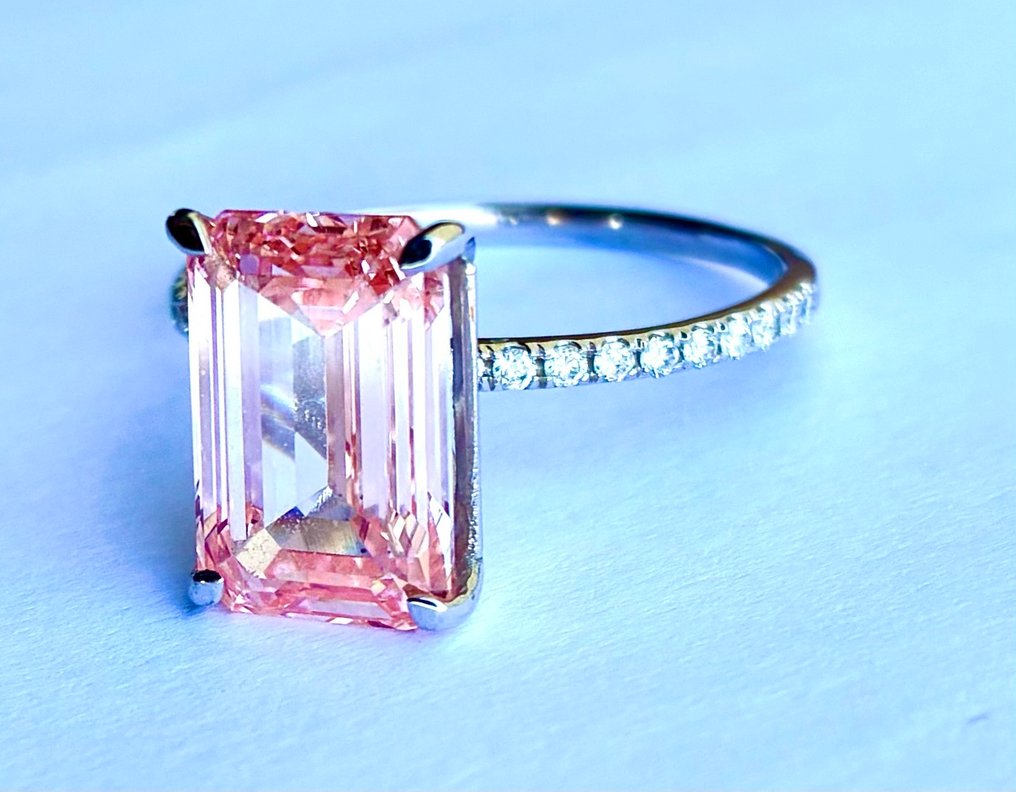
No reserve price - Statement ring - 14 kt. White gold - 5.29ct. tw. Pink Diamond (Fancy coloured lab-grown diamond) - Diamond - Fancy Intense Pink



04
days
03
hours
20
minutes
22
seconds

29 other people are watching this object
 Bidder 9425 Bidder 9425 | €73 | |
|---|---|---|
 Bidder 3093 Bidder 3093 | €68 | |
| Bidder 5717 | €63 | |
Catawiki Buyer Protection
Your payment’s safe with us until you receive your object.View details
Trustpilot 4.4 | 122813 reviews
Rated Excellent on Trustpilot.
A white‑gold 14k ring with a single 5.09 ct fancy intense pink emerald-cut diamond (VS2) surrounded by 20 lab-grown white diamonds totaling 0.20 ct, for a total of 5.29 ct and 2.85 g, delivered with IGI certificate LG707528534.
AI-assisted summary
Description from the seller
NO RESERVE PRICE.
NOTE: Buyers from the EU do not have to pay tax or duty
Exquisite statement ring with a beautiful Fancy Intense Pink diamond with high colour grading. The central diamond is surrounded by 20 white lab-grown diamonds to create a sensational ensemble.
Total Carat Weight: 5.29ct. (1 main Fancy Intense Pink diamond and 20 white surrounding diamonds)
Total Weight: 2.85 grams
Gold Purity: 14kt. (White)
Main Stone Grading Results:
Report Number IGI: LG707528534
Shape: Emerald
Weight: 5.09CT
Color: Fancy Intense Pink
Clarity: VS2
Polish: Very Good
Symmetry: Excellent
Fluorescence: Slight
Surrounding stones:
20 pieces for total of 0.20ct
Delivered With IGI certificate
Retail estimate: 9,400 - 10,700€
___________________________________________________
Lab-grown diamonds are diamonds produced by scientists using technology that recreates the conditions under which diamonds form deep in the earth. A lab-grown diamond is chemically, physically, and optically identical to diamonds that formed naturally - the only factor that makes them different from a natural diamond is that they originate from a lab.
___________________________________________________
For all diamonds, both lab-grown and natural, there exists the GIA Pink Diamond Colour Grade Scale. The scale is:
-Faint
-Very Light
-Light
-Fancy Light
-Fancy
-Fancy Intense
-Fancy Vivid
-Fancy Deep
The « Fancy » colours are the most desirable. Fancy Intense Pink diamonds surpass Fancy Pink diamonds in terms of colour depth, vibrancy, saturation and tone.
This ring’s primary stone is a lab-grown Fancy Intense Pink diamond. It is not a natural diamond. It is interesting to note, however, that natural pink diamonds are very rare since only about 0.01% of all mined natural diamonds are naturally pink. Among natural pink diamonds the most rare are Fancy Intense Pink and Fancy Vivid Pink.
The most popular shapes for pink diamonds include cushion, radiant, oval and pear as these minimise waste during cutting. Emerald cut shapes are less common because of the greater amount of waste during cutting. The main stone
of this ring is an Emerald Cut diamond.
_____________________________________________
~ If you are not fully aware of what you bid on, or have any disagreement with the grading standard after you examined the lot, please consider not bidding.
~ The ring is graded by the International Gemological Institute (IGI) and includes an original certificate.
~ Please note that the colour you see may vary on different devices, such as mobile phone or laptop. Please take this into account.
~ All shipments are insured and tracked.
~ The ring will be delivered in a gift box.
~ Please note, if the winning bidder decides to cancel/withdraw they will bear the risk, cost of all shipping and return import duties of the seller.
NO RESERVE PRICE.
NOTE: Buyers from the EU do not have to pay tax or duty
Exquisite statement ring with a beautiful Fancy Intense Pink diamond with high colour grading. The central diamond is surrounded by 20 white lab-grown diamonds to create a sensational ensemble.
Total Carat Weight: 5.29ct. (1 main Fancy Intense Pink diamond and 20 white surrounding diamonds)
Total Weight: 2.85 grams
Gold Purity: 14kt. (White)
Main Stone Grading Results:
Report Number IGI: LG707528534
Shape: Emerald
Weight: 5.09CT
Color: Fancy Intense Pink
Clarity: VS2
Polish: Very Good
Symmetry: Excellent
Fluorescence: Slight
Surrounding stones:
20 pieces for total of 0.20ct
Delivered With IGI certificate
Retail estimate: 9,400 - 10,700€
___________________________________________________
Lab-grown diamonds are diamonds produced by scientists using technology that recreates the conditions under which diamonds form deep in the earth. A lab-grown diamond is chemically, physically, and optically identical to diamonds that formed naturally - the only factor that makes them different from a natural diamond is that they originate from a lab.
___________________________________________________
For all diamonds, both lab-grown and natural, there exists the GIA Pink Diamond Colour Grade Scale. The scale is:
-Faint
-Very Light
-Light
-Fancy Light
-Fancy
-Fancy Intense
-Fancy Vivid
-Fancy Deep
The « Fancy » colours are the most desirable. Fancy Intense Pink diamonds surpass Fancy Pink diamonds in terms of colour depth, vibrancy, saturation and tone.
This ring’s primary stone is a lab-grown Fancy Intense Pink diamond. It is not a natural diamond. It is interesting to note, however, that natural pink diamonds are very rare since only about 0.01% of all mined natural diamonds are naturally pink. Among natural pink diamonds the most rare are Fancy Intense Pink and Fancy Vivid Pink.
The most popular shapes for pink diamonds include cushion, radiant, oval and pear as these minimise waste during cutting. Emerald cut shapes are less common because of the greater amount of waste during cutting. The main stone
of this ring is an Emerald Cut diamond.
_____________________________________________
~ If you are not fully aware of what you bid on, or have any disagreement with the grading standard after you examined the lot, please consider not bidding.
~ The ring is graded by the International Gemological Institute (IGI) and includes an original certificate.
~ Please note that the colour you see may vary on different devices, such as mobile phone or laptop. Please take this into account.
~ All shipments are insured and tracked.
~ The ring will be delivered in a gift box.
~ Please note, if the winning bidder decides to cancel/withdraw they will bear the risk, cost of all shipping and return import duties of the seller.
Details
Free resizing offered
No
Total carat weight of all stones
5.29
Lab report number
LG707528534
Fancy colour of main stone
Pink
Diamond type of main stone
Fancy coloured lab-grown diamond
Diamond type of surrounding stones
Lab-grown
Laboratory Report
International Gemological Institute (IGI)
Era
After 2000
Fineness
14 kt.
Brand jewellery
No
Number of diamonds main stone
1
Number of diamonds surrounding stones
20
Metal
White gold
Fancy colour intensity of main stone
Fancy intense
Total carat weight of main stone(s)
5.09
Total carat weight of surrounding stones
0.20
Main Stone
Diamond
Total weight
2.85 g
Diamond clarity grade of main stone
VS2
Surrounding Stones
Diamond
Condition
As new - unused
Country of Origin
Unknown
Gender
Women
Title additional information
Fancy Intense Pink
Shape of main stone
Emerald
Cutting style of main stone
Emerald cut
Sold by
Disclaimer
Catawiki always aims to offer you the best possible buying experience. Our experts virtually review and select every object in line with our submission guidelines. While we strive to provide a detailed description and photographs of each jewellery object, discrepancies or inaccuracies may occur. It is your responsibility to review all of the information provided about an object, including the condition and description, before placing an order. Sellers are responsible for the information, pictures and description provided, including the quality, quantity and nature of the jewellery supplied. A small imperfection that cannot be seen in the photo but is included in the description is not a non-conformity. What are lab-grown diamonds? Lab-grown diamonds are diamonds produced by scientists using technology that recreates the conditions under which diamonds form deep in the earth. A lab-grown diamond is chemically, physically, and optically identical to diamonds that formed naturally - the only factor that makes them different from a natural diamond is that they originate from a lab. For that reason, lab-grown diamonds cannot be considered ‘rare’ or ‘unique’ and as such they represent a more affordable option when compared to natural diamonds and are valued at a considerably lower price per carat. Due to their availability and evolving market dynamics, lab-grown diamonds may not retain value over time and typically do not carry much resale value. A Laboratory Report is not a guarantee, valuation or appraisal regarding the articles described therein. A Laboratory Report contains only the characteristics of an article described after it has been graded, tested, examined, and analysed using the techniques and equipment used at the time of the examination from that specific Gemological Laboratory. The results of any other examination performed on the article may differ depending when, how, by whom and with which grading standard the article is examined. In addition, any changes and improvements in techniques and equipment that may have occurred which may enable the examiner to detect, among other things, the use of processes for altering the characteristics of an article which use was previously undetectable, does not automatically mean the object does not conform to its description.
Catawiki always aims to offer you the best possible buying experience. Our experts virtually review and select every object in line with our submission guidelines. While we strive to provide a detailed description and photographs of each jewellery object, discrepancies or inaccuracies may occur. It is your responsibility to review all of the information provided about an object, including the condition and description, before placing an order. Sellers are responsible for the information, pictures and description provided, including the quality, quantity and nature of the jewellery supplied. A small imperfection that cannot be seen in the photo but is included in the description is not a non-conformity. What are lab-grown diamonds? Lab-grown diamonds are diamonds produced by scientists using technology that recreates the conditions under which diamonds form deep in the earth. A lab-grown diamond is chemically, physically, and optically identical to diamonds that formed naturally - the only factor that makes them different from a natural diamond is that they originate from a lab. For that reason, lab-grown diamonds cannot be considered ‘rare’ or ‘unique’ and as such they represent a more affordable option when compared to natural diamonds and are valued at a considerably lower price per carat. Due to their availability and evolving market dynamics, lab-grown diamonds may not retain value over time and typically do not carry much resale value. A Laboratory Report is not a guarantee, valuation or appraisal regarding the articles described therein. A Laboratory Report contains only the characteristics of an article described after it has been graded, tested, examined, and analysed using the techniques and equipment used at the time of the examination from that specific Gemological Laboratory. The results of any other examination performed on the article may differ depending when, how, by whom and with which grading standard the article is examined. In addition, any changes and improvements in techniques and equipment that may have occurred which may enable the examiner to detect, among other things, the use of processes for altering the characteristics of an article which use was previously undetectable, does not automatically mean the object does not conform to its description.