European School (XVII) - NO RESERVE - The Descent from the Cross - After Rubens



07
days
10
hours
49
minutes
58
seconds

33 other people are watching this object
 Bidder 5529 Bidder 5529 | €74 | |
|---|---|---|
 Bidder 8583 Bidder 8583 | €69 | |
| Bidder 5529 | €64 | |
Catawiki Buyer Protection
Your payment’s safe with us until you receive your object.View details
Trustpilot 4.4 | 122473 reviews
Rated Excellent on Trustpilot.
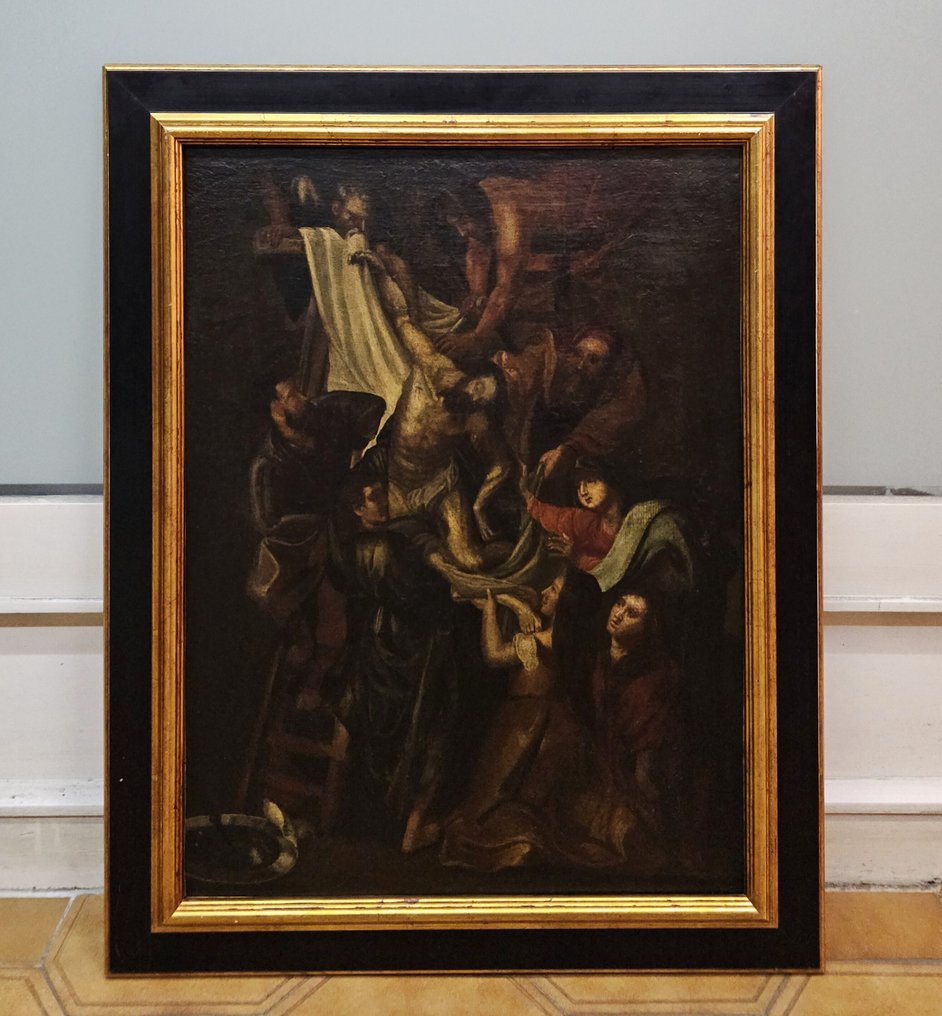
The Descent from the Cross - After Rubens, a 17th‑century oil painting on canvas from France in the Baroque European School, depicting a religious subject, sold with a frame.
AI-assisted summary
Description from the seller
Technical Data Sheet
Oil on canvas
Measurements: 81 × 61 cm; with frame 98 × 78 cm.
Baroque flamenco school, late 16th to early 17th century.
European School (XVII) After Rubens.
Support: old canvas, re-stretched, with a more modern back frame.
Condition of preservation: generalized fine craquelure, darkening of varnishes, and slight surface abrasions; the pictorial structure remains solid and legible with well-integrated restorations.
Marco: sober black frame with a gold inner edge, inspired by Baroque style, which enhances the devotional and museological character of the work.
Arguments for attribution to the workshop or circle of Rubens
The overall composition scheme – the main diagonal of the body of Christ, a compact group of characters surrounding it, with the cross partially outside the frame – is fully consistent with the Rubenian formulas for the Descent, known through paintings and engravings disseminated from his workshop.
The anatomical treatment of the body of Christ, with its robust musculature and serpentine torsion, reveals a direct knowledge of the classical and Miguelangelescos models that Rubens studied intensively.
The hands and heads of some characters, especially the bearded man holding the shroud, show a conception very close to that of the master, although the finish lacks the highest degree of refinement, which suggests the intervention of a qualified assistant following a Rubensian cartoon or sketch.
The warm palette of golden carnations, slightly broken whites, and deep reds, as well as the use of dark glazes to unify the shadows, is part of the technical practice of Rubens' school from the early decades of the 17th century.
The density and antiquity visible in the craquelure, along with the structure of the underlying drawing that can be inferred beneath the layers of color, seem compatible with an execution from the period, rather than a later academic copy.
However, certain rigidity in the articulation of the secondary figures, the lesser luminous brilliance, and the somewhat harsher modeling of some faces suggest placing this painting within the workshop or close circle rather than directly in Rubens's hand, maintaining a cautious attribution 'attrib. workshop of Peter Paul Rubens' pending technical study (X-rays, infrared reflectography, and pigment analysis) that could clarify its degree of proximity to the master.
Aesthetic valuation, frame, and collector potential.
Despite the darkening of the varnishes, the work retains a great dramatic strength and a very intense devotional presence, with a rhythm of diagonals and gazes that guides the viewer through the scene. The canvas possesses the theatrical and emotional quality sought in Baroque painting with a passionist theme and clearly stands above the average production of its time.
The black frame with a gold filet—of sober taste, probably later but well chosen—effectively dialogues with the artwork: it reinforces the chiaroscuro contrast, confers liturgical gravity, and allows for its immediate presentation in a museum context or in a specialized collection of old paintings.
From an expert point of view, this is a piece of high interest for the old Flemish painting market, especially due to its compositional and stylistic proximity to the Rubens universe.
A professional restoration that cleans the varnishes and stabilizes the surface, along with a rigorous technical study and eventual publication in a catalog raisonné or specialized exhibition, could significantly enhance its consideration and place it within a valuation range typical of the best workshop works associated with one of the most sought-after masters of European Baroque.
Compositional and iconographic description
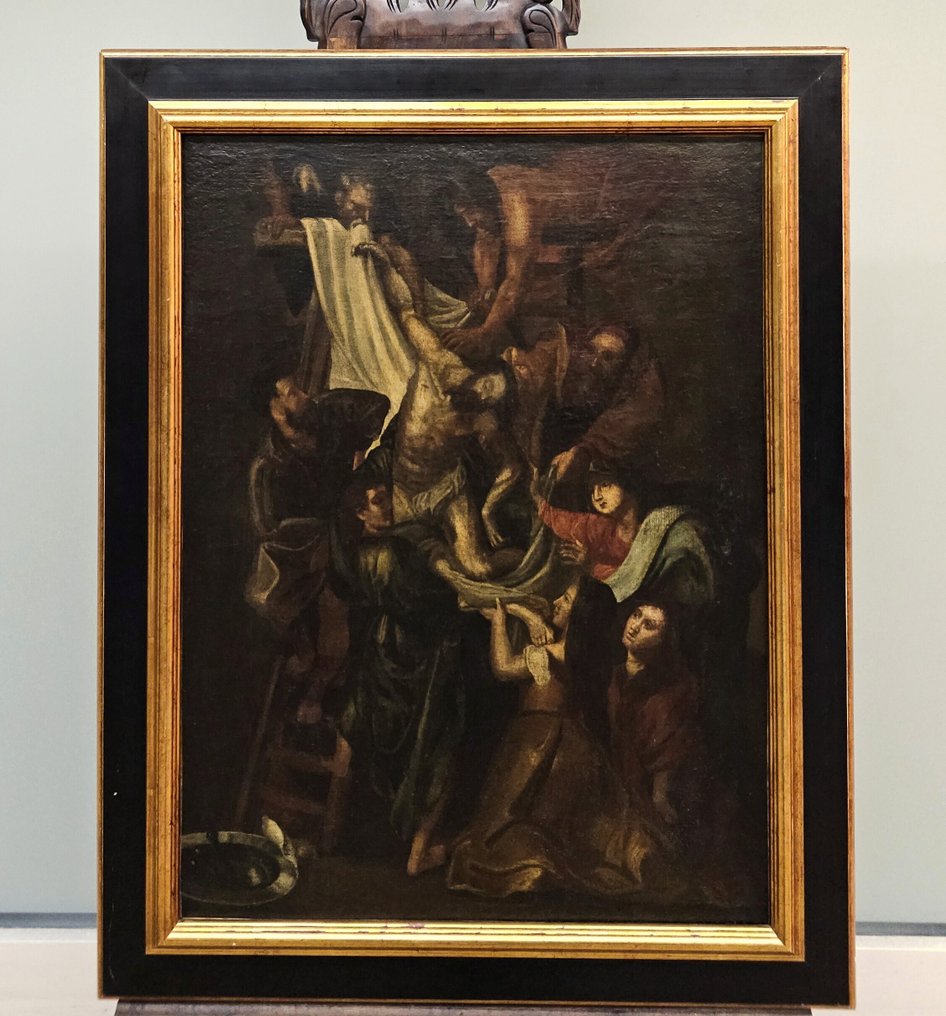
The scene depicts the Descent of Christ, with Jesus' inert body being unfastened from the cross and handed over to the figures waiting at its foot.
The composition is markedly vertical, articulated around a powerful diagonal that descends from the upper left – the crossbeam and the white canvas of the shroud – down to the body of Christ, supported by several characters.
In the upper area, two men climbing the ladder manipulate the shroud, generating a luminous mass that contrasts with the dark background. Below them, a bearded man—probably Joseph of Arimathea—and another figure hold the torso and arm of Christ.
At the bottom, the holy women are grouped together, including a youthful figure dressed in red who raises her arm towards Jesus' body, and another kneeling woman who directs her gaze towards the viewer, intensifying the emotional connection.
Chiaroscuro envelops the scene in a dramatic atmosphere: the background remains in shadow while the faces, hands, and main folds emerge in areas of warm light, focusing attention on the body of Christ and the gestures of pain and reverence.
The set corresponds to a fully counter-reformist language, designed for devout contemplation.
STYLE, SCHOOL, AND RUBENIAN CONTEXT
The volumetric treatment of the bodies, with powerful musculature and dynamic torsions, places the work within the realm of early Flemish Baroque. The brushwork is loose but disciplined, with more generous impastos in flesh tones and draperies, and a palette dominated by golden ochres, reddish earths, muted greens, and warm blacks, very much akin to Rubens' chromatic repertoire in his early period.
The composition recalls the models devised by Rubens for Passion themes: pyramidal structure, displaced cross, accumulation of figures around Christ, and the use of crossed diagonals to guide the viewer's gaze.
The faces display Rubenian facial features – straight noses, almond-shaped eyes, dense beards – although with a somewhat drier and less refined finish than in the autograph works, a common trait in workshop executions.
Echoes of the Italian Mannerist tradition (Tintoretto, the Bassano) are evident in the foreshortenings and the vehement gesturality of the figures, filtered through the Baroque synthesis characteristic of Rubens's environment, active between Italy and Antwerp around 1600-1620.
Seller's Story
At Barcelona Art Gallery, we are a large family of art collectors in Barcelona who have been acquiring all kinds of paintings for 2 centuries.
Headquartered in the Les Corts neighborhood of Barcelona.
We offer part of our private collection for auction: high period and modern paintings that we have been acquiring over time, mainly from art galleries, antique dealers, auctions, private collections and very diverse origins.
Translated by Google TranslateTechnical Data Sheet
Oil on canvas
Measurements: 81 × 61 cm; with frame 98 × 78 cm.
Baroque flamenco school, late 16th to early 17th century.
European School (XVII) After Rubens.
Support: old canvas, re-stretched, with a more modern back frame.
Condition of preservation: generalized fine craquelure, darkening of varnishes, and slight surface abrasions; the pictorial structure remains solid and legible with well-integrated restorations.
Marco: sober black frame with a gold inner edge, inspired by Baroque style, which enhances the devotional and museological character of the work.
Arguments for attribution to the workshop or circle of Rubens
The overall composition scheme – the main diagonal of the body of Christ, a compact group of characters surrounding it, with the cross partially outside the frame – is fully consistent with the Rubenian formulas for the Descent, known through paintings and engravings disseminated from his workshop.
The anatomical treatment of the body of Christ, with its robust musculature and serpentine torsion, reveals a direct knowledge of the classical and Miguelangelescos models that Rubens studied intensively.
The hands and heads of some characters, especially the bearded man holding the shroud, show a conception very close to that of the master, although the finish lacks the highest degree of refinement, which suggests the intervention of a qualified assistant following a Rubensian cartoon or sketch.
The warm palette of golden carnations, slightly broken whites, and deep reds, as well as the use of dark glazes to unify the shadows, is part of the technical practice of Rubens' school from the early decades of the 17th century.
The density and antiquity visible in the craquelure, along with the structure of the underlying drawing that can be inferred beneath the layers of color, seem compatible with an execution from the period, rather than a later academic copy.
However, certain rigidity in the articulation of the secondary figures, the lesser luminous brilliance, and the somewhat harsher modeling of some faces suggest placing this painting within the workshop or close circle rather than directly in Rubens's hand, maintaining a cautious attribution 'attrib. workshop of Peter Paul Rubens' pending technical study (X-rays, infrared reflectography, and pigment analysis) that could clarify its degree of proximity to the master.
Aesthetic valuation, frame, and collector potential.
Despite the darkening of the varnishes, the work retains a great dramatic strength and a very intense devotional presence, with a rhythm of diagonals and gazes that guides the viewer through the scene. The canvas possesses the theatrical and emotional quality sought in Baroque painting with a passionist theme and clearly stands above the average production of its time.
The black frame with a gold filet—of sober taste, probably later but well chosen—effectively dialogues with the artwork: it reinforces the chiaroscuro contrast, confers liturgical gravity, and allows for its immediate presentation in a museum context or in a specialized collection of old paintings.
From an expert point of view, this is a piece of high interest for the old Flemish painting market, especially due to its compositional and stylistic proximity to the Rubens universe.
A professional restoration that cleans the varnishes and stabilizes the surface, along with a rigorous technical study and eventual publication in a catalog raisonné or specialized exhibition, could significantly enhance its consideration and place it within a valuation range typical of the best workshop works associated with one of the most sought-after masters of European Baroque.
Compositional and iconographic description
The scene depicts the Descent of Christ, with Jesus' inert body being unfastened from the cross and handed over to the figures waiting at its foot.
The composition is markedly vertical, articulated around a powerful diagonal that descends from the upper left – the crossbeam and the white canvas of the shroud – down to the body of Christ, supported by several characters.
In the upper area, two men climbing the ladder manipulate the shroud, generating a luminous mass that contrasts with the dark background. Below them, a bearded man—probably Joseph of Arimathea—and another figure hold the torso and arm of Christ.
At the bottom, the holy women are grouped together, including a youthful figure dressed in red who raises her arm towards Jesus' body, and another kneeling woman who directs her gaze towards the viewer, intensifying the emotional connection.
Chiaroscuro envelops the scene in a dramatic atmosphere: the background remains in shadow while the faces, hands, and main folds emerge in areas of warm light, focusing attention on the body of Christ and the gestures of pain and reverence.
The set corresponds to a fully counter-reformist language, designed for devout contemplation.
STYLE, SCHOOL, AND RUBENIAN CONTEXT
The volumetric treatment of the bodies, with powerful musculature and dynamic torsions, places the work within the realm of early Flemish Baroque. The brushwork is loose but disciplined, with more generous impastos in flesh tones and draperies, and a palette dominated by golden ochres, reddish earths, muted greens, and warm blacks, very much akin to Rubens' chromatic repertoire in his early period.
The composition recalls the models devised by Rubens for Passion themes: pyramidal structure, displaced cross, accumulation of figures around Christ, and the use of crossed diagonals to guide the viewer's gaze.
The faces display Rubenian facial features – straight noses, almond-shaped eyes, dense beards – although with a somewhat drier and less refined finish than in the autograph works, a common trait in workshop executions.
Echoes of the Italian Mannerist tradition (Tintoretto, the Bassano) are evident in the foreshortenings and the vehement gesturality of the figures, filtered through the Baroque synthesis characteristic of Rubens's environment, active between Italy and Antwerp around 1600-1620.
Seller's Story
At Barcelona Art Gallery, we are a large family of art collectors in Barcelona who have been acquiring all kinds of paintings for 2 centuries.
Headquartered in the Les Corts neighborhood of Barcelona.
We offer part of our private collection for auction: high period and modern paintings that we have been acquiring over time, mainly from art galleries, antique dealers, auctions, private collections and very diverse origins.
Translated by Google TranslateDetails
Artist
European School (XVII) - NO RESERVE
Sold with frame
Yes
Title of artwork
The Descent from the Cross - After Rubens
Technique
Oil painting
Signature
Not signed
Country of Origin
France
Condition
Good condition
Height
98 cm
Width
78 cm
Weight
7 kg
Depiction/Theme
Religion
Style
Baroque
Period
17th century
Sold by
