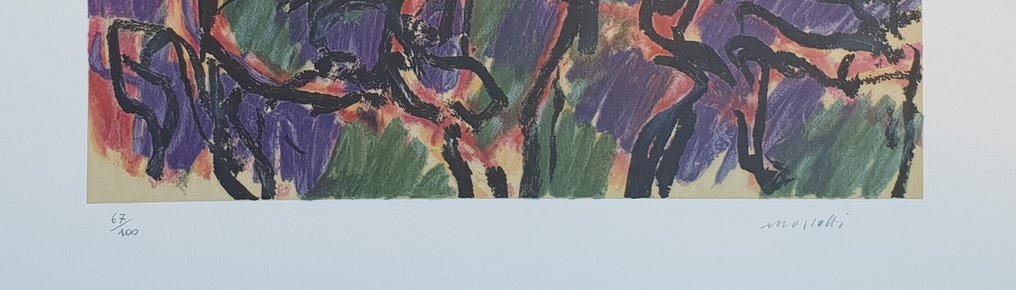
Ennio Morlotti (1910-1992) - Bosco


04
days
19
hours
11
minutes
27
seconds
Current bid
€ 11
No reserve price

Expert
Selected by Silvia Possanza
Held senior specialist role at Finarte for 12 years, specialising in modern prints.
Estimate € 200 - € 250
20 other people are watching this object
 Bidder 2524 Bidder 2524 | €11 | |
|---|---|---|
| Bidder 9085 | €4 | |
 Bidder 4968 Bidder 4968 | €3 | |
Catawiki Buyer Protection
Your payment’s safe with us until you receive your object.View details
Trustpilot 4.4 | 122813 reviews
Rated Excellent on Trustpilot.
Ennio Morlotti Bosco, a 1991 lithograph measuring 50 x 70 cm, hand-signed lower right and numbered 66/100 lower left, in an excellent condition limited edition with origin from Italy.
AI-assisted summary
Description from the seller
Lithograph on paper in 11 colors - Hand-signed artwork at the bottom right and numbered at the bottom left - 50x70 cm - Year 1991 - Limited edition - piece to be shipped with warranty certificate 66/100 - without frame - excellent condition - private collection - purchased and originating from Italy - shipping via UPS, SDA, DHL, TNT, BRT.
Biography
Ennio Morlotti, one of the leading figures of the Italian and European artistic scene of the second half of the twentieth century, was born in Lecco, on Lake Como, on September 21, 1910, into a family where the father was a war invalid and the mother was a teacher.
After attending primary school in a boarding school, where he excelled academically, he began working as an accountant in an oil mill in 1923. He then worked as an office clerk in a paint factory and as a worker in a mechanical factory until 1936.
Despite the harsh living conditions of those years, she dedicated herself to studying ancient art in churches and museums, also taking an interest in contemporary art, until she obtained her artistic maturity at Brera as a private candidate.
After being laid off from the factory, he moved to Florence and enrolled at the Academy, where, under the guidance of Felice Carena, he graduated with a thesis on Giotto, receiving the highest grades.
In 1937, thanks to the proceeds from the sale of three paintings exhibited during a landscape competition in Lecco, he traveled to Paris where he saw the original works of the beloved Cézanne and Picasso.
In 1940, he joined the group of Corrente, which was inspired by the university magazine 'Corrente di vita giovanile,' directed by Ernesto Treccani, following the French expressionist orientation, from Van Gogh to the Fauves.
In 1945, he married Anna, and the following year he joined the Communist Party, to which he adhered for six months; this was a difficult year economically but fruitful culturally, as he signed the Manifesto of Realism, joined the New Front of the Arts, and held his first solo exhibition at the II Camino gallery in Milan. That year, thanks to a scholarship awarded by Lionello Venturi, he could have stayed in Paris for two years with Renato Birolli, but after two months he returned to Milan because he was unable to paint; despite this, he had met and visited Picasso's studio, and had encountered Braque, Dominguez, De Stael, Sartre, and Camus.
It was then, immediately after the XXIV Venice Biennale (1948), where he exhibited alongside all the artists of the Fronte Nuovo delle Arti, that Morlotti's position was defined, as he, together with Birolli, broke away from the 'realist' members of the group.
It was precisely in the 1950s that he produced some of the major works of informal art, not only Italian but also European, certainly connected to the experiences of artists such as Wols, Fautrier, De Stael, but also Pollock and De Kooning.
The Biennale hosted its works numerous times: in 1950; in 1952 together with the Gruppo degli Otto; in 1954 with a room presented by Giovanni Testori (destroying the exhibited works immediately after); in 1962 winning the prize (ex aequo with Capogrossi) reserved for an Italian artist; in 1964 within the section 'Art Today in Museums'; in 1972 with a solo room; in 1988 with another solo exhibition in the pavilion dedicated to Italy; and in the section dedicated to the review 'Il Fronte nuovo delle Arti at the 1948 Biennale'.
In 1986 and 1992, he was invited to the National Quadriennale of Art in Rome.
The most important comprehensive exhibitions of the last decade are those of 1987 in Locarno and Milan, and the 1994 exhibition in Ferrara, held after the death that occurred on December 15, 1992, in Milan.
Lithograph on paper in 11 colors - Hand-signed artwork at the bottom right and numbered at the bottom left - 50x70 cm - Year 1991 - Limited edition - piece to be shipped with warranty certificate 66/100 - without frame - excellent condition - private collection - purchased and originating from Italy - shipping via UPS, SDA, DHL, TNT, BRT.
Biography
Ennio Morlotti, one of the leading figures of the Italian and European artistic scene of the second half of the twentieth century, was born in Lecco, on Lake Como, on September 21, 1910, into a family where the father was a war invalid and the mother was a teacher.
After attending primary school in a boarding school, where he excelled academically, he began working as an accountant in an oil mill in 1923. He then worked as an office clerk in a paint factory and as a worker in a mechanical factory until 1936.
Despite the harsh living conditions of those years, she dedicated herself to studying ancient art in churches and museums, also taking an interest in contemporary art, until she obtained her artistic maturity at Brera as a private candidate.
After being laid off from the factory, he moved to Florence and enrolled at the Academy, where, under the guidance of Felice Carena, he graduated with a thesis on Giotto, receiving the highest grades.
In 1937, thanks to the proceeds from the sale of three paintings exhibited during a landscape competition in Lecco, he traveled to Paris where he saw the original works of the beloved Cézanne and Picasso.
In 1940, he joined the group of Corrente, which was inspired by the university magazine 'Corrente di vita giovanile,' directed by Ernesto Treccani, following the French expressionist orientation, from Van Gogh to the Fauves.
In 1945, he married Anna, and the following year he joined the Communist Party, to which he adhered for six months; this was a difficult year economically but fruitful culturally, as he signed the Manifesto of Realism, joined the New Front of the Arts, and held his first solo exhibition at the II Camino gallery in Milan. That year, thanks to a scholarship awarded by Lionello Venturi, he could have stayed in Paris for two years with Renato Birolli, but after two months he returned to Milan because he was unable to paint; despite this, he had met and visited Picasso's studio, and had encountered Braque, Dominguez, De Stael, Sartre, and Camus.
It was then, immediately after the XXIV Venice Biennale (1948), where he exhibited alongside all the artists of the Fronte Nuovo delle Arti, that Morlotti's position was defined, as he, together with Birolli, broke away from the 'realist' members of the group.
It was precisely in the 1950s that he produced some of the major works of informal art, not only Italian but also European, certainly connected to the experiences of artists such as Wols, Fautrier, De Stael, but also Pollock and De Kooning.
The Biennale hosted its works numerous times: in 1950; in 1952 together with the Gruppo degli Otto; in 1954 with a room presented by Giovanni Testori (destroying the exhibited works immediately after); in 1962 winning the prize (ex aequo with Capogrossi) reserved for an Italian artist; in 1964 within the section 'Art Today in Museums'; in 1972 with a solo room; in 1988 with another solo exhibition in the pavilion dedicated to Italy; and in the section dedicated to the review 'Il Fronte nuovo delle Arti at the 1948 Biennale'.
In 1986 and 1992, he was invited to the National Quadriennale of Art in Rome.
The most important comprehensive exhibitions of the last decade are those of 1987 in Locarno and Milan, and the 1994 exhibition in Ferrara, held after the death that occurred on December 15, 1992, in Milan.
Details
Artist
Ennio Morlotti (1910-1992)
Sold by
Owner or reseller
Edition
Limited edition
Edition number
66/100
Title of artwork
Bosco
Technique
Lithograph
Signature
Hand signed
Country of Origin
Italy
Year
1991
Condition
Excellent condition
Height
50 cm
Width
70 cm
Style
Contemporary
Period
1990-2000
Sold with frame
No
Sold by