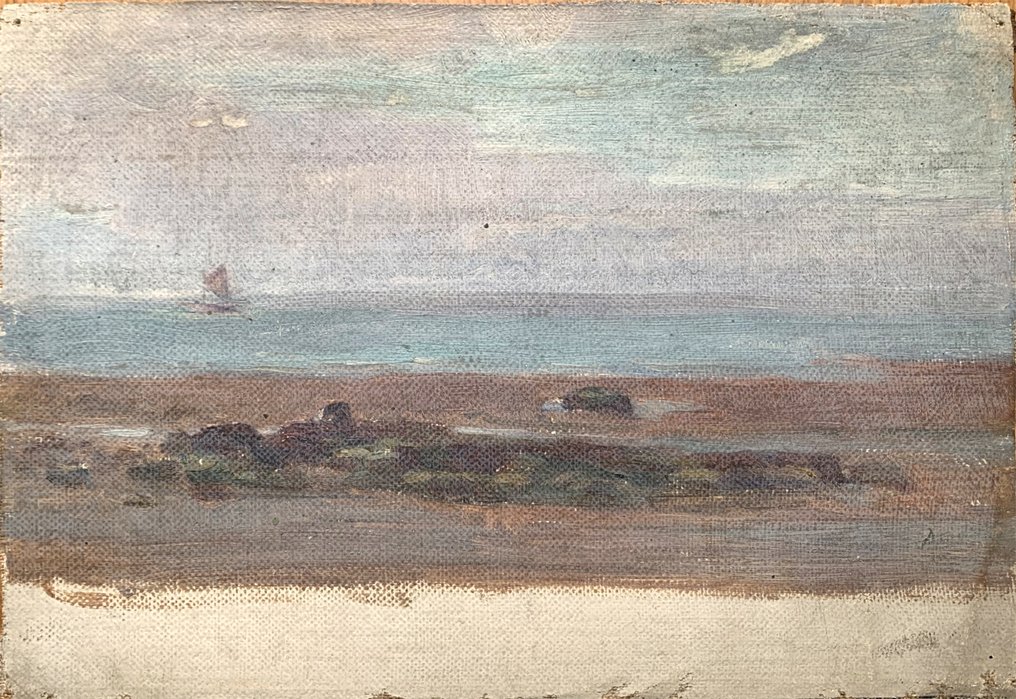
Jules Cyrille Cavé (1859-1949) - Effet de ciel, bord de mer



04
days
06
hours
05
minutes
44
seconds
Starting bid
€ 1
Reserve price not met

No bids placed
Catawiki Buyer Protection
Your payment’s safe with us until you receive your object.View details
Trustpilot 4.4 | 123053 reviews
Rated Excellent on Trustpilot.
Effet de ciel, bord de mer is a nineteenth‑century oil painting by Jules Cyrille Cavé (1859–1949), signed, depicting a marine scene, created in France, measuring 14 cm high by 20.5 cm wide and weighing 100 g.
AI-assisted summary
Description from the seller
Dated around 1890–1910, the work is part of the period when Jules-Cyrille Cavé (Paris, 1859–1949) regularly exhibited at the Salon of the French Artists. Trained with Bouguereau and Tony Robert-Fleury, he belongs to a generation of painters for whom studying en plein air is not a manifesto but a method: quickly testing an harmony of values, a light, a sea state, in order to feed—if necessary—more ambitious compositions. This practice naturally places Cavé in the continuum of outdoor painting history, from Barbizon to modern marine scenes, while maintaining a rigor of construction inherited from the academy (clear plans, sharp transitions, a deliberately tightened palette).
By its spirit and format, the piece dialogues with the tradition of study marines associated with Boudin or Jongkind, and, through its sobriety and economy of means, with certain small formats by Stanislas Lépine. What distinguishes Cavé here is precisely this successful tension between the immediacy of the motif and the discipline of the craft: a sketch thought of as a 'document of light' as much as an autonomous work.
Rarer than his portraits and allegories, Cavé's marine sketches constitute a more intimate aspect of his work. Indeed, they hold particular interest for the late 19th-century outdoor enthusiast: they combine authenticity, typological rarity, and craftsmanship, while providing direct insight into how an academically trained painter approached the study of reality on a daily basis.
Dated around 1890–1910, the work is part of the period when Jules-Cyrille Cavé (Paris, 1859–1949) regularly exhibited at the Salon of the French Artists. Trained with Bouguereau and Tony Robert-Fleury, he belongs to a generation of painters for whom studying en plein air is not a manifesto but a method: quickly testing an harmony of values, a light, a sea state, in order to feed—if necessary—more ambitious compositions. This practice naturally places Cavé in the continuum of outdoor painting history, from Barbizon to modern marine scenes, while maintaining a rigor of construction inherited from the academy (clear plans, sharp transitions, a deliberately tightened palette).
By its spirit and format, the piece dialogues with the tradition of study marines associated with Boudin or Jongkind, and, through its sobriety and economy of means, with certain small formats by Stanislas Lépine. What distinguishes Cavé here is precisely this successful tension between the immediacy of the motif and the discipline of the craft: a sketch thought of as a 'document of light' as much as an autonomous work.
Rarer than his portraits and allegories, Cavé's marine sketches constitute a more intimate aspect of his work. Indeed, they hold particular interest for the late 19th-century outdoor enthusiast: they combine authenticity, typological rarity, and craftsmanship, while providing direct insight into how an academically trained painter approached the study of reality on a daily basis.
Details
Artist
Jules Cyrille Cavé (1859-1949)
Sold with frame
No
Title of artwork
Effet de ciel, bord de mer
Technique
Oil painting
Signature
Signed
Country of Origin
France
Condition
Excellent condition
Height
14 cm
Width
20.5 cm
Weight
100 g
Depiction/Theme
Seascape
Style
Post-Impressionism
Period
19th century
Sold by
