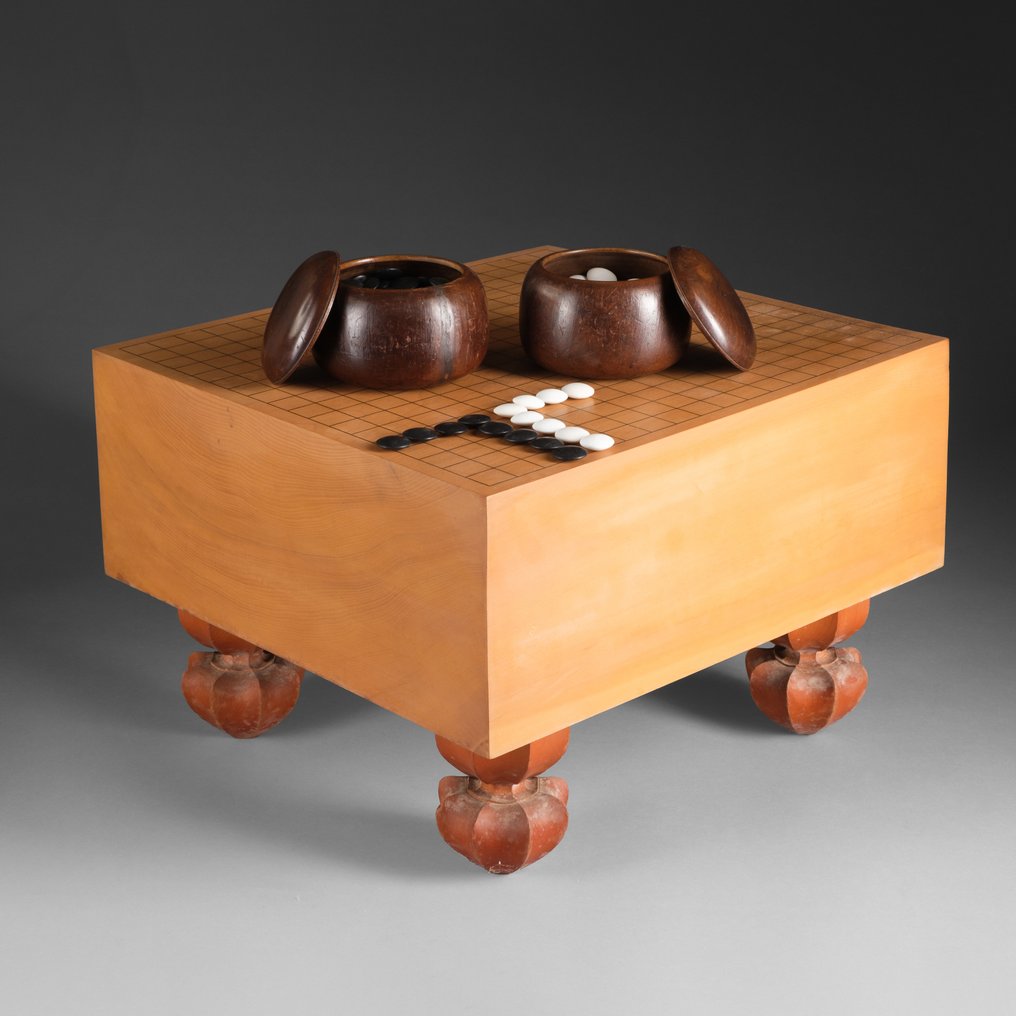
Go-game table 碁盤 (goban) complete with go-stones 碁石 (go-ishi) - 17.2 kg - Solid wood, Glass, Slate - Japan - Shōwa period (1926-1989)


01
day
16
hours
56
minutes
32
seconds
Current bid
€ 320
Reserve price not met

Expert
Selected by Surya Rutten
Has over 25 years' experience in Asian art and owned an art gallery.
Estimate € 430 - € 480
27 other people are watching this object
 Bidder 3008 Bidder 3008 | €320 | |
|---|---|---|
| Bidder 3008 | €300 | |
 Bidder 1022 Bidder 1022 | €185 |
Catawiki Buyer Protection
Your payment’s safe with us until you receive your object.View details
Trustpilot 4.4 | 122986 reviews
Rated Excellent on Trustpilot.
A heavy Shōwa‑period Go table (goban) in Japan, made of solid wood with a two‑tone grain, 30.7 cm high, 45.4 cm wide and 41.8 cm deep, weighing 17.2 kg, complete with glass white go‑stones and black Nachiguroishi slate stones stored in dark brown wooden boxes and raised on four faceted baluster feet.
AI-assisted summary
Description from the seller
A heavy solid wooden Go-game table 碁盤 (goban) with a set of go-stones 碁石 (go-ishi). The broad top is made of solid wood, and has a beautiful continuous grain in two different natural shades. Raised by four faceted baluster feet.
Complete with go-stones 碁石 (go-ishi) in lidded containers. The boxes are made of dark brown wood 桑 (kuwa). The white go-stones are made from glass, and the black ones are from Nachiguroishi, it is a fine type of slate from Kumano in the province of Mie.
The table is in a very good condition with a few superficial traces of use. The go-stones have traces of usage, which is quite common. Stone boxes with traces of use. Please look at the photos for a condition reference.
Period: Japan – Shôwa period (1929-1989).
Dimensions:
Go-table
Height 30.7 cm, Width 45.4 cm, Depth 41.8 cm, top thickness 17.4 cm.
Weight 17.2 kg.
Two boxes of the go-stones:
Height 9 cm, Diameter 11.8 cm.
Black an white stones:
Height B 0.7 cm, W 0.9 cm, Diameter B 2.1 cm, W 2.0 cm.
Go, also known as "Igo" or "Baduk," is a strategic board game originating from ancient China but widely popularized in Japan. Played on a grid board, the objective is to surround and capture the opponent's stones by strategic placement and movement. Go is renowned for its simple rules but complex gameplay, involving deep strategic thinking, spatial awareness, and intuition. With a profound cultural significance, it has been embraced as an art form and a means of personal growth.
Seller's Story
Since 1996, Japanese Antique Store has been importing Japanese antiques directly from Japan.
We travel several times a year through Japan and visit auctions, shows, dealers, and collectors.
Besides our physical store in Amsterdam, we are also active on Catawiki. We specialize in Samoeraipantser (Yoroi) and objects, lacquerware, screens, paintings, Buddhist images, and many more Japanese artifacts!
Translated by Google TranslateA heavy solid wooden Go-game table 碁盤 (goban) with a set of go-stones 碁石 (go-ishi). The broad top is made of solid wood, and has a beautiful continuous grain in two different natural shades. Raised by four faceted baluster feet.
Complete with go-stones 碁石 (go-ishi) in lidded containers. The boxes are made of dark brown wood 桑 (kuwa). The white go-stones are made from glass, and the black ones are from Nachiguroishi, it is a fine type of slate from Kumano in the province of Mie.
The table is in a very good condition with a few superficial traces of use. The go-stones have traces of usage, which is quite common. Stone boxes with traces of use. Please look at the photos for a condition reference.
Period: Japan – Shôwa period (1929-1989).
Dimensions:
Go-table
Height 30.7 cm, Width 45.4 cm, Depth 41.8 cm, top thickness 17.4 cm.
Weight 17.2 kg.
Two boxes of the go-stones:
Height 9 cm, Diameter 11.8 cm.
Black an white stones:
Height B 0.7 cm, W 0.9 cm, Diameter B 2.1 cm, W 2.0 cm.
Go, also known as "Igo" or "Baduk," is a strategic board game originating from ancient China but widely popularized in Japan. Played on a grid board, the objective is to surround and capture the opponent's stones by strategic placement and movement. Go is renowned for its simple rules but complex gameplay, involving deep strategic thinking, spatial awareness, and intuition. With a profound cultural significance, it has been embraced as an art form and a means of personal growth.
Seller's Story
Since 1996, Japanese Antique Store has been importing Japanese antiques directly from Japan.
We travel several times a year through Japan and visit auctions, shows, dealers, and collectors.
Besides our physical store in Amsterdam, we are also active on Catawiki. We specialize in Samoeraipantser (Yoroi) and objects, lacquerware, screens, paintings, Buddhist images, and many more Japanese artifacts!
Translated by Google TranslateDetails
Dynastic Style/Period
Shōwa period (1926-1989)
No. of items
1
Country of Origin
Japan
Material
Solid wood, Glass, Slate
Height
30.7 cm
Width
45.4 cm
Title of artwork
Go-game table 碁盤 (goban) complete with go-stones 碁石 (go-ishi) - 17.2 kg
Depth
41.8 cm
Condition
Excellent condition
Sold by
